Thank you for visiting SNEWPapers!
Sign up free
Lynchburg Virginian
Lynchburg, Virginia
What is this article about?
A letter urges the Editor of the American Farmer to publish Hon. Elisha Whittlesey's full address to the Montgomery County Agricultural Society, praises its content on agriculture and labor, suggests a semi-monthly publication to address space issues, and provides extracts highlighting the honor of farming and elevating manual labor.
Clipping
OCR Quality
Full Text
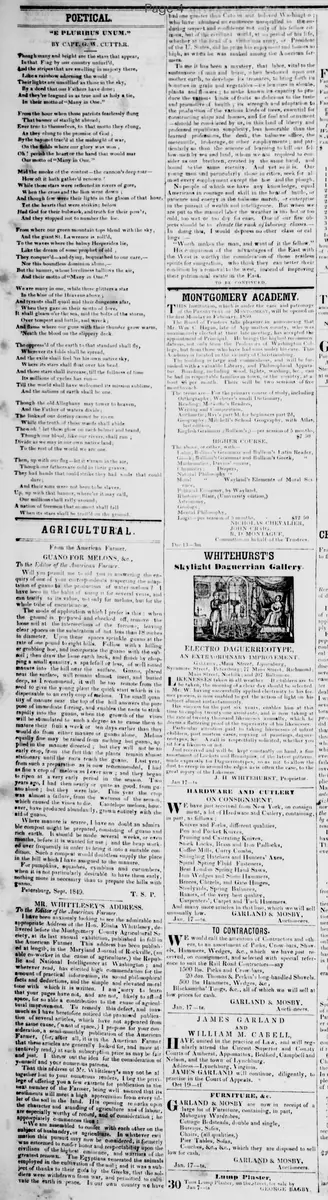
To the Editor of the American Farmer.
I have been anxiously looking to see the admirable and appropriate Address of the Hon. Elisha Whittlesey, delivered before the Montgomery County Agricultural Society, at its last annual exhibition, published in full in the American Farmer. This address has been published at length, in the Maryland Journal of Rockville, (an able co-worker in the cause of agriculture,) the Republican and National Intelligencer at Washington; and wherever read, has elicited high commendation for the amount of practical information, its sound philosophical facts and deductions, and the simple and elevated moral tone with which it is written. I am sorry to learn that your pages have not, and are not, likely to afford space, for so able a contribution to the cause of agricultural improvement. To remedy this defect, and inasmuch as I have heretofore noticed the promised publication of several articles, which have not appeared from the same cause, (want of space.) I propose for your consideration, a semi-monthly publication of the American Farmer, (for, after all, it is in the American Farmer that these articles are generally looked for, and more attentively read.) at such subscription price as may be fair and just. I throw out the idea for the consideration of yourself and your numerous patrons.
That this address of Mr. Whittlesey's may not be altogether lost to your numerous readers, I beg the privilege of offering you a few extracts for publication in the next number of the Farmer, being well assured that its sentiments will meet a high appreciation from every tiller of the soil in the land. His opening remarks upon the character and standing of agriculture and of labour, are especially worthy of record, and of consideration; he appropriately commences thus:
"We are assembled to confer with each other on the subject of husbandry, or agriculture. In whatever estimation this pursuit may now be considered, it formerly was esteemed to confer honor and respectability upon the civilians of the highest eminence, and warriors of the greatest renown. The Egyptians venerated the animals employed in the cultivation of the soil; and it was a subject of thanks to their gods by the Greeks, that the soldiers were withdrawn from war, and permitted to cultivate the earth in peace. In our own country we have had one greater than Cato in our beloved Washington; who have obtained an eminence unequalled in the enduring respect and confidence not only of his fellow citizens, but of the civilized world, at no period of his life, whether at the head of a victorious army, or President of the United States, did he prize his enjoyment and honors so high, as when he was ranked among the American farmers.
To me it has been a mystery, that labor, vital to the sustenance of man and beast, when bestowed upon our mother earth, to develope its treasures, to bring forth its bounties in grain and vegetables—its beauties in shrubs, plants and flowers; to make known its capacity to produce the various kinds of fruits so delicious to the taste and promotive of health: its strength and adaptation to the production of the various kinds of trees, essential for constructing ships and houses, and for fuel and ornament—should be considered by us, in this land of liberty and professed republican simplicity, less honorable than the learned professions, the desk, the toilsome office, the mercantile, brokerage, or other employments; and particularly so than the science of learning to kill our fellow-men by sea and land, whom we are required to consider as our brethren, created by the same hand, and bound to the same eternity. And yet so it is. Our young men and particularly those in cities, seek for almost every employment except the hoe and the plough. No people of which we have any knowledge, equal Americans in courage and skill in the heat of battle, or patience and energy in the toilsome march, or enterprise in the pursuit of wealth and intelligence. But when we are put to the manual labour the weather is too hot or too cold, too wet or too dry for ease. One of our first objects should be to elevate the rank of laboring classes. In doing this, I would depress no other class or calling:-
'Worth makes the man, and want of it the fellow.'
His comparison of the advantages of the East with the West is worthy the consideration of those restless spirits for emigration, who think they can better their condition by a removal to the west, instead of improving their patrimonial estate in the East.
TO BE CONTINUED.
What sub-type of article is it?
What themes does it cover?
What keywords are associated?
What entities or persons were involved?
Letter to Editor Details
Recipient
To The Editor Of The American Farmer
Main Argument
the letter urges full publication of hon. elisha whittlesey's address in the american farmer due to its value, proposes a semi-monthly edition to resolve space constraints, and provides extracts to share its insights on the honor of agriculture and the need to elevate manual labor.
Notable Details