Thank you for visiting SNEWPapers!
Sign up free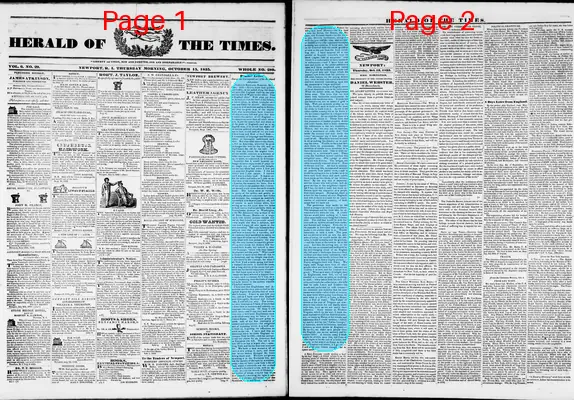
Herald Of The Times
Newport, Newport County, Rhode Island
What is this article about?
In a June 1835 letter, an American traveler expresses joy upon arriving in England, contrasting its cultivated, soothing scenery with America's wild grandeur. He reflects on shared Anglo-American heritage, cultural differences in landscape appreciation, and the novelty each finds in the other's homeland.
Merged-components note: Continuation of Brooks' Letters across pages, text flows directly from 'we exchange' to 'change this magnificence' (likely OCR error in connection).
Clippings

1 of 2
OCR Quality
Full Text
European Correspondence of the Portland Advertiser.
Things in England, Scenery, &c.-
June, 1835.-Every heart beat quicker and louder, as we sailed along the channel with Old England itself on one side and the Isle of Wight on the other. This is England then! With what joy does an American visit the land of his fathers, in whose glory, in whose triumphs over man and matter he shares! Shakespeare is ours as well as theirs, and so is Milton, and that by-gone host of the mighty dead, who in aforetimes have consecrated almost every hill and glen that dots or marks the surface of old England.-
An American more than all other strangers, is just the man to feel and share in all: he pride of England-and so is an English man, if he would but shake off his narrow political prejudices, the very man to love us and ours, as we are bone of their bone and flesh of their flesh.-
A community of language and literature, makes us thoroughly understand each other. But what adds more to the charm, is, that an American, wherever he goes exchanges the new for the old, and an Englishman the old for the new. We step from the forest, the mighty river, and the terrific cataract, to a scenery so unlike ours as one can fancy-so soothing, so quiet, so cultivated, so deliciously beautiful that I would heartily exchange all mere enjoyments of years for one single day of unutterable delight, that the eye alone had when I first put foot upon the English shore. I did not believe that I saw nature. I fancied that I was in a fairy land. It was so unlike, for miles and miles as I rode on an outer seat of the coach from Portsmouth to London, the scenery we have, that it did not seem to me possible that even nature herself could cover the earth in such beauty. The lawns were so verdant; the parks of the nobles and gentry so beautifully adorned with trees and walks and bridges; the cottages so tastefully inwreathed with flowers and ivy; all, and all nature in such holiday attire, that moving as we did more than ten miles an hour over a road as perfectly made as Pennsylvania Avenue in Washington, or the Mc-Adamized way in front of the old State House, Boston-in a stage coach with twelve persons outside and four in, that I could not persuade myself it was aught else than a delusion, and even now I enjoy all over again in the mere narration. The very horses as they galloped over the well-watered road, (and here is luxury for a traveller, and the roads are kept sprinkled for miles, on some lines 60 miles out of London, from wells filled with iron pumps by the way side) the very horses (so superbly groomed!) as they shook the flowers that festooned their heads, did indeed in their light trappings, "share with their master the pleasure and the pride." What could be fresher or more novel than all this to an American, and my delight was doubly increased by the contrast: for when I left New York a tardy spring had hardly warmed the earth or leafed the trees, and a long stretch of the ocean had prepared me for the full enjoyment of a summer that burst upon us as if by magic.—
I could not have selected a happier time to enjoy such a contrast, for it was, as it were, awakening from the frosts of rough and surly winter to the sudden warmth of Lapland summer.
I have said that Englishmen and Americans are the very men to feel in the highest degree the peculiarities of each other's homes. I have in part told you why, and as I have now seen England quite thoroughly, Scotland and Ireland some, I will tell you why. The horror. the utter detestation I have of much that is done here in manners and matters, no language can express. Of them I will speak anon--and I can very well see in what way a well bred Englishman must be shocked every step he takes in the United States. But I am now going to speak only of the first impression of scenery and associations-the delightful part of travelling which it is well only to think of, forgetting its afflictions as much as one can. I have said that an American when he visits England exchanges New for Old,-but her antiquity has one charm for an American that no European can tell. The old is not only old to us but it is new also,-something fresh and for the first time seen and felt. We have a new sensation all at once, a new soul as it were, and ideas that never before thronged the brain throng there now. We have not grown up among it as the European has, and lost the novelty of the sight by a constant gaze,-but we have come from a far-off land, where Cathedrals are the arched forests of a thousand years, with an antiquity beyond the stretch of History, the builder of whose temples has been God himself,-working for ages in sublimity, and silence, and terror amid the Mountain, Lake and River,-and we exchange this magnificence of Nature for what has been History—for the land where the Briton, the Saxon, the Roman, and Norman dwelt—for the Gothic pile, the lofty battlement, overgrown with the yew and the elm, and the tower buried in ivy—for a scenery beautiful, soothing and quiet; as I have said, but as far removed from the awful grandeur of ours as the sun from the least twinkling star. I have laughed till it was painful at English waterfalls kept for show (sights sold at six-pence! over which it is fashionable to have spasmodic enthusiasm)—and I have been sad and cast down at the pitiful ambition of man, as I have wandered over ruined Abbeys, and the broken open stone coffins of great men and kings which the peasant now kicks from his pathway.—
Oh what lessons for the young American—how faithful with moral instruction, and how solemnly impressive upon him the meanness of vulgar ambition!
The peculiar charm of English scenery in an American eye is its cultivation. What we dislike most, an Englishman loves most. The trees that we hew down with barbarous recklessness, he plants with assiduous care. Forests that are bores to us, are as mines of gold to him. With just as much avidity as we (of the North) seek to build on the road, he seeks to build from it. As we of the cities dislike country life so he loves it. As we cluster together in villages so he avoids them. As we seek the heart of a town so he abhors it. These facts and the possession of landed property in few and noble hands, lead to some remarkable differences in the two countries.—
Hence, tho' we may say in America, with a semblance of truth, that God made the country and man made the town, we cannot say it here with any truth at all. Man here has had as much to do in making the country as in making the town. Wealth seeks it and lavishes there its possessions. The chief ambition of almost every merchant is to have his country seat. One is quite necessary to a nobleman's rank. Thus, even the humblest farmer catches this delightful taste. His cottage is often covered with flowers. The hedges are often beautifully trimmed about it. Fine walks are laid out. All that is unpleasant in farming life, is concealed as much as possible from public view,—and it would be a disgrace for a farmer here to have such front doors and such public barn yards as two thirds of our farmers have. By the way this is important, and the farmer who will reform, will do great service to his neighbors important I say, for such a taste has more influence upon the character of a people than any suspect. Hence too, there is a love for the country all over England, and with it there is a taste for an appreciation of cultivated scenery, of landscape that we have not,
The gentleman here seeks for his house a prospect as well as a foundation. The mountain and the little lake he always looks for when he can. A rivulet that we would think nothing of, I have often seen made every thing that is beautiful. The cliff that would be wild forever with us, is often adorned with walks, and flowers and hedges. Even the little cascade is fashioned and shaped to make it yet prettier than it is. Wealth luxuriates in such a taste. The poor are not driven as with us into the suburbs of towns, for wealth seeks the suburbs, to build its walks and its gardens,—and the heart of the town is let to the poor. Let then the setting sun, or the mid day sun as softened and mellowed by the over-hanging cloud of an English sky fall upon a landscape thus ever kept verdant and thus richly cultivated,—and an American can hardly believe that he sees aught else than a mighty picture.—
Fancy struggles hard with Facts. We enjoy such things more than all other people when we see them here, because our country is so new, and the contrast is so great. What an ecstasy of delight, then an Englishman must feel, rocked and cradled in a scene so quiet, so soothing, so mild,—when taken from his little rivulets and brooks he calls rivers,—his hills that he calls Lakes and Lochs—his woods and parks that he calls forests—his cascades and bubbles that he misnames waterfalls—what depth of emotion he must have when going from home, he sees what is a River, a Lake, a Mountain, a Fall of water. The Father of waters or the roar of Niagara are wonders to him which we can hardly share with him, born as we are under their influence. Some scenes in Western Virginia, which by the way, I think the most impressive of all our American scenery, or many in Maine in her woods, and fastnesses that I could mention,—which by and by will be the "Lakes George," of America, would be fortunes, immense fortunes, as mere shows in England.—
By the by, we differ as a people from the English, just as our scenery and localities differ. A curious essay I think might be written upon this, but I am at what ought to be the end of a letter, lost already in the mist of an Essay in doors, and a London coal smoke, if I go out.—
I will send you letters enough and to spare anon.
What sub-type of article is it?
What themes does it cover?
What keywords are associated?
What entities or persons were involved?
Literary Details
Title
Things In England, Scenery, &C.
Author
Brooks
Subject
American Impressions Of English Scenery And Cultural Contrasts, June 1835
Form / Style
Prose Travel Letter Reflecting On Landscape And Society
Key Lines