Thank you for visiting SNEWPapers!
Sign up free
Literary
May 28, 1805
The Enquirer
Richmond, Henrico County, Virginia
What is this article about?
Miscellaneous notes describe Pope Pius VII's 1805 visit to the Imperial printing press in Paris, where he received the Lord's Prayer printed in 46 Asian, 75 European, 12 African, and American dialects. Also mentions a rare German alphabet collection by Prof. Busching and an upcoming English 'Selection of Modern Classics' translating major European authors.
Clipping
OCR Quality
95%
Excellent
Full Text
Miscellaneous.
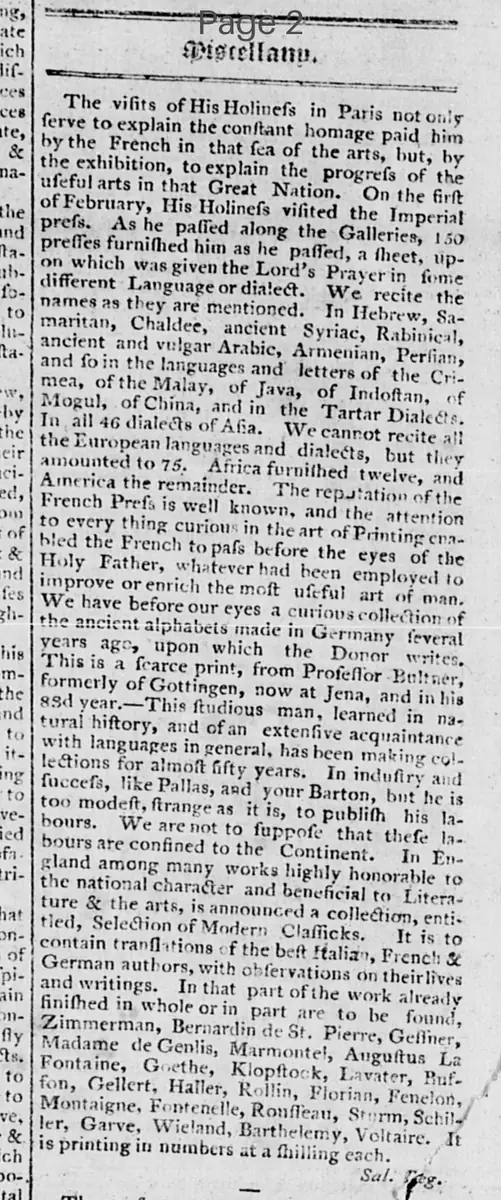
The visits of His Holiness in Paris not only serve to explain the constant homage paid him by the French in that era of the arts, but, by the exhibition, to explain the progress of the useful arts in that Great Nation. On the first of February, His Holiness visited the Imperial press. As he passed along the Galleries, 150 presses furnished him as he passed, a sheet, upon which was given the Lord's Prayer in some different Language or dialect. We recite the names as they are mentioned. In Hebrew, Samaritan, Chaldee, ancient Syriac, Rabbinical, ancient and vulgar Arabic, Armenian, Persian, and on the languages and letters of the Crimea, of the Malay, of Java, of Indostan, of Mogul, of China, and in the Tartar Dialects. In all 46 dialects of Asia. We cannot recite all the European languages and dialects, but they amounted to 75. Africa furnished twelve, and America the remainder. The reputation of the French Press is well known, and the attention to every thing curious in the art of Printing can enabled the French to pass before the eyes of the Holy Father, whatever had been employed to improve or enrich the most useful art of man.
We have before our eyes a curious collection of the ancient alphabets made in Germany several years ago, upon which the Doctor writes. This is a scarce print, from Professor Busching, formerly of Gottingen, now at Jena, and in his 83d year.—This studious man, learned in natural history, and of an extensive acquaintance with languages in general, has been making collections for almost fifty years. In industry and success, like Pallas, and your Barton, but he is too modest, strange as it is, to publish his labours. We are not to suppose that these labours are confined to the Continent. In England among many works highly honorable to the national character and beneficial to Literature & the arts, is announced a collection, entitled, Selection of Modern Classics. It is to contain translations of the best Italian, French & German authors, with observations on their lives and writings. In that part of the work already finished in whole or in part are to be found, Zimmerman, Bernardin de St. Pierre, Gesner, Madame de Genlis, Marmontel, Augustus La Fontaine, Goethe, Klopstock, Lavater, Rousseau, Gellert, Haller, Rollin, Florian, Fenelon, Montaigne, Fontenelle, Rousseau, Sturm, Schiller, Garve, Wieland, Barthelemy, Voltaire. It is printing in numbers at a shilling each.
The visits of His Holiness in Paris not only serve to explain the constant homage paid him by the French in that era of the arts, but, by the exhibition, to explain the progress of the useful arts in that Great Nation. On the first of February, His Holiness visited the Imperial press. As he passed along the Galleries, 150 presses furnished him as he passed, a sheet, upon which was given the Lord's Prayer in some different Language or dialect. We recite the names as they are mentioned. In Hebrew, Samaritan, Chaldee, ancient Syriac, Rabbinical, ancient and vulgar Arabic, Armenian, Persian, and on the languages and letters of the Crimea, of the Malay, of Java, of Indostan, of Mogul, of China, and in the Tartar Dialects. In all 46 dialects of Asia. We cannot recite all the European languages and dialects, but they amounted to 75. Africa furnished twelve, and America the remainder. The reputation of the French Press is well known, and the attention to every thing curious in the art of Printing can enabled the French to pass before the eyes of the Holy Father, whatever had been employed to improve or enrich the most useful art of man.
We have before our eyes a curious collection of the ancient alphabets made in Germany several years ago, upon which the Doctor writes. This is a scarce print, from Professor Busching, formerly of Gottingen, now at Jena, and in his 83d year.—This studious man, learned in natural history, and of an extensive acquaintance with languages in general, has been making collections for almost fifty years. In industry and success, like Pallas, and your Barton, but he is too modest, strange as it is, to publish his labours. We are not to suppose that these labours are confined to the Continent. In England among many works highly honorable to the national character and beneficial to Literature & the arts, is announced a collection, entitled, Selection of Modern Classics. It is to contain translations of the best Italian, French & German authors, with observations on their lives and writings. In that part of the work already finished in whole or in part are to be found, Zimmerman, Bernardin de St. Pierre, Gesner, Madame de Genlis, Marmontel, Augustus La Fontaine, Goethe, Klopstock, Lavater, Rousseau, Gellert, Haller, Rollin, Florian, Fenelon, Montaigne, Fontenelle, Rousseau, Sturm, Schiller, Garve, Wieland, Barthelemy, Voltaire. It is printing in numbers at a shilling each.
What sub-type of article is it?
Essay
What themes does it cover?
Religious
Political
Commerce Trade
What keywords are associated?
Papal Visit
Imperial Press
Lords Prayer
Languages Dialects
Ancient Alphabets
Professor Busching
Modern Classics
Literary Translations
Literary Details
Title
Miscellaneous
Subject
Visits Of His Holiness In Paris And Literary Announcements
Key Lines
As He Passed Along The Galleries, 150 Presses Furnished Him As He Passed, A Sheet, Upon Which Was Given The Lord's Prayer In Some Different Language Or Dialect.
In All 46 Dialects Of Asia. We Cannot Recite All The European Languages And Dialects, But They Amounted To 75. Africa Furnished Twelve, And America The Remainder.
Selection Of Modern Classics. It Is To Contain Translations Of The Best Italian, French & German Authors, With Observations On Their Lives And Writings.