Thank you for visiting SNEWPapers!
Sign up free
Story
January 29, 1931
The Republican
Oakland, Garrett County, Maryland
What is this article about?
Historical account of indentured servants in early colonial Maryland, detailing labor needs, indenture contracts, protections against abuse, daily life, and societal impacts leading to increased slavery.
Clipping
OCR Quality
98%
Excellent
Full Text
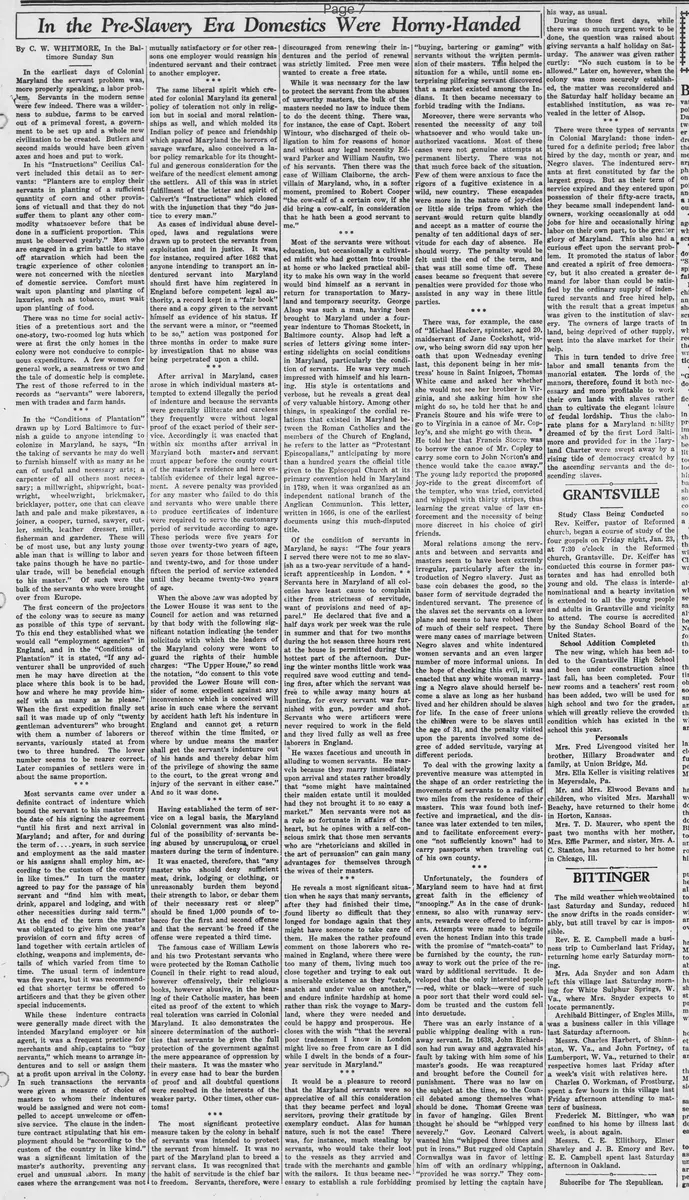
In the Pre-Slavery Era Domestics Were Horny-Handed
By C. W. WHITMORE, In the Baltimore Sunday Sun
In the earliest days of Colonial Maryland the servant problem was, more properly speaking, a labor problem. Servants in the modern sense were few indeed. There was a wilderness to subdue, farms to be carved out of a primeval forest, a government to be set up and a whole new civilization to be created. Butlers and second maids would have been given axes and hoes and put to work.
In his "Instructions" Cecilius Calvert included this detail as to servants: "Planters are to employ their servants in planting of a sufficient quantity of corn and other provisions of victual and that they do not suffer them to plant any other commodity whatsoever before that be done in a sufficient proportion. This must be observed yearly." Men who are engaged in a grim battle to stave off starvation which had been the tragic experience of other colonies were not concerned with the niceties of domestic service. Comfort must wait upon planting and planting of luxuries, such as tobacco, must wait upon planting of food.
There was no time for social activities of a pretentious sort and the one-story, two-roomed log huts which were at first the only homes in the colony were not conducive to conspicuous expenditure. A few women for general work, a seamstress or two and the tale of domestic help is complete. The rest of those referred to in the records as "servants" were laborers men with trades and farm hands.
In the "Conditions of Plantation" drawn up by Lord Baltimore to furnish a guide to anyone intending to colonize in Maryland, he says, "In the taking of servants he may do well to furnish himself with as many as he can of useful and necessary arts; a carpenter of all others most necessary; a millwright, shipwright, boatwright, wheelwright, brickmaker, bricklayer, potter, one that can cleave lath and pale and make pikestaves, a joiner, a cooper, turner, sawyer, cutter, smith, leather dresser, miller, fisherman and gardener. These will be of most use, but any lusty young able man that is willing to labor and take pains though he have no particular trade, will be beneficial enough to his master." Of such were the bulk of the servants who were brought over from Europe.
The first concern of the projectors of the colony was to secure as many as possible of this type of servant. To this end they established what we would call "employment agencies" in England, and in the "Conditions of Plantation" it is stated. "If any adventurer shall be unprovided of such men he may have direction at the place where this book is to be had, how and where he may provide himself with as many as he please."
When the first expedition finally set sail it was made up of only "twenty gentleman adventurers" who brought with them a number of laborers or servants, variously stated at from two to three hundred. The lower number seems to be nearer correct. Later companies of settlers were in about the same proportion.
Most servants came over under a definite contract of indenture which bound the servant to his master from the date of his signing the agreement "until his first and next arrival in Maryland; and after, for and during the term of....years, in such service and employment as the said master or his assigns shall employ him, according to the custom of the country in like times." In turn the master agreed to pay for the passage of his servant and "find him with meat, drink, apparel and lodging, and with other necessities during said term."
At the end of the term the master was obligated to give him one year's provision of corn and fifty acres of land together with certain articles of clothing, weapons and implements, details of which varied from time to time. The usual term of indenture was five years, but it was recommended that shorter terms be offered to artificers and that they be given other special inducements.
While these indenture contracts were generally made direct with the intended Maryland employer or his agent, it was a frequent practice for merchants and ship captains to "buy servants," which means to arrange indentures and to sell or assign them at a profit upon arrival in the Colony. In such transactions the servants were given a measure of choice of masters to whom their indentures would be assigned and were not compelled to accept unwelcome or offensive service. The clause in the indenture contract stipulating that his employment should be "according to the custom of the country in like kind." was a significant limitation of the master's authority, preventing any cruel and unusual labors. In many cases where the arrangement was not mutually satisfactory or for other reasons one employer would reassign his indentured servant and their contract to another employer.
The same liberal spirit which created for colonial Maryland its general policy of toleration not only in religion but in social and moral relationships as well, and which molded its Indian policy of peace and friendship which spared Maryland the horrors of savage warfare, also conceived a labor policy remarkable for its thoughtful and generous consideration for the welfare of the neediest element among the settlers. All of this was in strict fulfillment of the letter and spirit of Calvert's "Instructions" which closed with the injunction that they "do justice to every man."
As cases of individual abuse developed, laws and regulations were drawn up to protect the servants from exploitation and injustice. It was, for instance, required after 1682 that anyone intending to transport an indentured servant into Maryland should first have him registered in England before competent legal authority, a record kept in a "fair book" there and a copy given to the servant himself as evidence of his status. If the servant were a minor, or "seemed to be so," action was postponed for three months in order to make sure by investigation that no abuse was being perpetrated upon a child.
After arrival in Maryland, cases arose in which individual masters attempted to extend illegally the period of indenture and because the servants were generally illiterate and careless they frequently were without legal proof of the exact period of their service. Accordingly it was enacted that within six months after arrival in Maryland both master and servant must appear before the county court of the master's residence and here establish evidence of their legal agreement. A severe penalty was provided for any master who failed to do this and servants who were unable there to produce certificates of indenture were required to serve the customary period of servitude according to age. These periods were five years for those over twenty-two years of age, seven years for those between fifteen and twenty-two, and for those under fifteen the period of service extended until they became twenty-two years of age.
When the above law was adopted by the Lower House it was sent to the Council for action and was returned by that body with the following significant notation indicating the tender solicitude with which the leaders of the Maryland colony were wont to guard the rights of their humble charges: "The Upper House," so read the notation, "do consent to this vote provided the Lower House will consider of some expedient against any inconvenience which is conceived will arise in such case where the servant by accident hath left his indenture in England and cannot get a return thereof within the time limited, or where by undue means the master shall get the servant's indenture out of his hands and thereby debar him of the privilege of showing the same to the court, to the great wrong and injury of the servant in either case." And so it was done.
Having established the term of service on a legal basis, the Maryland Colonial government was also mindful of the possibility of servants being abused by unscrupulous or cruel masters during the term of indenture. It was enacted, therefore, that "any master who should deny sufficient meat, drink, lodging or clothing, or unreasonably burden them beyond their strength to labor, or debar them of their necessary rest or sleep" should be fined 1,000 pounds of tobacco for the first and second offense and that the servant be freed if the offense were repeated a third time.
The famous case of William Lewis and his two Protestant servants who were protected by the Roman Catholic Council in their right to read aloud, however offensively, their religious books, however abusive, in the hearing of their Catholic master, has been cited as proof of the extent to which real toleration was carried in Colonial Maryland. It also demonstrates the sincere determination of the authorities that servants be given the full protection of the government against the mere appearance of oppression by their masters. It was the master who in every case had to bear the burden of proof and all doubtful questions were resolved in the interests of the weaker party. Other times, other customs!
The most significant protective measure taken by the colony in behalf of servants was intended to protect the servant from himself. It was no part of the Maryland plan to breed a servant class. It was recognized that the habit of servitude is the chief bar to freedom. Servants, therefore, were discouraged from renewing their indentures and the period of renewal was strictly limited. Free men were wanted to create a free state.
While it was necessary for the law to protect the servant from the abuses of unworthy masters, the bulk of the masters needed no law to induce them to do the decent thing. There was, for instance, the case of Capt. Robert Wintour, who discharged of their obligation to him for reasons of honor and without any legal necessity Edward Parker and William Naufin, two of his servants. Then there was the case of William Claiborne, the arch-villain of Maryland, who, in a softer moment, promised to Robert Cooper "the cow-calf of a certain cow, if she did bring a cow-calf, in consideration that he hath been a good servant to me."
Most of the servants were without education, but occasionally a cultivated misfit who had gotten into trouble at home or who lacked practical ability to make his own way in the world would bind himself as a servant in return for transportation to Maryland and temporary security. George Alsop was such a man, having been brought to Maryland under a four-year indenture to Thomas Stockett, in Baltimore county. Alsop had left a series of letters giving some interesting sidelights on social conditions in Maryland, particularly the condition of servants. He was very much impressed with himself and his learning. His style is ostentatious and verbose, but he reveals a great deal of very valuable history. Among other things, in speaking of the cordial relations that existed in Maryland between the Roman Catholics and the members of the Church of England, he refers to the latter as "Protestant Episcopalians," anticipating by more than a hundred years the official title given to the Episcopal Church at its primary convention held in Maryland in 1789, when it was organized as an independent national branch of the Anglican Communion. This letter, written in 1666, is one of the earliest documents using this much-disputed title.
Of the condition of servants in Maryland, he says: "The four years I served there were not to me so slavish as a two-year servitude of a handicraft apprenticeship in London. * * Servants here in Maryland of all colonies have least cause to complain either from strictness of servitude, want of provisions and need of apparel." He declared that five and a half days work per week was the rule in summer and that for two months during the hot season three hours rest at the house is permitted during the hottest part of the afternoon. During the winter months little work was required save wood cutting and tending fires, after which the servant was free to while away many hours at hunting, for every servant was furnished with gun, powder and shot. Servants who were artificers were never required to work in the field and they lived fully as well as free laborers in England.
He waxes facetious and uncouth in alluding to women servants. He marvels because they marry immediately upon arrival and states rather broadly that "some might have maintained their maiden estate until it moulded had they not brought it to so easy a market." Men servants were not as a rule so fortunate in affairs of the heart, but he opines with a self-conscious smirk that those men servants who are "rhetoricians and skilled in the art of persuasion" can gain many advantages for themselves through the wives of their masters.
He reveals a most significant situation when he says that many servants, after they had finished their time, found liberty so difficult that they longed for bondage again that they might have someone to take care of them. He makes the rather profound comment on those laborers who remained in England, where there were too many of them, living much too close together and trying to eke out a miserable existence as they "catch, snatch and under value on another," and endure infinite hardship at home rather than risk the voyage to Maryland, where they were needed and could be happy and prosperous. He closes with the wish "that the several poor tradesmen I know in London might live so free from care as I did while I dwelt in the bonds of a four-year servitude in Maryland."
It would be a pleasure to record that the Maryland servants were so appreciative of all this consideration that they became perfect and loyal servitors, proving their gratitude by exemplary conduct. Alas for human nature, such is not the case! There was, for instance, much stealing by servants, who would take their loot to the vessels as they arrived and trade with the merchants and gamble with the sailors. It thus became necessary to establish a rule forbidding "buying, bartering or gaming" with servants without the written permission of their masters. This helped the situation for a while, until some enterprising pilfering servant discovered that a market existed among the Indians. It then became necessary to forbid trading with the Indians.
Moreover, there were servants who resented the necessity of any toil whatsoever and who would take unauthorized vacations. Most of these cases were not genuine attempts at permanent liberty. There was not that much force back of the situation. Few of them were anxious to face the rigors of a fugitive existence in a wild, new country. These escapades were more in the nature of joy-rides or little side trips from which the servant would return quite blandly and accept as a matter of course the penalty of ten additional days of servitude for each day of absence. He should worry. The penalty would be felt until the end of the term, and that was still some time off. These cases became so frequent that severe penalties were provided for those who assisted in any way in these little parties.
There was, for example, the case of "Michael Hacker, spinster, aged 20, maidservant of Jane Cockshott, widow, who being sworn did say upon her oath that upon Wednesday evening last, this deponent being in her mistress' house in Saint Inigoes, Thomas White came and asked her whether she would not see her brother in Virginia, and she asking him how she might do so, he told her that he and Francis Stoure and his wife were to go to Virginia in a canoe of Mr. Copley's, and she might go with them. He told her that Francis Stoure was to borrow the canoe of Mr. Copley to carry some corn to John Norton's and thence would take the canoe away." The young lady reported the proposed joy-ride to the great discomfort of the tempter, who was tried, convicted and whipped with thirty stripes, thus learning the great value of law enforcement and the necessity of being more discreet in his choice of girl friends.
Moral relations among the servants and between servants and masters seem to have been extremely irregular, particularly after the introduction of Negro slavery. Just as base coin debases the good, so the baser form of servitude degraded the indentured servant. The presence of the slaves set the servants on a lower plane and seems to have robbed them of much of their self respect. There were many cases of marriage between Negro slaves and white indentured women servants and an even larger number of more informal unions. In the hope of checking this evil, it was enacted that any white woman marrying a Negro slave should herself become a slave as long as her husband lived and her children should be slaves for life. In the case of freer unions the children were to be slaves until the age of 31, and the penalty visited upon the parents involved some degree of added servitude, varying at different periods.
To deal with the growing laxity a preventive measure was attempted in the shape of an order restricting the movements of servants to a radius of two miles from the residence of their masters. This was found both ineffective and impractical, and the distance was later extended to ten miles, and to facilitate enforcement everyone "not sufficiently known" had to carry passports when traveling out of his own county.
Unfortunately, the founders of Maryland seem to have had at first great faith in the efficiency of "snooping." As in the case of drunkenness, so also with runaway servants, rewards were offered to informers. Attempts were made to beguile even the honest Indian into this trade with the promise of "match-coats" to be furnished by the county, the runaway to work out the price of the reward by additional servitude. It developed that the only interested people—red, white or black—were of such a poor sort that their word could seldom be trusted and the custom fell into desuetude.
There was an early instance of a public whipping dealing with a runaway servant. In 1638, John Richardson had run away and aggravated his fault by taking with him some of his master's goods. He was recaptured and brought before the Council for punishment. There was no law on the subject at the time, so the Council debated among themselves what should be done. Thomas Greene was in favor of hanging. Giles Brent thought he should be "whipped very severely." Gov. Leonard Calvert wanted him "whipped three times and put in irons." But rugged old Captain Cornwaleys was in favor of letting him off with an ordinary whipping, "provided he was sorry." They compromised by letting the captain have his way.
During those first days, while there was so much urgent work to be done, the question was raised about giving servants a half holiday on Saturday. The answer was given rather curtly: "No such custom is to be allowed." Later on, however, when the colony was more securely established, the matter was reconsidered and the Saturday half holiday became an established institution, as was revealed in the letter of Alsop.
There were three types of servants in Colonial Maryland: those indentured for a definite period; free labor hired by the day, month or year, and Negro slaves. The indentured servants at first constituted by far the largest group. But as their term of service expired and they entered upon possession of their fifty-acre tracts, they became small independent landowners, working occasionally at odd jobs for hire and occasionally hiring labor on their own part, to the greater glory of Maryland. This also had a curious effect upon the servant problem. It promoted the status of labor and created a spirit of free democracy, but it also created a greater demand for labor than could be satisfied by the ordinary supply of indentured servants and free hired help, with the result that a great impetus was given to the institution of slavery. The owners of large tracts of land, being deprived of other supply, went into the slave market for their help.
This in turn tended to drive free labor and small tenants from the manorial estates. The lords of the manors, therefore, found it both necessary and more profitable to work their own lands with slaves rather than to cultivate the elegant leisure of feudal lordship. Thus the elaborate plans for a Maryland nobility dreamed of by the first Lord Baltimore and provided for in the Maryland Charter were swept away by a rising tide of democracy created by the ascending servants and the descending slaves.
By C. W. WHITMORE, In the Baltimore Sunday Sun
In the earliest days of Colonial Maryland the servant problem was, more properly speaking, a labor problem. Servants in the modern sense were few indeed. There was a wilderness to subdue, farms to be carved out of a primeval forest, a government to be set up and a whole new civilization to be created. Butlers and second maids would have been given axes and hoes and put to work.
In his "Instructions" Cecilius Calvert included this detail as to servants: "Planters are to employ their servants in planting of a sufficient quantity of corn and other provisions of victual and that they do not suffer them to plant any other commodity whatsoever before that be done in a sufficient proportion. This must be observed yearly." Men who are engaged in a grim battle to stave off starvation which had been the tragic experience of other colonies were not concerned with the niceties of domestic service. Comfort must wait upon planting and planting of luxuries, such as tobacco, must wait upon planting of food.
There was no time for social activities of a pretentious sort and the one-story, two-roomed log huts which were at first the only homes in the colony were not conducive to conspicuous expenditure. A few women for general work, a seamstress or two and the tale of domestic help is complete. The rest of those referred to in the records as "servants" were laborers men with trades and farm hands.
In the "Conditions of Plantation" drawn up by Lord Baltimore to furnish a guide to anyone intending to colonize in Maryland, he says, "In the taking of servants he may do well to furnish himself with as many as he can of useful and necessary arts; a carpenter of all others most necessary; a millwright, shipwright, boatwright, wheelwright, brickmaker, bricklayer, potter, one that can cleave lath and pale and make pikestaves, a joiner, a cooper, turner, sawyer, cutter, smith, leather dresser, miller, fisherman and gardener. These will be of most use, but any lusty young able man that is willing to labor and take pains though he have no particular trade, will be beneficial enough to his master." Of such were the bulk of the servants who were brought over from Europe.
The first concern of the projectors of the colony was to secure as many as possible of this type of servant. To this end they established what we would call "employment agencies" in England, and in the "Conditions of Plantation" it is stated. "If any adventurer shall be unprovided of such men he may have direction at the place where this book is to be had, how and where he may provide himself with as many as he please."
When the first expedition finally set sail it was made up of only "twenty gentleman adventurers" who brought with them a number of laborers or servants, variously stated at from two to three hundred. The lower number seems to be nearer correct. Later companies of settlers were in about the same proportion.
Most servants came over under a definite contract of indenture which bound the servant to his master from the date of his signing the agreement "until his first and next arrival in Maryland; and after, for and during the term of....years, in such service and employment as the said master or his assigns shall employ him, according to the custom of the country in like times." In turn the master agreed to pay for the passage of his servant and "find him with meat, drink, apparel and lodging, and with other necessities during said term."
At the end of the term the master was obligated to give him one year's provision of corn and fifty acres of land together with certain articles of clothing, weapons and implements, details of which varied from time to time. The usual term of indenture was five years, but it was recommended that shorter terms be offered to artificers and that they be given other special inducements.
While these indenture contracts were generally made direct with the intended Maryland employer or his agent, it was a frequent practice for merchants and ship captains to "buy servants," which means to arrange indentures and to sell or assign them at a profit upon arrival in the Colony. In such transactions the servants were given a measure of choice of masters to whom their indentures would be assigned and were not compelled to accept unwelcome or offensive service. The clause in the indenture contract stipulating that his employment should be "according to the custom of the country in like kind." was a significant limitation of the master's authority, preventing any cruel and unusual labors. In many cases where the arrangement was not mutually satisfactory or for other reasons one employer would reassign his indentured servant and their contract to another employer.
The same liberal spirit which created for colonial Maryland its general policy of toleration not only in religion but in social and moral relationships as well, and which molded its Indian policy of peace and friendship which spared Maryland the horrors of savage warfare, also conceived a labor policy remarkable for its thoughtful and generous consideration for the welfare of the neediest element among the settlers. All of this was in strict fulfillment of the letter and spirit of Calvert's "Instructions" which closed with the injunction that they "do justice to every man."
As cases of individual abuse developed, laws and regulations were drawn up to protect the servants from exploitation and injustice. It was, for instance, required after 1682 that anyone intending to transport an indentured servant into Maryland should first have him registered in England before competent legal authority, a record kept in a "fair book" there and a copy given to the servant himself as evidence of his status. If the servant were a minor, or "seemed to be so," action was postponed for three months in order to make sure by investigation that no abuse was being perpetrated upon a child.
After arrival in Maryland, cases arose in which individual masters attempted to extend illegally the period of indenture and because the servants were generally illiterate and careless they frequently were without legal proof of the exact period of their service. Accordingly it was enacted that within six months after arrival in Maryland both master and servant must appear before the county court of the master's residence and here establish evidence of their legal agreement. A severe penalty was provided for any master who failed to do this and servants who were unable there to produce certificates of indenture were required to serve the customary period of servitude according to age. These periods were five years for those over twenty-two years of age, seven years for those between fifteen and twenty-two, and for those under fifteen the period of service extended until they became twenty-two years of age.
When the above law was adopted by the Lower House it was sent to the Council for action and was returned by that body with the following significant notation indicating the tender solicitude with which the leaders of the Maryland colony were wont to guard the rights of their humble charges: "The Upper House," so read the notation, "do consent to this vote provided the Lower House will consider of some expedient against any inconvenience which is conceived will arise in such case where the servant by accident hath left his indenture in England and cannot get a return thereof within the time limited, or where by undue means the master shall get the servant's indenture out of his hands and thereby debar him of the privilege of showing the same to the court, to the great wrong and injury of the servant in either case." And so it was done.
Having established the term of service on a legal basis, the Maryland Colonial government was also mindful of the possibility of servants being abused by unscrupulous or cruel masters during the term of indenture. It was enacted, therefore, that "any master who should deny sufficient meat, drink, lodging or clothing, or unreasonably burden them beyond their strength to labor, or debar them of their necessary rest or sleep" should be fined 1,000 pounds of tobacco for the first and second offense and that the servant be freed if the offense were repeated a third time.
The famous case of William Lewis and his two Protestant servants who were protected by the Roman Catholic Council in their right to read aloud, however offensively, their religious books, however abusive, in the hearing of their Catholic master, has been cited as proof of the extent to which real toleration was carried in Colonial Maryland. It also demonstrates the sincere determination of the authorities that servants be given the full protection of the government against the mere appearance of oppression by their masters. It was the master who in every case had to bear the burden of proof and all doubtful questions were resolved in the interests of the weaker party. Other times, other customs!
The most significant protective measure taken by the colony in behalf of servants was intended to protect the servant from himself. It was no part of the Maryland plan to breed a servant class. It was recognized that the habit of servitude is the chief bar to freedom. Servants, therefore, were discouraged from renewing their indentures and the period of renewal was strictly limited. Free men were wanted to create a free state.
While it was necessary for the law to protect the servant from the abuses of unworthy masters, the bulk of the masters needed no law to induce them to do the decent thing. There was, for instance, the case of Capt. Robert Wintour, who discharged of their obligation to him for reasons of honor and without any legal necessity Edward Parker and William Naufin, two of his servants. Then there was the case of William Claiborne, the arch-villain of Maryland, who, in a softer moment, promised to Robert Cooper "the cow-calf of a certain cow, if she did bring a cow-calf, in consideration that he hath been a good servant to me."
Most of the servants were without education, but occasionally a cultivated misfit who had gotten into trouble at home or who lacked practical ability to make his own way in the world would bind himself as a servant in return for transportation to Maryland and temporary security. George Alsop was such a man, having been brought to Maryland under a four-year indenture to Thomas Stockett, in Baltimore county. Alsop had left a series of letters giving some interesting sidelights on social conditions in Maryland, particularly the condition of servants. He was very much impressed with himself and his learning. His style is ostentatious and verbose, but he reveals a great deal of very valuable history. Among other things, in speaking of the cordial relations that existed in Maryland between the Roman Catholics and the members of the Church of England, he refers to the latter as "Protestant Episcopalians," anticipating by more than a hundred years the official title given to the Episcopal Church at its primary convention held in Maryland in 1789, when it was organized as an independent national branch of the Anglican Communion. This letter, written in 1666, is one of the earliest documents using this much-disputed title.
Of the condition of servants in Maryland, he says: "The four years I served there were not to me so slavish as a two-year servitude of a handicraft apprenticeship in London. * * Servants here in Maryland of all colonies have least cause to complain either from strictness of servitude, want of provisions and need of apparel." He declared that five and a half days work per week was the rule in summer and that for two months during the hot season three hours rest at the house is permitted during the hottest part of the afternoon. During the winter months little work was required save wood cutting and tending fires, after which the servant was free to while away many hours at hunting, for every servant was furnished with gun, powder and shot. Servants who were artificers were never required to work in the field and they lived fully as well as free laborers in England.
He waxes facetious and uncouth in alluding to women servants. He marvels because they marry immediately upon arrival and states rather broadly that "some might have maintained their maiden estate until it moulded had they not brought it to so easy a market." Men servants were not as a rule so fortunate in affairs of the heart, but he opines with a self-conscious smirk that those men servants who are "rhetoricians and skilled in the art of persuasion" can gain many advantages for themselves through the wives of their masters.
He reveals a most significant situation when he says that many servants, after they had finished their time, found liberty so difficult that they longed for bondage again that they might have someone to take care of them. He makes the rather profound comment on those laborers who remained in England, where there were too many of them, living much too close together and trying to eke out a miserable existence as they "catch, snatch and under value on another," and endure infinite hardship at home rather than risk the voyage to Maryland, where they were needed and could be happy and prosperous. He closes with the wish "that the several poor tradesmen I know in London might live so free from care as I did while I dwelt in the bonds of a four-year servitude in Maryland."
It would be a pleasure to record that the Maryland servants were so appreciative of all this consideration that they became perfect and loyal servitors, proving their gratitude by exemplary conduct. Alas for human nature, such is not the case! There was, for instance, much stealing by servants, who would take their loot to the vessels as they arrived and trade with the merchants and gamble with the sailors. It thus became necessary to establish a rule forbidding "buying, bartering or gaming" with servants without the written permission of their masters. This helped the situation for a while, until some enterprising pilfering servant discovered that a market existed among the Indians. It then became necessary to forbid trading with the Indians.
Moreover, there were servants who resented the necessity of any toil whatsoever and who would take unauthorized vacations. Most of these cases were not genuine attempts at permanent liberty. There was not that much force back of the situation. Few of them were anxious to face the rigors of a fugitive existence in a wild, new country. These escapades were more in the nature of joy-rides or little side trips from which the servant would return quite blandly and accept as a matter of course the penalty of ten additional days of servitude for each day of absence. He should worry. The penalty would be felt until the end of the term, and that was still some time off. These cases became so frequent that severe penalties were provided for those who assisted in any way in these little parties.
There was, for example, the case of "Michael Hacker, spinster, aged 20, maidservant of Jane Cockshott, widow, who being sworn did say upon her oath that upon Wednesday evening last, this deponent being in her mistress' house in Saint Inigoes, Thomas White came and asked her whether she would not see her brother in Virginia, and she asking him how she might do so, he told her that he and Francis Stoure and his wife were to go to Virginia in a canoe of Mr. Copley's, and she might go with them. He told her that Francis Stoure was to borrow the canoe of Mr. Copley to carry some corn to John Norton's and thence would take the canoe away." The young lady reported the proposed joy-ride to the great discomfort of the tempter, who was tried, convicted and whipped with thirty stripes, thus learning the great value of law enforcement and the necessity of being more discreet in his choice of girl friends.
Moral relations among the servants and between servants and masters seem to have been extremely irregular, particularly after the introduction of Negro slavery. Just as base coin debases the good, so the baser form of servitude degraded the indentured servant. The presence of the slaves set the servants on a lower plane and seems to have robbed them of much of their self respect. There were many cases of marriage between Negro slaves and white indentured women servants and an even larger number of more informal unions. In the hope of checking this evil, it was enacted that any white woman marrying a Negro slave should herself become a slave as long as her husband lived and her children should be slaves for life. In the case of freer unions the children were to be slaves until the age of 31, and the penalty visited upon the parents involved some degree of added servitude, varying at different periods.
To deal with the growing laxity a preventive measure was attempted in the shape of an order restricting the movements of servants to a radius of two miles from the residence of their masters. This was found both ineffective and impractical, and the distance was later extended to ten miles, and to facilitate enforcement everyone "not sufficiently known" had to carry passports when traveling out of his own county.
Unfortunately, the founders of Maryland seem to have had at first great faith in the efficiency of "snooping." As in the case of drunkenness, so also with runaway servants, rewards were offered to informers. Attempts were made to beguile even the honest Indian into this trade with the promise of "match-coats" to be furnished by the county, the runaway to work out the price of the reward by additional servitude. It developed that the only interested people—red, white or black—were of such a poor sort that their word could seldom be trusted and the custom fell into desuetude.
There was an early instance of a public whipping dealing with a runaway servant. In 1638, John Richardson had run away and aggravated his fault by taking with him some of his master's goods. He was recaptured and brought before the Council for punishment. There was no law on the subject at the time, so the Council debated among themselves what should be done. Thomas Greene was in favor of hanging. Giles Brent thought he should be "whipped very severely." Gov. Leonard Calvert wanted him "whipped three times and put in irons." But rugged old Captain Cornwaleys was in favor of letting him off with an ordinary whipping, "provided he was sorry." They compromised by letting the captain have his way.
During those first days, while there was so much urgent work to be done, the question was raised about giving servants a half holiday on Saturday. The answer was given rather curtly: "No such custom is to be allowed." Later on, however, when the colony was more securely established, the matter was reconsidered and the Saturday half holiday became an established institution, as was revealed in the letter of Alsop.
There were three types of servants in Colonial Maryland: those indentured for a definite period; free labor hired by the day, month or year, and Negro slaves. The indentured servants at first constituted by far the largest group. But as their term of service expired and they entered upon possession of their fifty-acre tracts, they became small independent landowners, working occasionally at odd jobs for hire and occasionally hiring labor on their own part, to the greater glory of Maryland. This also had a curious effect upon the servant problem. It promoted the status of labor and created a spirit of free democracy, but it also created a greater demand for labor than could be satisfied by the ordinary supply of indentured servants and free hired help, with the result that a great impetus was given to the institution of slavery. The owners of large tracts of land, being deprived of other supply, went into the slave market for their help.
This in turn tended to drive free labor and small tenants from the manorial estates. The lords of the manors, therefore, found it both necessary and more profitable to work their own lands with slaves rather than to cultivate the elegant leisure of feudal lordship. Thus the elaborate plans for a Maryland nobility dreamed of by the first Lord Baltimore and provided for in the Maryland Charter were swept away by a rising tide of democracy created by the ascending servants and the descending slaves.
What sub-type of article is it?
Historical Event
Biography
Curiosity
What themes does it cover?
Justice
Social Manners
Moral Virtue
What keywords are associated?
Indentured Servants
Colonial Maryland
Labor System
Indenture Contracts
Servant Protections
Historical Labor
Slavery Transition
What entities or persons were involved?
Cecilius Calvert
Lord Baltimore
George Alsop
Capt. Robert Wintour
William Claiborne
Leonard Calvert
Thomas Greene
Giles Brent
Captain Cornwaleys
John Richardson
Where did it happen?
Colonial Maryland
Story Details
Key Persons
Cecilius Calvert
Lord Baltimore
George Alsop
Capt. Robert Wintour
William Claiborne
Leonard Calvert
Thomas Greene
Giles Brent
Captain Cornwaleys
John Richardson
Location
Colonial Maryland
Event Date
Earliest Days Of Colonial Maryland, 1638, 1666, After 1682
Story Details
Article details the labor system of indentured servants in early Maryland, their recruitment, contracts, protections by law and custom, daily conditions, misbehaviors, and how the system evolved toward slavery while promoting democracy.