Thank you for visiting SNEWPapers!
Sign up free
Story
September 2, 1942
The Daily Monitor Leader
Mount Clemens, Macomb County, Michigan
What is this article about?
Rep. Voorhis (D-Calif) calls on Congress to combat inflation through direct legislation, including higher taxes, compulsory savings, wage limits, and farm price controls, instead of relying on President Roosevelt's executive powers. (178 characters)
Clipping
OCR Quality
98%
Excellent
Full Text
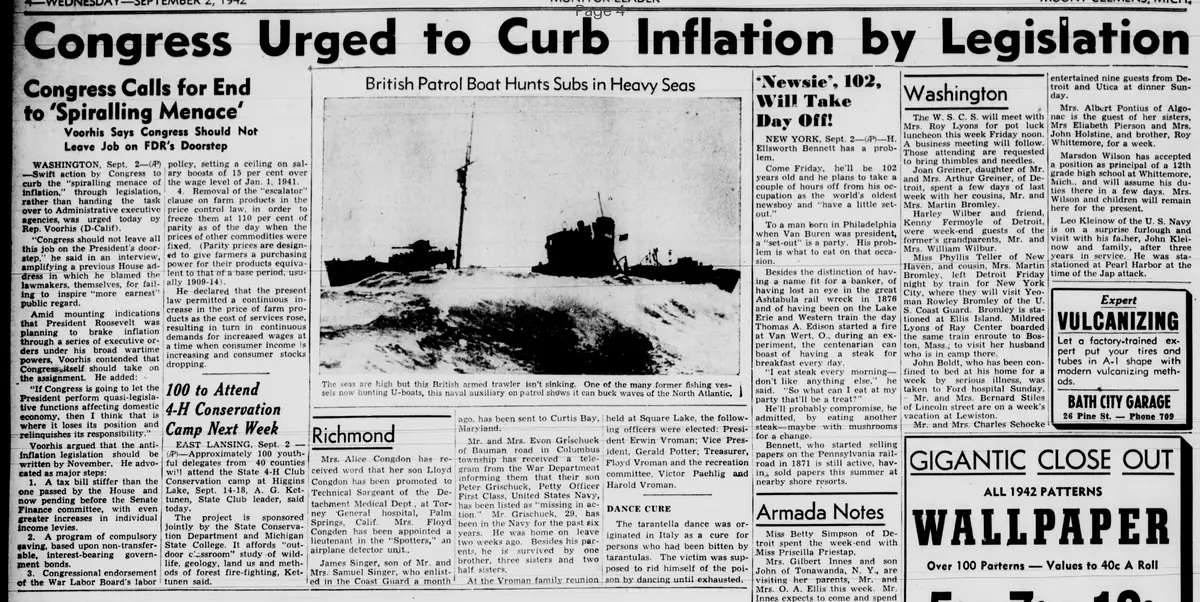
Congress Urged to Curb Inflation by Legislation
Congress Calls for End to 'Spiralling Menace' Voorhis Says Congress Should Not Leave Job on FDR's Doorstep.
WASHINGTON, Sept. 2-(AP)- Swift action by Congress to curb the "spiralling menace of inflation," through legislation, rather than handing the task over to Administrative executive agencies, was urged today by Rep. Voorhis (D-Calif).
"Congress should not leave all this job on the President's doorstep," he said in an interview, amplifying a previous House address in which he blamed the lawmakers, themselves, for failing to inspire "more earnest" public regard.
Amid mounting indications that President Roosevelt was planning to brake inflation through a series of executive orders under his broad wartime powers, Voorhis contended that Congress itself should take on the assignment. He added:
"If Congress is going to let the President perform quasi-legislative functions affecting domestic economy, then I think that is where it loses its position and relinquishes its responsibility."
Voorhis argued that the anti-inflation legislation should be written by November. He advocated as major steps:
1. A tax bill stiffer than the one passed by the House and now pending before the Senate Finance committee, with even greater increases in individual income levies.
2. A program of compulsory saving, based upon non-transferable, interest-bearing government bonds.
3. Congressional endorsement of the War Labor Board's labor policy, setting a ceiling on salary boosts of 15 per cent over the wage level of Jan. 1, 1941.
4. Removal of the "escalator" clause on farm products in the price control law, in order to freeze them at 110 per cent of parity as of the day when the prices of other commodities were fixed. (Parity prices are designed to give farmers a purchasing power for their products equivalent to that of a base period, usually 1909-14).
He declared that the present law permitted a continuous increase in the price of farm products as the cost of services rose, resulting in turn in continuous demands for increased wages at a time when consumer income is increasing and consumer stocks dropping.
Congress Calls for End to 'Spiralling Menace' Voorhis Says Congress Should Not Leave Job on FDR's Doorstep.
WASHINGTON, Sept. 2-(AP)- Swift action by Congress to curb the "spiralling menace of inflation," through legislation, rather than handing the task over to Administrative executive agencies, was urged today by Rep. Voorhis (D-Calif).
"Congress should not leave all this job on the President's doorstep," he said in an interview, amplifying a previous House address in which he blamed the lawmakers, themselves, for failing to inspire "more earnest" public regard.
Amid mounting indications that President Roosevelt was planning to brake inflation through a series of executive orders under his broad wartime powers, Voorhis contended that Congress itself should take on the assignment. He added:
"If Congress is going to let the President perform quasi-legislative functions affecting domestic economy, then I think that is where it loses its position and relinquishes its responsibility."
Voorhis argued that the anti-inflation legislation should be written by November. He advocated as major steps:
1. A tax bill stiffer than the one passed by the House and now pending before the Senate Finance committee, with even greater increases in individual income levies.
2. A program of compulsory saving, based upon non-transferable, interest-bearing government bonds.
3. Congressional endorsement of the War Labor Board's labor policy, setting a ceiling on salary boosts of 15 per cent over the wage level of Jan. 1, 1941.
4. Removal of the "escalator" clause on farm products in the price control law, in order to freeze them at 110 per cent of parity as of the day when the prices of other commodities were fixed. (Parity prices are designed to give farmers a purchasing power for their products equivalent to that of a base period, usually 1909-14).
He declared that the present law permitted a continuous increase in the price of farm products as the cost of services rose, resulting in turn in continuous demands for increased wages at a time when consumer income is increasing and consumer stocks dropping.
What sub-type of article is it?
Historical Event
What keywords are associated?
Inflation
Congress
Voorhis
Roosevelt
Legislation
Price Control
Wartime Economy
Wage Ceiling
Farm Parity
What entities or persons were involved?
Rep. Voorhis (D Calif)
President Roosevelt
Where did it happen?
Washington
Story Details
Key Persons
Rep. Voorhis (D Calif)
President Roosevelt
Location
Washington
Event Date
Sept. 2
Story Details
Rep. Voorhis urges Congress to enact anti-inflation legislation by November, including stiffer taxes, compulsory savings, wage ceilings, and farm price freezes, rather than delegating to executive agencies.