Thank you for visiting SNEWPapers!
Sign up free
Literary Cadet And Rhode Island Statesman
Providence, Providence County, Rhode Island
What is this article about?
The Literary Cadet, published in Providence on September 19, critiques excessive American press mourning of British statesman George Canning's recent death, highlighting his lifelong enmity toward the US and rejecting 'man-worship' in favor of republican principles. It quotes balanced views from editors Robert Walsh and John Binns, and an excerpt from the National Intelligencer detailing Canning's anti-American policies.
Clipping
OCR Quality
Full Text
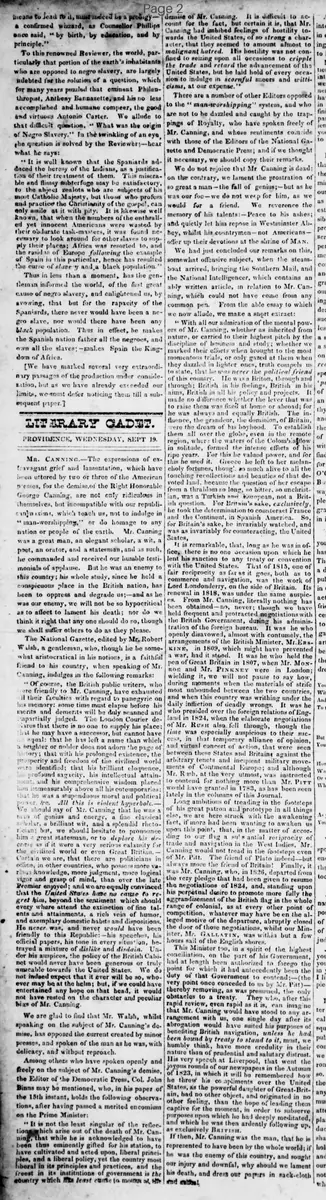
PROVIDENCE, WEDNESDAY, SEPT 19.
Mr. Canning.—The expressions of extravagant grief and lamentation, which have been uttered by two or three of the American presses, for the demise of the Right Honorable George Canning, are not only ridiculous in themselves, but incompatible with our republican maxims, which teach us, not to indulge in "man-worshipping," or do homage to any nation or people of the earth. Mr. Canning was a great man, an elegant scholar, a wit, a poet, an orator, and a statesman, and as such he commanded and received our humble testimonials of applause. But he was an enemy to this country: his whole study, since he held a conspicuous place in the British nation, has been to oppress and degrade us;—and as he was our enemy, we will not be so hypocritical as to affect to lament his death; nor do we think it right that any one should do so, though we shall suffer others to do as they please.
The National Gazette, edited by Mr. Robert Walsh, a gentleman, who, though he be somewhat aristocratical in his notions, is a faithful friend to his country, when speaking of Mr. Canning, indulges in the following remarks:
"Of course, the British public writers, who are friendly to Mr. Canning, have exhausted all their faculties with regard to panegyric on his memory: some time must elapse before his merits and demerits will be duly scanned and impartially judged. The London Courier desires that there is no one to supply his place; but he may have a successor, but cannot have an equal: that he has left a name than which a brighter or nobler does not adorn the page of history; that with his prolonged existence, the prosperity and freedom of the civilized world were identified; that his brilliant eloquence, his profound sagacity, his intellectual attainment, and his comprehensive wisdom placed him inmeasurably above all his cotemporaries: that he was a stupendous moral and political power, &c. All this is violent hyperbole.—
We should say of Mr. Canning that he was a man of genius and energy, a fine classical scholar, a brilliant wit, and a splendid rhetorician; but, we should hesitate to pronounce him a great statesman, or to deplore his decease as if it were a very serious calamity for the civilized world or even Great Britain.—
Certain we are, that there are politicians in office, in other countries, who possess more various knowledge, more judgment, more logical vigor and grasp of mind, than ever the late Premier enjoyed; and we are equally convinced that the United States have no cause to regret him, beyond the sentiment which should every where attend the extinction of fine talents and attainments, a rich vein of humor, and exemplary domestic habits and dispositions.
He never was, and never would have been friendly to this Republic:—his speeches, his official papers, his tone in every situation, betrayed a mixture of dislike and disdain. Under his auspices, the policy of the British Cabinet would never have been generous or truly amicable towards the United States. We do not indeed expect that it ever will be so, whoever may be at the helm; but, if we could have entertained any hope on that head, it would not have rested on the character and peculiar bias of Mr. Canning.
We are glad to find that Mr. Walsh, whilst speaking on the subject of Mr. Canning's demise, has opposed the current created by minor presses, and spoken of the man as he was, with delicacy, and without reproach.
Among others who have spoken openly and freely on the subject of Mr. Canning's demise, the Editor of the Democratic Press, Col. John Binns may be mentioned, who, in his paper of the 15th instant, holds the following observations, after having passed a merited encomium on the Prime Minister:
"It is not the least singular of the reflections which arise out of the death of Mr. Canning that while he is acknowledged to have been thus eminently gifted for his station, to have cultivated and acted upon, liberal principles, and a liberal policy, yet the country most liberal in its principles and practices, and the freest in its institutions of government is the country which has least cause to mourn at his demise. It is difficult to account for the fact, but certain it is, that Mr. Canning had imbibed feelings of hostility towards the United States, of so strong a character, that they seemed to amount almost to malignant hatred. His hostility was not confined to seizing upon all occasions to cripple the trade and retard the advancement of the United States, but he laid hold of every occasion to indulge in scornful sneers and witticisms, at our expense.
There are a number of other Editors opposed to the "man-worshipping" system, and who are not to be dazzled and caught by the trappings of Royalty, who have spoken freely of Mr. Canning, and whose sentiments coincide with those of the Editors of the National Gazette and Democratic Press; and if we thought it necessary, we should copy their remarks.
We do not rejoice that Mr. Canning is dead: on the contrary, we lament the prostration of so great a man—the fall of genius;—but as he was our foe—we do not weep for him, as we would for a friend.
We reverence the memory of his talents:—Peace to his ashes: and quietly let him repose in Westminster Abbey, whilst his countrymen—not Americans—offer up their devotions at the shrine of MAN.
We had just concluded our remarks on this, somewhat offensive subject, when the steamboat arrived, bringing the Southern Mail, and the National Intelligencer, which contains an ably written article, in relation to Mr. Canning, which could not have come from any common pen. From the able essay to which we now allude, we make a short extract:
"With all our admiration of the mental powers of Mr. Canning, whether as inherited from nature, or carried to their highest pitch by the discipline of business and study; whether we marked their efforts when brought to the most momentous trials, or only gazed at them when they dazzled in lighter ones, truth compels us to state, that he was never the political friend of this country. He was a Briton, through and through; British in his feelings, British in his aims, British in all his policy and projects. It made no difference whether the lever that was to raise them was fixed at home or abroad; for he was always and equally British. The influence, the grandeur, the dominion, of Britain, were the dream of his boyhood. To establish them all over the globe, even in the remote region, where the waters of the Columbia flow in solitude, formed the intense efforts of his ripe years. For this he valued power, and for this he used it. Greece he left to her melancholy fortunes, though so much alive to all the touching recollections and beauties of that devoted land, because the question of her escape from a thraldom so long, so bitter, so unchristian, was a Turkish and European, not a British question. For Britain's sake, exclusively he took the determination to counteract France and the Continent, in Spanish America. So, for Britain's sake, he invariably watched, and was as invariably for counteracting, the United States.
It is remarkable, that, long as he was in office, there is no one occasion upon which he lent his sanction to any treaty or convention with the United States. That of 1815, one of fair reciprocity as far as it goes, both as to commerce and navigation, was the work of Lord Londonderry, on the side of Britain. Its renewal in 1818, was under the same auspices. From Mr. Canning, literally nothing has been obtained—no, never; though we have held frequent and protracted negotiations with the British Government, during his administration of the foreign bureau. It was he who openly disavowed, almost with contumely, the arrangements of the British Minister, Mr. Erskine, in 1809, which might have prevented a war, had it stood. It was he who held the pen of Great Britain in 1807, when Mr. Monroe and Mr. Pinkney were in London: wielding it, we will not pause to say how, during moments when the materials of strife most unbounded between the two countries, and when this country was writhing under the daily infliction of deadly wrongs. It was he who presided over the foreign relations of England in 1824, when the elaborate negotiations of Mr. Rush also fell through, though the time was especially auspicious to their success, in that temporary alliance of opinion, and virtual concert of action, that were seen between these States and Britain against the arbitrary tenets and incipient military movements of Continental Europe; and although Mr. Rush, at the very utmost, was instructed to contend for nothing more than Mr. Pitt would have granted in 1783, as has been seen lately in the columns of this Journal.
Long ambitious of treading in the footsteps of his great patron and prototype in all things else, we are here struck with the awakening fact, if none had been wanting to awaken us upon this point, that, in the matter of according to our flag a substantial reciprocity of trade and navigation in the West Indies, Mr. Canning would not tread in the footsteps even of Mr. Pitt. The friend of Plato indeed—but always more the friend of Britain! Finally, it was Mr. Canning, who, in 1826, departed from the very pledge that had been given to resume the negotiations of 1824, and, standing upon his perpetual desire to promote more fully the aggrandizement of the British flag in the whole range of colonial, as at every other point of competition, whatever may have been the alleged motive of the departure, abruptly closed the door of those negotiations, whilst our Minister, Mr. Gallatin, was within but a few hours sail of the English shores.
This Minister too, in a spirit of the highest conciliation, on the part of his Government, had at length been authorized to forego the point for which it had antecedently been the duty of that Government to contend; (the very point once conceded to us by Mr. Pitt)—thereby removing, as was presumed, the only obstacles to a treaty. They who, after this rapid review, even rapid as it is, can imagine that Mr. Canning would have stood to any arrangement with us, one single day after its abrogation would have suited his purposes of benefiting British navigation, unless he had been bound by treaty to stand to it, must, we humbly think, have more credulity in their nature than of prudential and salutary distrust.
His very speech at Liverpool, that went the joyous rounds of our newspapers in the Autumn of 1823, in which it will be remembered how he threw his compliments over the United States, as the powerful daughter of Great-Britain, had no other object, and originated in no other feeling, than the hope of leading them captive for the moment, in order to subserve purposes upon which he had deeply meditated, and which he was then ardently following up, as exclusively British.
If then, Mr. Canning was the man, that he is represented to have been by the whole world; if he was the enemy of this country, and sought our injury and downfall, why should we lament his death, and dress out our papers in sack-cloth and ashes!"
What sub-type of article is it?
What themes does it cover?
What keywords are associated?
What entities or persons were involved?
Where did it happen?
Story Details
Key Persons
Location
Providence
Event Date
September 19
Story Details
American newspaper editors critique excessive mourning of George Canning's death, praising his talents but emphasizing his enmity toward the US through policies and negotiations that hindered American interests, advocating restraint in line with republican principles.