Thank you for visiting SNEWPapers!
Sign up free
The Daily Phoenix
Columbia, Richland County, South Carolina
What is this article about?
On December 22, 1871, the South Carolina Senate received a message from Governor Robert K. Scott urging action on impeachment resolutions against him and Treasurer Niles G. Parker before adjourning. The House debated and defeated impeachment resolutions against both. Both chambers recessed until January 1872.
Clipping
OCR Quality
Full Text
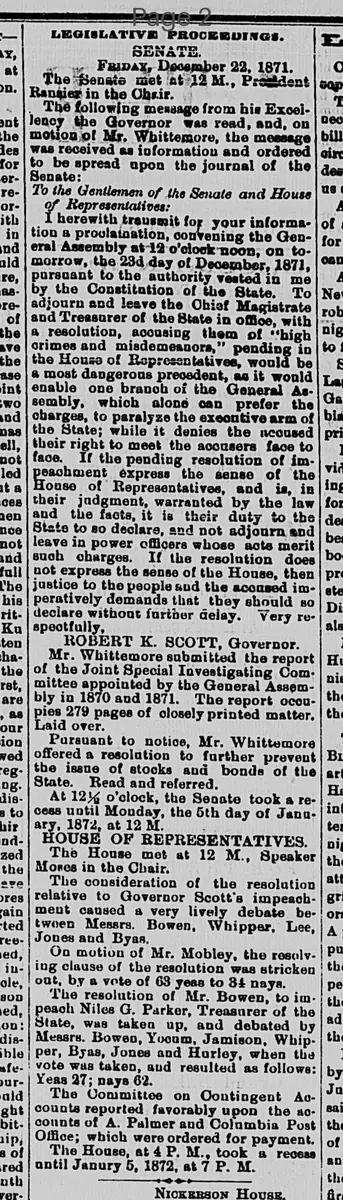
Senate.
Friday, December 22, 1871.
The Senate met at 12 M., President Ransier in the Chair.
The following message from his Excellency the Governor was read, and, on motion of Mr. Whittemore, the message was received as information and ordered to be spread upon the journal of the Senate:
To the Gentlemen of the Senate and House of Representatives:
I herewith transmit for your information a proclamation, convening the General Assembly at 12 o'clock noon, on to-morrow, the 23d day of December, 1871, pursuant to the authority vested in me by the Constitution of the State. To adjourn and leave the Chief Magistrate and Treasurer of the State in office, with a resolution, accusing them of "high crimes and misdemeanors," pending in the House of Representatives, would be a most dangerous precedent, as it would enable one branch of the General Assembly, which alone can prefer the charges, to paralyze the executive arm of the State; while it denies the accused their right to meet the accusers face to face. If the pending resolution of impeachment express the sense of the House of Representatives, and is, in their judgment, warranted by the law and the facts, it is their duty to the State to so declare, and not adjourn and leave in power officers whose acts merit such charges. If the resolution does not express the sense of the House, then justice to the people and the accused imperatively demands that they should so declare without further delay. Very respectfully,
ROBERT K. SCOTT, Governor.
Mr. Whittemore submitted the report of the Joint Special Investigating Committee appointed by the General Assembly in 1870 and 1871. The report occupies 279 pages of closely printed matter. Laid over.
Pursuant to notice, Mr. Whittemore offered a resolution to further prevent the issue of stocks and bonds of the State. Read and referred.
At 12½ o'clock, the Senate took a recess until Monday, the 5th day of January, 1872, at 12 M.
House of Representatives.
The House met at 12 M., Speaker Moses in the Chair.
The consideration of the resolution relative to Governor Scott's impeachment caused a very lively debate between Messrs. Bowen, Whipper, Lee, Jones and Byas.
On motion of Mr. Mobley, the resolving clause of the resolution was stricken out, by a vote of 63 yeas to 31 nays.
The resolution of Mr. Bowen, to impeach Niles G. Parker, Treasurer of the State, was taken up, and debated by Messrs. Bowen, Yooum, Jamison, Whipper, Byas, Jones and Hurley, when the vote was taken, and resulted as follows: Yeas 27; nays 62.
The Committee on Contingent Accounts reported favorably upon the accounts of A. Palmer and Columbia Post Office; which were ordered for payment.
The House, at 4 P. M., took a recess until January 5, 1872, at 7 P. M.
What sub-type of article is it?
What themes does it cover?
What keywords are associated?
What entities or persons were involved?
Where did it happen?
Story Details
Key Persons
Location
South Carolina
Event Date
December 22, 1871
Story Details
The Senate received and recorded Governor Scott's message opposing adjournment amid pending impeachment resolutions against him and Treasurer Parker. A committee report was submitted and laid over, and a resolution on state bonds was referred. The Senate recessed until January 5, 1872. In the House, debates on impeaching Scott and Parker resulted in defeats by votes of 63-31 and 62-27, respectively. Minor accounts were approved for payment, and the House recessed until January 5, 1872.