Thank you for visiting SNEWPapers!
Sign up free
The Potters Herald
East Liverpool, Columbiana County, Ohio
What is this article about?
Leon Henderson and businessmen urge Congress to repeal wartime sales taxes for consumer price cuts, job growth, and economic expansion, arguing benefits like $2B in savings outweigh $2.2B revenue loss through offsets including higher income taxes.
Clipping
OCR Quality
Full Text
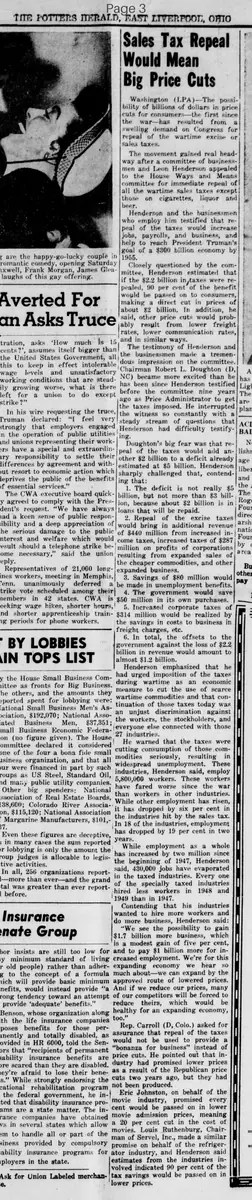
Sales Tax Repeal Would Mean Big Price Cuts
Washington (LPA)—The possibility of billions of dollars in price cuts for consumers—the first since the war—has resulted from a swelling demand on Congress for repeal of the wartime excise or sales taxes.
The movement gained real headway after a committee of businessmen and Leon Henderson appealed to the House Ways and Means committee for immediate repeal of all the wartime sales taxes except those on cigarettes, liquor and beer.
Henderson and the businessmen who employ him testified that repeal of the taxes would increase jobs, payrolls, and business, and help to reach President Truman's goal of a $300 billion economy by 1955.
Closely questioned by the committee, Henderson estimated that if the $2.2 billion in taxes were repealed, 90 per cent of the benefit would be passed on to consumers, making a direct cut in prices of about $2 billion. In addition, he said, other price cuts would probably result from lower freight rates, lower communication rates, and in similar ways.
The testimony of Henderson and all the businessmen made a tremendous impression on the committee. Chairman Robert L. Doughton (D, NC) became more excited than he has been since Henderson testified before the committee nine years ago as Price Administrator to get the taxes imposed. He interrupted the witness so constantly with a steady stream of questions that Henderson had difficulty testifying.
Doughton's big fear was that repeal of the taxes would add another $2 billion to a deficit already estimated at $5 billion. Henderson sharply challenged that, contending that:
1. The deficit is not really $5 billion, but not more than $3 billion, because about $2 billion is in loans that will be repaid.
2. Repeal of the excise taxes would bring in additional revenue of $440 million from increased income taxes, increased taxes of $287 million on profits of corporations resulting from expanded sales of the cheaper commodities, and other expanded business.
3. Savings of $80 million would be made in unemployment benefits.
4. The government would save $50 million in its own purchases.
5. Increased corporate taxes of $314 million would be realized by the savings in costs to business in freight charges. etc.
6. In total, the offsets to the government against the loss of $2.2 billion in revenue would amount to almost $1.2 billion.
Henderson emphasized that he had urged imposition of the taxes during wartime as an economic measure to cut the use of scarce wartime commodities and that continuation of those taxes today was an unjust discrimination against the workers, the stockholders, and everyone else connected with those 27 industries.
He warned that the taxes were cutting consumption of those commodities seriously, resulting in widespread unemployment. These industries, Henderson said, employ 5,800,000 workers. These workers have fared worse since the war than workers in other industries.
While other employment has risen, it has dropped by six per cent in the industries hit by the sales tax. In 18 of the industries, employment has dropped by 19 per cent in two years.
While employment as a whole has increased by two million since the beginning of 1947, Henderson said, 430,000 jobs have evaporated in the taxed industries. Every one of the specially taxed industries hired less workers in 1948 and 1949 than in 1947.
Contending that his industries wanted to hire more workers and do more business, Henderson said: "We see the possibility to gain $1.7 billion more business, which is a modest gain of five per cent, and to pay $1 billion more for increased employment. We're for this expanding economy we hear so much about—we can expand by the approved route of lowered prices.
And if we reduce our prices, many of our competitors will be forced to reduce theirs, which would be healthy for an expanding economy, too."
Rep. Carroll (D, Colo.) asked for assurance that repeal of the taxes would not be used to provide a "bonanza for business" instead of price cuts. He pointed out that industry had promised lower prices as a result of the Republican price cuts two years ago, but they had not been produced.
Eric Johnston, on behalf of the movie industry, promised every cent would be passed on in lower movie admission prices, meaning a 20 per cent cut in the cost of movies. Louis Ruthenburg, Chairman of Servel, Inc., made a similar promise on behalf of the refrigerator industry, and Henderson said estimates from the industries involved indicated 90 per cent of the tax savings would be passed on in lower prices.
What sub-type of article is it?
What themes does it cover?
What keywords are associated?
What entities or persons were involved?
Where did it happen?
Story Details
Key Persons
Location
Washington
Event Date
Post War Period, 1947 1949
Story Details
Businessmen and Leon Henderson testify before House Ways and Means Committee advocating repeal of wartime excise taxes (except on cigarettes, liquor, beer) to cut prices, increase jobs, and support economic growth to $300 billion by 1955. They estimate 90% of $2.2 billion tax savings passed to consumers, offsetting revenue loss through increased taxes and savings.