Thank you for visiting SNEWPapers!
Sign up free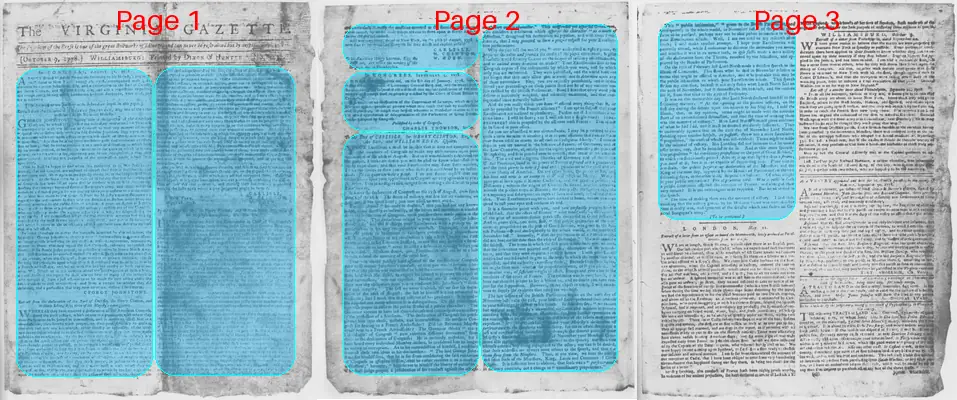
The Virginia Gazette
Richmond, Williamsburg, Richmond County, Virginia
What is this article about?
In October 1778, the Continental Congress reads and responds to declarations from British commissioners George Johnstone, Earl of Carlisle, Henry Clinton, and William Eden. They defend against accusations, demand release of Burgoyne's troops per Saratoga convention, and criticize Congress's alliance with France, while Congress rejects negotiations and upholds prior resolutions.
Merged-components note: These components form a single continuous story reporting on congressional proceedings, declarations from British commissioners, and a responsive letter regarding the Carlisle Commission and Saratoga Convention. Sequential reading order and direct text continuation across pages 1-3 confirm they belong to one logical unit focused on this diplomatic exchange.
Clippings
1 of 3
OCR Quality
Full Text
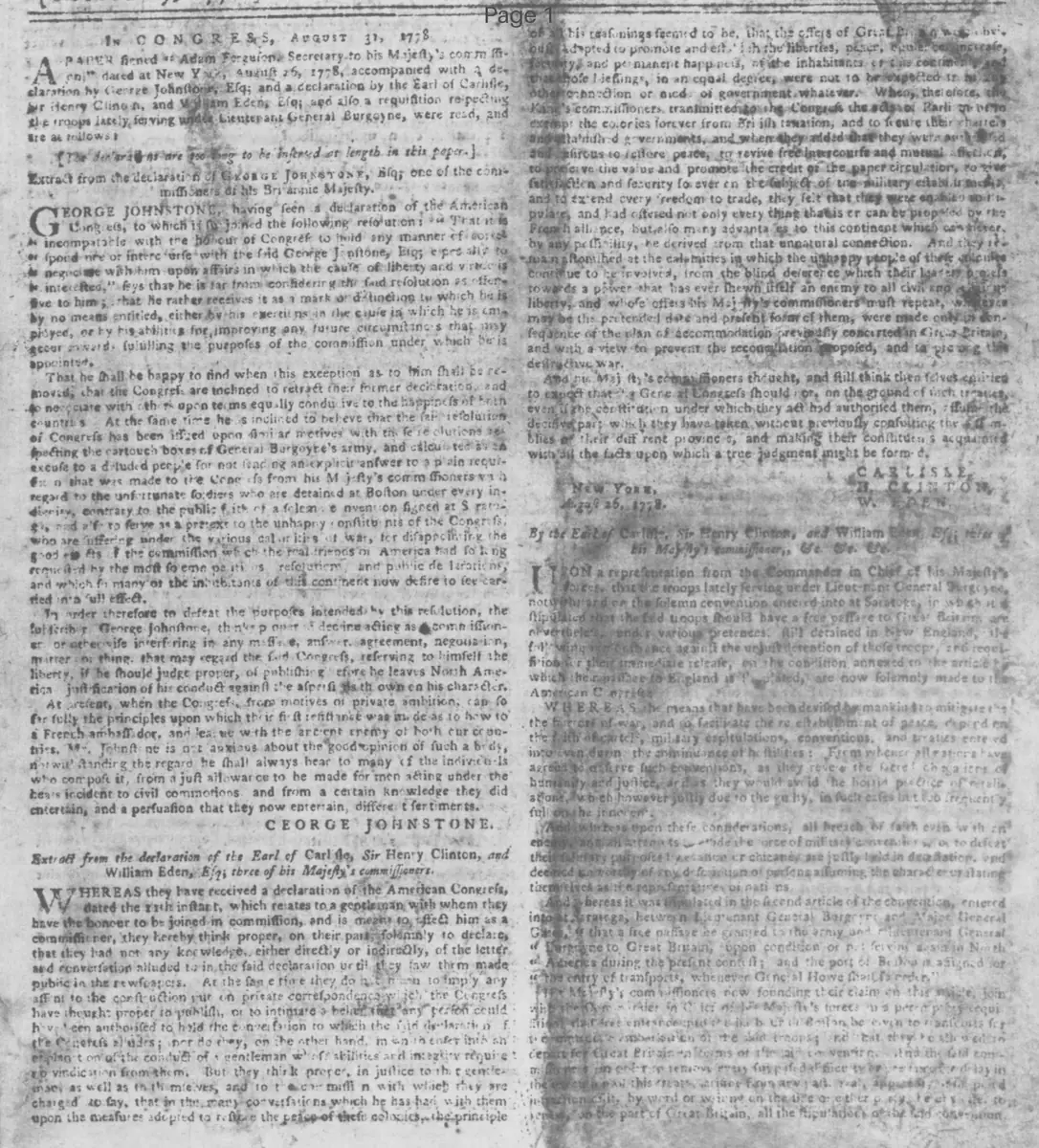
Papers signed Adam Ferguson, Secretary to his Majesty's commissioners, Henry Clinton, and William Eden, Esq; and also a requisition respecting declaration by George Johnstone, Esq; and a declaration by the Earl of Carlisle, dated at New York, August 26, 1778, accompanied with a declaration... The troops lately serving under Lieutenant General Burgoyne, were read, and
Resolved...
[The declarations are going to be inserted at length in this paper.]
Extract from the declaration of George Johnstone, Esq; one of the commissioners of his Britannic Majesty.
GEORGE JOHNSTONE, having seen a declaration of the American Congress, in which it is said to be incompatible with the honor of Congress to hold any manner of conference with the said George Johnstone, Esq; to which is subjoined the following resolution: "That it is not in the power of intercourse with the said George Johnstone, Esq; or to negotiate with him upon affairs in which the cause of liberty and America is interested," says that he is far from considering the said resolution as offensive to him; that he rather receives it as a mark of distinction to which he is by no means entitled, either by his exertions in the cause in which he is commissioned, fulfilling the purposes of the commission under which he is placed, or by his ability of improving any future circumstances that may appoint.
He declares that upon terms equally conducive to the happiness of both countries, he moved that the Congress are inclined to retract their former declaration, and that he shall be happy to find when this exception as to him shall be removed.
At the same time he is inclined to believe that the said resolution in Congress has been issued upon misinformation with respect to the conduct of General Burgoyne's army, and calculated to excuse to a deluded people or not ending an explicit answer to a plain requisition that was made to the Congress from his Majesty's commissioners with regard to the unfortunate soldiers who are detained at Boston under every indignity contrary to the public faith of the convention signed at Saratoga.
And to reserve a pretense to the unhappy situation of the Congress, who are suffering under the various calamities of war, for disparaging the good faith in the commission which the true interests of America had induced by the most solemn treaties and public declarations, and which many of the inhabitants of this continent now desire to see carried into full effect.
In order therefore to defeat the purposes intended by this resolution, the said George Johnstone thinks proper to declare that he will act no more as commissioner or otherwise interfering in any manner or thing that may regard the said Congress, reserving to himself the liberty, if he should judge proper, of publishing before he leaves North America a justification of his conduct against the aspersions thrown on his character.
At present, when the Congress, from motives of private ambition, seek to sully the principles upon which this just resistance was founded as to have to French ambassador, and even with the ancient enemy of both our countries. Mr. Johnstone is not anxious about the good opinion of such a body, notwithstanding the regard he shall always bear to many of the individuals who compose it, from a just allowance to be made for men acting under the ties incident to civil commotions and from a certain knowledge they did entertain, and a persuasion that they now entertain, different sentiments.
GEORGE JOHNSTONE.
Extract from the declaration of the Earl of Carlisle, Sir Henry Clinton, and William Eden, Esq; three of his Majesty's commissioners.
WHEREAS they have received a declaration of the American Congress, dated the 11th instant, which relates to a gentleman with whom they have the honor to be joined in commission, and is meant to set him as a commissioner, they hereby think proper, on their part, solemnly to declare, that they had not any knowledge, either directly or indirectly, of the letter and conversation alluded to in the said declaration until they saw them made public in the newspapers. At the same time they do not mean to imply any want to the connection but on private correspondence with the Congress have thought proper to publish, or to intimate a belief that any person could have been authorized to hold the conversation to which the said declaration of the Congress alludes. They do, on the other hand, manifest their acknowledgment of the explanation of the conduct of a gentleman of abilities and integrity entitled to vindication from them. But they think proper, in justice to that gentleman as well as to themselves, and to the commission with which they are charged, that in the many conversations which he has had with them upon the measures adopted to restore the peace of these colonies, the principle of all his meanings seemed to be, that the views of Great Britain would be adapted to promote and establish the liberties, peace, commerce, safety, and permanent happiness of the inhabitants of this continent; that of the two things, in an equal degree, were not so despaired of an union or aid of government whatever.
When, therefore, the King's commissioners transmitted to the Congress the said acts of Parliament to exempt the colonies forever from British taxation, and to secure their charter and established governments, and whereby added that they were armed and desirous to incline peace, to revive free intercourse and mutual affection, to preserve the value and promote the credit of the paper circulation, to give satisfaction and security forever on the subject of the military establishment, and to extend every freedom to trade, they felt that they were enabled to the public, and had offered not only everything that is or can be produced by the French alliance, but also many advantages to this continent which can hereafter by any possibility be derived from that unnatural connection. And they are astonished at the calamities in which the unhappy people of that deluded continent continue to be involved, from the blind deference which their leaders pay to a power that has ever shown itself an enemy to all civil and religious liberty, and whose offers his Majesty's commissioners must repeat, even may be the pretended date and present form of them, were made in consequence of the plan of accommodation previously concerted in Great Britain and with a view to prevent the recognition proposed, and a prelude to the defensive war.
And his Majesty's commissioners thought, and still think themselves entitled to expect that a General Congress should, on the ground of such treaties, even if the said commission under which they act had authorized them, judge the decisive part which they have taken without previously consulting the different provinces, and making their constituents acquainted with all the facts upon which a true judgment might be formed.
CARLISLE
New York,
CLINTON
Aug. 25, 1778.
EDEN.
By the Earl of Carlisle, Sir Henry Clinton, and William Eden, Esq; his Majesty's commissioners.
ON a representation from the Commander in Chief of his Majesty's forces, that the troops lately serving under Lieutenant General Burgoyne, now held by the solemn convention entered into at Saratoga, and it stipulated that the said troops should have free passage to Great Britain, nevertheless, under various pretenses, still retained in New England, in violation of the said convention, and in contravention of the unjust detention of those troops, to receive their immediate release, on the condition annexed to the article to which he captains to England is allied, are now solemnly made to the American Congress.
WHEREAS the means that have been devised by mankind to mitigate the horrors of war, and to facilitate the re-establishment of peace and order in the midst of obstacles, military capitulations, conventions, and grants entered into even during the animosities of the fiercest contests, from reverence paid to the character of human nature, all such conventions as they receive the sacred character of treaties, humanity and justice, as they would avoid the horrors proscribed by the laws of war, however justly due to the guilty, in such cases both to humanity.
And whereas upon these considerations, all breaches of or even attempts made to the force of military conventions are to defeat their salutary purpose in advance of chastity as justly liable in death sentence, and deemed sacredly of the prudence assuming the character of legislators or patriots.
Whereas it was stipulated in the second article of the convention, entered into at Saratoga, between Lieutenant General Burgoyne and Major General Gates, that a race nature engaged to the army under Lieutenant General Burgoyne to Great Britain, upon condition of not serving again in North America during the present contest; and the port of New York assigned or the country of transports, whenever General Howe shall so order.
His Majesty's commissioners now founding their claim on that mile, with the rather in Chief a joint Majesty's forces to purchase.
... [continuing the proclamation text with corrections for readability, preserving archaic forms]
[Omitted garbled section as it appears to be severe OCR error: darAre cnendeptd hbu h lon he evn to aneosts r p.caec wmsucn d. te hi (rnor rid tat they'eh vedn cepaey €ueat Prirain nloums ot eai~ venirn. nd th Gt em. re jm err r renn ey sipofdafice tyo wu diay in the eewei this natriaoefunarw jat.y-a,apput,.sptd ijshcn gi by wtd or wino cn theueoeta p aylectvdt. to en, do the partcf Creat Brain, all ihe tipu'hdoc oade d -bao-uun.]
And particularly to notify the detention annexed to the second article thereof above recited, by which these troops are not to serve again in North America during the present contest.
And a letter dated at New York, on the 26th of August, 1778, is now at one remove urges Congress for their direct and explicit answer.
CARLISLE.
H. CLINTON
To his Excellency Henry Laurens, Esqr.
President and others the members of the
Congress, Philadelphia.
W. EDEN.
CONGRESS,
SEPTEMBER 4, 1778.
WHEREAS Congress did, on the 6th day of January, 1778, resolve,
so that the
Convention of Lieutenant General Burgoyne, and the troops under
his command suspended till a distinct and explicit ratification of the con-
vention of Saratoga shall be properly notified by the Court of Great Britain to
Congress
that no notification of the Convention of Saratoga, which may be
in force in consequence of powers which may reach that case by construction
and implication, or which may subject whatever is granted relative to it to
the act of approbation or disapprobation of the Parliament of Great Britain,
can be conveyed by Congress.
Published by order of Congress.
CHARLES THOMSON, Secty.
To the Earl of CARLISLE, Sir HENRY CLINTON, Knight of
the Bath, and WILLIAM EDEN, Esquire,
YOUR Excellencies must be sensible that it does not comport with
the measures of Congress to make any observations upon your
declaration of the 26th of August. But as it was evidently calculated for
the people, I make no doubt you will be glad to know what effect it is
likely to produce; and that your Excellencies may form some opinion,
I take the liberty to show you in what light it is considered by an indivi-
dual: Paucis verbis quantum valere potest. I do not flatter myself that my
observations upon your applications to Congress are very agreeable to you:
However, I am in no degree discouraged from writing a third letter to your
Excellencies.
It seems the declaration of Congress on the 14th of August, drew forth
yours of the 16th. The storm of military war has lost its violence; on
your part it has spent itself; you now assail us with words.
You are pleased solemnly to declare, 'that you had not any know-
ledge either directly or indirectly, of the letters and conversation alluded
to in the declaration of Congress, until you saw them made public in the
newspapers.' This declaration related to your colleague, George John-
stone, Esq; nor did it charge your Excellencies with a privity to, or
participation in his very exceptionable conduct. Unaccused, you have
thought proper to endeavour to exculpate yourselves; a circumstance
which strongly brings to my recollection a rule which Charles the First
recommended to his favourite Stafford, as one that may serve for a states-
man, courtier or lover 'never to make a defence or apology before you
are accused.' Without doubt, your Excellencies will not be at a loss
to comprehend the meaning of the royal hint.
That you would publicly have assented to the construction Congress
have to Governor Johnstone's conduct, or that you would intimate a be-
lief that any person was authorized to hold the conversation stated to have
been held with Mr. Read, to engage his interest to promote the object of
'deceit and disunion.' The first we never doubted, till we saw his decla-
ration; there was any obligation upon you to vindicate Mr. Johnstone's 'abili-
ties' your commission, was not expected. Neither was it imagined, that
you would have descended to the meanness of your declaration of the 26th of August; the last he himself has not attempted to
vindicate; and I make this an instance of his prudence: It is lauda-
ble. It is also proper to observe the duties of a public character: The
public is to point out merit wherever it is distinguished. On the other hand,
the Governor appears to have lost that calmness and circumspection necessary
in the profession of a statesman.
The declaration of Congress has preci-
pitated him into abuse, mistake, and contradiction.
He censures Con-
gress for bowing to a French Ambassador!
Did his Britannic
Majesty
never bow to a French Ambassador?
The Governor thinks
many
individuals of Congress
now entertain different sentiments
from
those in the declaration of Congress. He is certainly mistaken, for I
am an enemy to corruption. As to his contradiction of himself, I need only
have heard every individual Member declare, he considered him no longer
Contract these two ideas in his declaration: 'The said George John-
stone for himself says, that he is far from considering the said resolution
'of Congress as offensive to him, that he rather receives it as a mark of
distinction:' however, 'he reserves to himself the liberty of publishing.
if he shall judge proper, a justification of his conduct against the asperi-
aspersions thrown on his character.'
This is our foppish yet affected Gentleman,
who considers a resolution which asperses his character 'as a mark of
distinction,' draughted his declaration ad populum, and with them I will
leave it, that I may proceed to show a proper respect for your Excel-
cies performance,
Why do you tell the world you 'were authorized to restore peace,
preserve the value and promote the credit of the paper circulation, to give
satisfaction and security forever on the selves of military establishments,
and to extend every freedom to trade?' Your Excellencies sent to the
Congress copies of the instruments by which you were, and by which
only you are authorized. They were published, and the world have not
yet forgot that they only allow you to treat, not to determine upon any
of those particulars. Nay, you are expressly prohibited, and it is de-
clared your proceedings on those points shall not be of any validity uns
less ratified by the British Parliament. Need I hint that every word you
deliver is accurately weighed, and critically examined, and that con-
sequential ideas naturally follow
And do you really think you have 'offered every thing that is, or
can be proposed by the French alliance?' I am apt to suspect that your
Excellencies are inclined to pleasantry. Pardon me if I introduce a se-
rious idea; I will be short; may I use but a single word: Inde-
pendence! this is proposed by the alliance with France: It is not
to be found in your offers.
As you are astonished at one circumstance, I may be permitted to ex-
press a little surprise at another: it is at your assertion that France 'has
ever shewn itself an enemy to all civil and religious liberty.' I cannot
suppose you are unread in the histories of France, of Germany, and of
this Low Countries, especially for the eighty years preceding the peace of
Westphalia; and it is painful even to remark, that there is an alter-
native. The civil and religious liberties of Germany and of the Low
Countries found in the power of France a friend and a guarantee;
and the same power is now a friend and a guarantee to the civil and re-
ligious liberty of America. On the other hand, the power of England
has been and now is an enemy to civil and religious liberty. Witness
your penal laws against Roman Catholics, and the rejected petition of
Dissenters; witness the reigns of Charles the Second and his successor
witness the present reign in Britain; the stamp act, the Quebec bill, the
contemporary and subsequent outrages of laws and arms, against Ame-
rica. Your Excellencies ought to have looked at home, before you ven-
tured to cast your eyes and censures abroad.
It is a favourite point with you, and you constantly press to have it
established, that the offers of France 'were made only in consequence
of the plan of accommodation previously concerted in Great Britain.'
And to prove this, you aver, first, 'that public intimation of the con-
ciliatory propositions on the part of Great Britain, was given to the Bri-
tish Parliament and consequently to the whole world, in the month of
November last.' Secondly, 'that the preliminaries of a French treaty,
did not bear earlier date than the 6th of December.' We will examine
the subject. The terms in which the first point is couched, give an idea,
that the intimation was pointed and punctual, descriptive of the proposi-
tions, and that they were important in their nature I wish your Excel-
lencies had condescended to give us the terms in which the intimation was
expressed, and the authority expressing them. Because from these lights,
we might have seen, whether the propositions were, or if you please, the
intimation was, of sufficient weight to affect, change and give a tone to the
measures of the court of France. The evidence was in your hands, you
have not thought proper to lay it before us, and no doubt you have rea-
sons for the suppression. However, as my object is truth, I will endea-
vour to supply the evidence that you have withheld.
The late session of the British Parliament began on the 26th day of
November last. On the 27th, your house of Lords presented their address
to your Sovereign in answer to his speech. In that they say, 'we cannot
but applaud your Majesty's unwearied vigilance and wisdom in reco-
mmending to us, to provide at all events, for such further operations as
perseverance in the measures now pursuing, for the re-establishment of a
just and constitutional obedience through the several parts of your
dominion' On the 3d of December your House of Com-
mons also presented their address in answer to the speech; nor does this
address contain any thing repugnant to the other; nor can it be denied,
that these addresses are always mere echoes to the speech, and that the
three flow from the Ministers. Thus, at one view, we have the public
and joint sense of the Ministers, King, Lords and Commons of Great
Britain. It is sufficient here to observe, that sense was a 'perseverance'
in military coercion, not a charge to 'conciliatory propositions.'
This "public intimation," given to the British Parliament, and consequently to the whole world, in November last, "of the public measures to be pursued," perhaps may not be that public intimation to which your Excellencies allude. Well, I am not tired in my research after truth; I will make another attempt. I hope your Excellencies will patiently attend, while I endeavour to discover the intimation you mean, and whether it was in its nature such, as ipso facto made a mere nullity of the declaration from the Throne, couched by the Ministers, and approved by the Houses of Parliament.
On the 17th of February last Lord North made a decisive speech in the House of Commons. This states what he said in November relative to terms that might be offered to America, and it is probable this may be what strikes my attention, because it not only states what Lord North said on the public intimation to which your Excellencies allude. This speech of the 20th of November, but it demonstrates his conduct and the reasons for it, from that time to the 27th of February.
It was on this memorable day that Lord North declared himself in the following manner: "At the opening of the present sessions, on the first day during the debate upon the address to his Majesty, I told the House, that, in my opinion, terms might be made with the colonies short of an unconditioned submission, and that the time of making them was the moment of victory." Here Lord North himself gives evidence of what he had said, and it must be deemed absolutely sufficient. Thus it undeniably appears that on the 20th day of November Lord North, speaking upon another subject, en passant, threw out a mere speculative in the moment of victory. His Lordship did not intimate that he would "proposition," the truth of which was self-evident: Terms might be made
And is this mere speculative proposition the conciliatory propositions on the part of Great Britain, to which you so anxiously point? Already it appears lighter than a feather; you catch at it, but it is not capable of supporting you. Place this in one scale, the public persevering declaration of the Ministers and the following days, in the other scale, suspend the balance. Of what weight a public intimation affected the councils of France, and charged their King of the same day, approved by the Houses of Parliament (in the two is your public intimation? Vox et praeterea nihil. Was it possible such very natural It is too extravagant to be supposed. But let us attend to the speech.
thinking that the victory gained by Sir William Howe was more decisive than it really was, and ignorant of the disaster which had fallen on General Burgoyne's army."
The time of making them was the moment of victory. I said this,
(To be continued.)
What sub-type of article is it?
What themes does it cover?
What keywords are associated?
What entities or persons were involved?
Where did it happen?
Story Details
Key Persons
Location
New York, Philadelphia, Boston
Event Date
1778 08 26 To 1778 10 11
Story Details
British commissioners issue declarations defending George Johnstone against Congress's refusal to negotiate with him, demanding release of Burgoyne's troops per Saratoga convention, and criticizing the French alliance; Congress responds by upholding resolutions and rejecting British offers lacking independence.