Thank you for visiting SNEWPapers!
Sign up free
Winchester Gazette
Winchester, Virginia
What is this article about?
A letter from near Hamburg dated June 25 describes the city's misery under French occupation after a failed defense, with fortifications, martial law, arrests, and an unpaid 48 million contribution. It laments the flight of leader Van Hesse, critiques alliances involving Prussians, Russians, Swedes, Danes, and British, and hopes for peace amid Napoleonic oppression.
Merged-components note: Merged continuation of Hamburg letter on European political events.
Clipping
OCR Quality
Full Text
N. Y. Herald,
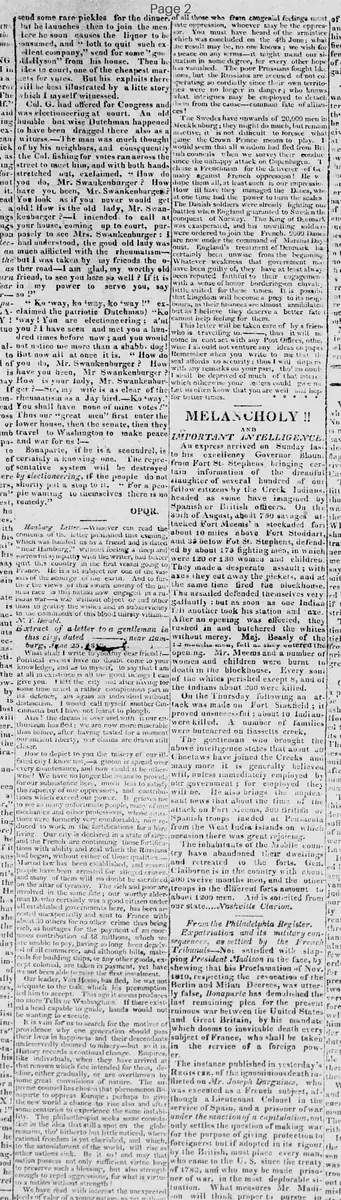
Extract of a letter to a gentleman in this city, dated near Hamburg, June 25th.
What shall I write to you my dear friend?-- Political events have no doubt come to your knowledge, and as to myself, to say that I am at all in existence is all the good tidings I can give you. I left the city and after having for some time acted a rather conspicuous part in its defence, am again an individual without distinction. I would call myself another Cincinnatus but I have not learnt to plough.
Alas! the dream is over and with it our enthusiasm has fled: we are now more miserable than before, after having tasted for a moment our ancient liberty, our chains are drawn still closer.
How to depict to you the misery of our ill-fated city I know not--a gloom is spread over every countenance, and how could it be otherwise? We have no longer the means to provide for our subsistence here, much less to satisfy the rapacity of our oppressors, and contributions which exceed our power. It grieves me to see so many unfortunate people, many of our mechanics and other professions, whose situations were formerly very comfortable, now reduced to work in the fortifications for a bare living. Our city is declared in a state of siege and the French are continuing those fortifications with ability and zeal which the Russians had began, without either of those qualities-- Martial law has been established, and several people have been arrested for alleged crimes. and many of them will no doubt be sacrificed on the altar of tyranny. The rich and poor are involved in the same fate: our worthy alderman D. who certainly was a good citizen under all established governments here, has been arrested unexpectedly and sent to France with about 30 others for no other crime than being rich, as hostages for the payment of an enormous contribution of 48 millions, which we are unable to pay, having so long been deprived of all commerce, and although bills, materials for building ships, or any other goods, except colonial, are taken in payment, yet have we not been able to raise the first instalment.
Our leader, Van Hesse, has fled, he was not adequate to the task which his presumption led him to accept. This age it seems produces no more Tells or Washingtons. If there existed a head capable to guide, hands would not be wanting to execute.
It is vain for us to search for the motives of providence why one generation should pass their lives in happiness and their descendants undeservedly doomed to misery--but so it is. History records a continual change. Empires, like individuals, when they have arrived at that renown which fate intended for them, decline, either gradually, or are overthrown by some great convulsions of nature. The supreme counsel has chosen that phenomenon Bonaparte to oppress Europe: perhaps to give the new world a chance to rise also and after some centuries to experience the same instability. The philanthropist seeks some consolation in the idea that still a spot on the globe remains, tho' hitherto but little noticed, where rational freedom is yet cherished, and which, to the astonishment of the world, will rise as other nations sink. Be it so! and may that nation possess not only sufficient virtue long to preserve such a blessing, but also strength enough to repel aggressions, for what is virtue to a nation without strength?
We have read with interest the unexpected display of valor of a young nation, as yet without character or reputation, but who dared to assert her rights against the colossal power of the mistress of the ocean. Where conquest is not her object, she will have the good wishes
of all those who from congenial feelings must hate oppression, whoever may be the oppressor. You must have heard of the armistice which was concluded on the 4th June: what the result may be, no one knows; we wish for a peace on any terms--it might mend our situation in some degree, for every other hope has vanished. The poor Prussians fought like lions, but the Russians are accused of not cooperating so cordially since their own territories were no longer in danger: who knows what intrigues may be employed to detach them from the cause--common fate of alliances!
The Swedes have upwards of 20,000 men in Mecklenburg: they might do much, but remain inactive; it is not difficult to foresee what game the Crown Prince means to play. It would seem that all wisdom had fled from British councils when we survey their conduct since the unhappy attack on Copenhagen. To chase a Frenchman for the deliverer -of Germany against French oppression! He will dupe them all, at least such is our impression. How ill have they managed the Danes, who at one time had the power to turn the scales. The Danish soldiers were already fighting our battles when England guaranteed to Sweden the conquest of Norway. The King of Denmark was exasperated, and his unwilling soldiers were ordered to join the French. 3000 Danes are now under the command of Marshal Davoust. England's treatment of Denmark has certainly been unwise from the beginning. Whatever weakness that government may have been guilty of, they have at least always been reputed faithful to their engagements. with a sense of honor bordering-on chivalry little suited for these times. It is possible that kingdom will become a prey to its neighbors, as their finances are almost annihilated but as I believe they deserve a better fate I cannot help feeling for them.
This letter will be taken care of by a friend who is traveling to.-- thus it will not come in contact with any Post Offices, otherwise I should not venture any ideas on paper. Remember when you write to me that the seal affords no security: thus I will disperse with any remarks on your part, tho' no doubt I shall be deprived of much of that interest which otherwise your letters could give me. Let us often know that you are well and hope for better times.
What sub-type of article is it?
What keywords are associated?
What entities or persons were involved?
Where did it happen?
Foreign News Details
Primary Location
Hamburg
Event Date
June 25th
Key Persons
Outcome
city in state of siege; martial law established; several arrests including alderman d. and 30 others sent to france as hostages for 48 million contribution (unpaid first installment); leader van hesse fled; armistice concluded on 4th june; prussians fought valiantly but russians uncooperative; swedes inactive in mecklenburg; 3000 danes under davoust.
Event Details
Letter from near Hamburg details the writer's role in the city's defense before its fall to French forces, now under siege with continued fortifications, martial law, and economic hardship. Residents, including mechanics, forced to labor for subsistence; rich targeted as hostages for unpaid contributions. Broader commentary on failed alliances, Prussian defeat, Russian inaction, Swedish inactivity, British mishandling of Danes, and hope for peace amid Napoleonic oppression in Europe.