Thank you for visiting SNEWPapers!
Sign up free
The Rhode Island American, And General Advertiser
Providence, Providence County, Rhode Island
What is this article about?
London report on British military expedition to Baltimore in September 1814, where troops under General Ross engaged and dispersed American forces but withdrew after Ross's death and lack of naval support; notes prior successful capture of Washington.
Clipping
OCR Quality
Full Text
Dispatch vessel
New-York.
America.
LONDON, October .
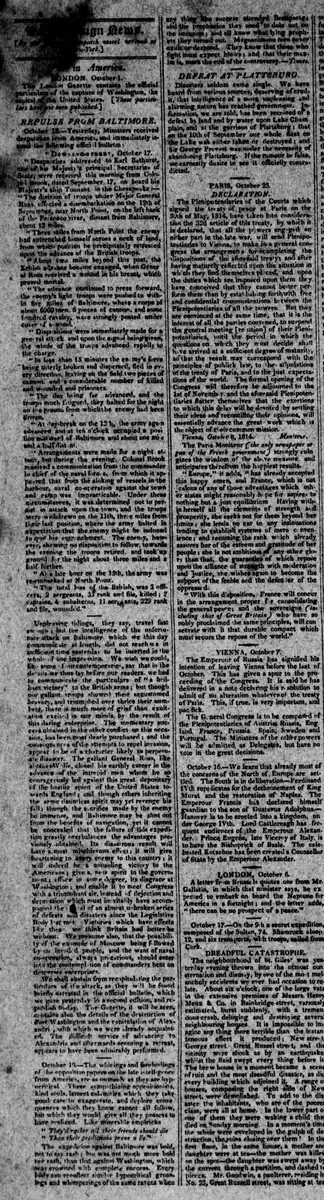
The London Gazette contains the official particulars of the capture of Washington, the capital of the United States. [These particulars have not been published.]
REPULSE FROM BALTIMORE.
October 18. Yesterday, Ministers received despatches from America, and immediately issued the following official bulletin:
"Despatches addressed to Earl Bathurst, one of his Majesty's principal Secretaries of State, were received this morning from Colonel Brook, dated September 17, on board his Majesty's ship Tonnant in the Chesapeake;
"The division of troops under Major General Ross, effected a disembarkation on the 12th of September, near North Point, on the left bank of the Patapsco river, distant from Baltimore about 13 miles.
"Three miles from North Point the enemy had entrenched himself across a neck of land, from which position he precipitately retreated upon the advance of the British troops.
About two miles beyond this post, the British advance became engaged, when General Ross received a wound in his breast, which proved mortal.
The advance continued to press forward. The enemy's light troops were pushed to within five miles of Baltimore, where a corps of about 6000 men, 6 pieces of cannon, and some hundred cavalry, were strongly posted under cover of a wood.
Dispositions were immediately made for general attack, and upon the signal being given, the whole of the troops advanced rapidly to the charge."
In less than 15 minutes the enemy's force being utterly broken and dispersed, fled in every direction, leaving on the field two pieces of cannon, and a considerable number of killed and wounded and prisoners.
The day being far advanced, and the troops much fatigued, they halted for the night on the ground which the enemy had been driven,
At day-break on the 13th, the army again advanced, and at ten o'clock occupied a position eastward of Baltimore and about one mile and a half distant.
Arrangements were made for a night attack, but during the evening, Colonel Brook received a communication from the commander in chief of the naval force, from which it appeared that from the sinking of vessels in the harbour, naval co-operation against the town and camp was impracticable. Under these circumstances, it was determined not to persist in attack upon the town, and the troops were withdrawn on the 14th, three miles from their last position, where the army halted in expectation that the enemy might be induced to quit his entrenchment. The enemy, however, showing no disposition to follow, towards the evening the troops retired, and took up ground for the night about three miles and half further.
At a late hour on the 15th, the army was re-embarked at North Point.
The total loss of the British, was 3 officers, 2 sergeants, 35 rank and file, killed; 7 Captains, 4 subalterns, 11 sergeants, 229 rank and file, wounded."
Unpleasing tidings, they say, travel fast enough; but the intelligence of the unfortunate attack on Baltimore, which we this day communicate at length, did not reach us in sufficient time yesterday to be inserted in the whole of one impression. We wish we could, like some of our contemporaries, say that in the details we this day lay before our readers, we had to communicate the particulars of "brilliant victory" to the British arms; but though our gallant troops showed their accustomed bravery, and triumphed over thrice their number, there is much more of grief than exultation excited in our minds, by the result of this daring enterprise. The momentary success obtained in the other conflict on this occasion, has been most dearly purchased; and the consequences of the attempts to repel invasion, appear to be of a character likely to perpetuate disaster. The gallant General Ross, like his brother, closed his earthly career in the advance of the intrepid men whom he so courageously led against this great depositary of the hostile spirit of the United States, towards England; and though others inheriting the same dauntless spirit may yet revenge his fall; though the sacrifice made by the enemy be immense, and Baltimore may be shut out from the benefits of navigation, yet it cannot be concealed that the failure of this expedition greatly overbalances the advantages previously obtained. Its disastrous result will have a most mischievous effect; it will give heartening to every enemy to this country: it will indeed be a consoling victory to the Americans; give a new spirit to the government; efface in some degree, its disgrace at Washington; and enable it to meet Congress with a triumphant air, instead of dejection and depression which must inevitably have accompanied the fall of an almost unbroken series of defeats and disasters since the Legislative Body last met. Victories which have effect like these we think Britain had better be without. We presume also, that the possibility of the example of Moscow being followed by an invaded people, and the want of naval co-operation, always precarious, should enter into the contemplation of commanders bent on desperate enterprises.
We shall abstain from recapitulating the particulars of the attack, as they will be found briefly narrated in the official bulletin, which we gave yesterday in a second edition; and re-publish to-day. The Gazette, it will be seen, contains also the details of the destruction of Fort Washington and the capitulation of Alexandria, with which we were already acquainted. The difficult service of advancing to Alexandria and afterwards securing a retreat appears to have been admirably performed.
October 19.--The whinings and forebodings of the opposition papers on the late intelligence from America, are as common as they are hypocritical. These sympathizing oppositionists, kind souls, lament calamities which they take good care to exaggerate, and deplore consequences which they know cannot all follow, but which they would give all they possess to have realized. Like miserable empiricks
"They'd rather all their friends should die
Than their predictions prove a lie."
The expedition against Baltimore was bold, not to say rash; but was not much more bold nor rash, than that against Washington, which was crowned with complete success. Everybody can recollect similar hypocritical groanings and whimperings of the same ravens when anything like success attended Bonaparte's and the prophecies they used to dole out on the occasion; and all know what lying prophets they turned out. Magnanimous men never exult or despond. They know that those who fight must expect blows- and that their maxim is, mark this end of the controversy,--fines.
What sub-type of article is it?
What keywords are associated?
What entities or persons were involved?
Where did it happen?
Foreign News Details
Primary Location
Baltimore, United States
Event Date
September 12 15, 1814
Key Persons
Outcome
british losses: 3 officers, 2 sergeants, 35 rank and file killed; 7 captains, 4 subalterns, 11 sergeants, 229 rank and file wounded. enemy left two pieces of cannon, considerable number killed, wounded, and prisoners. troops withdrawn due to lack of naval cooperation.
Event Details
British troops under Major General Ross disembarked near North Point on September 12. Enemy retreated from entrenchments. Ross mortally wounded in engagement. British advanced to within five miles of Baltimore, charged enemy force of 6000 men, 6 cannon, cavalry, dispersing them. Halted for night. On September 13, advanced to position near Baltimore but night attack abandoned due to sunk vessels preventing naval support. Withdrew on September 14, re-embarked September 15. References prior capture of Washington and actions at Fort Washington and Alexandria.