Thank you for visiting SNEWPapers!
Sign up free
The Ypsilanti Daily Press
Ypsilanti, Washtenaw County, Michigan
What is this article about?
In Washington on June 16, the House approved a resolution in committee endorsing U.S. participation in international machinery for post-war peace, sparking isolationist opposition from Midwest Republicans like Rep. Short, while Democrats like McCormack and Fulbright praised it; Senate cautious.
Clipping
OCR Quality
Full Text
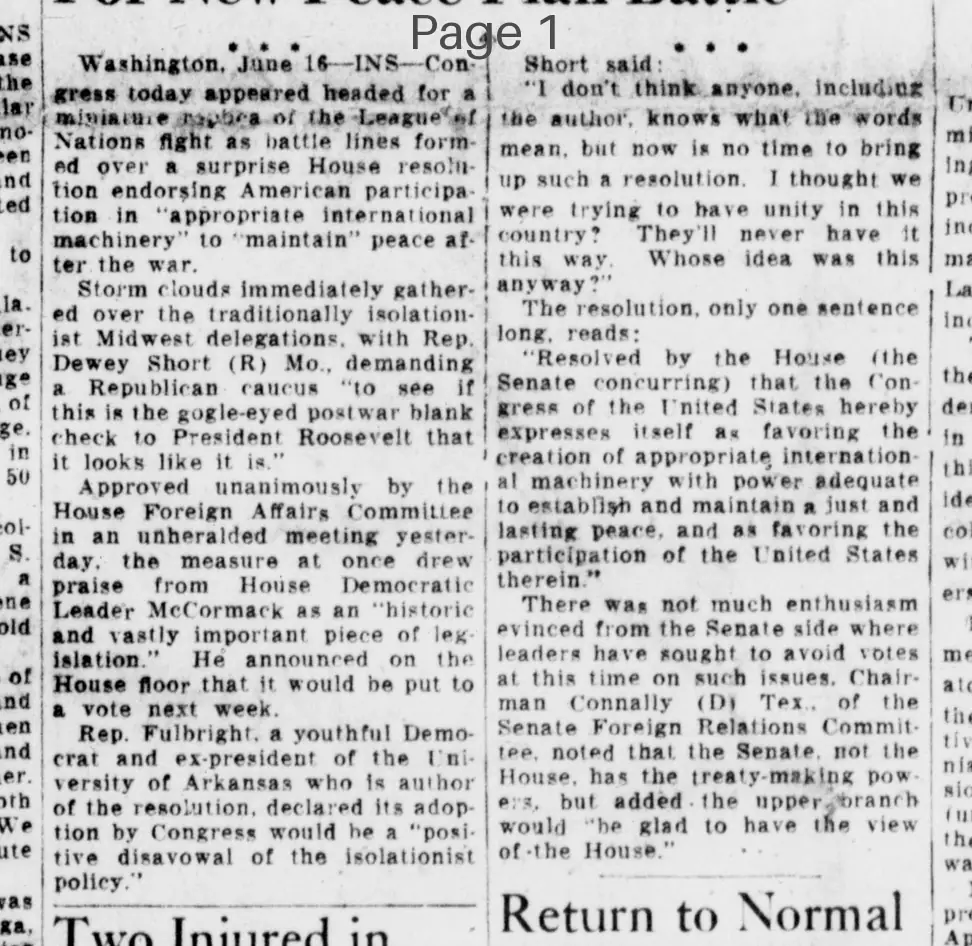
Approved unanimously by the House Foreign Affairs Committee in an unheralded meeting yesterday, the measure at once drew praise from House Democratic Leader McCormack as an "historic and vastly important piece of legislation." He announced on the House floor that it would be put to a vote next week. Rep. Fulbright, a youthful Democrat and ex-president of the University of Arkansas who is author of the resolution, declared its adoption by Congress would be a "positive disavowal of the isolationist policy."
I don't think anyone, including the author, knows what the words mean, but now is no time to bring up such a resolution. I thought we were trying to have unity in this country? They'll never have it this way. Whose idea was this anyway?
The resolution, only one sentence long, reads: "Resolved by the House (the Senate concurring) that the Congress of the United States hereby expresses itself as favoring the creation of appropriate international machinery with power adequate to establish and maintain a just and lasting peace, and as favoring the participation of the United States therein."
There was not much enthusiasm evinced from the Senate side where leaders have sought to avoid votes at this time on such issues. Chairman Connally (D) Tex. of the Senate Foreign Relations Committee, noted that the Senate, not the House, has the treaty-making powers, but added the upper branch would "be glad to have the view of the House."
What sub-type of article is it?
What keywords are associated?
What entities or persons were involved?
Where did it happen?
Domestic News Details
Primary Location
Washington
Event Date
June 16
Key Persons
Outcome
approved unanimously by the house foreign affairs committee; scheduled for house vote next week; senate leaders avoiding votes on such issues but open to house view.
Event Details
Congress appeared headed for a rehash of the League of Nations fight over a House resolution endorsing American participation in appropriate international machinery to maintain peace after the war. Rep. Dewey Short demanded a Republican caucus, calling it a postwar blank check to President Roosevelt. House Democratic Leader McCormack praised it as historic legislation. Rep. Fulbright, author of the resolution, declared it a disavowal of isolationist policy. The resolution reads: Resolved by the House (the Senate concurring) that the Congress of the United States hereby expresses itself as favoring the creation of appropriate international machinery with power adequate to establish and maintain a just and lasting peace, and as favoring the participation of the United States therein. Senate leaders showed little enthusiasm.