Thank you for visiting SNEWPapers!
Sign up free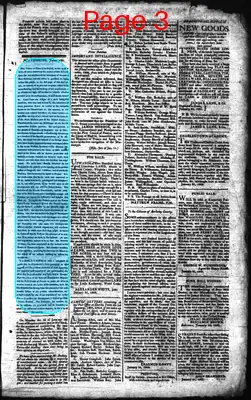
Berkeley And Jefferson Intelligencer
Martinsburg, Berkeley County, Virginia
What is this article about?
Editorial from Martinsburg on January 21 discusses the Spanish Intendant's closure of New Orleans port, violating a treaty and threatening Western U.S. trade via the Mississippi. Links it to France's recent cession of Louisiana, Bonaparte's ambitions, and calls for firm U.S. government action, including Monroe's negotiations.
Clipping
OCR Quality
Full Text
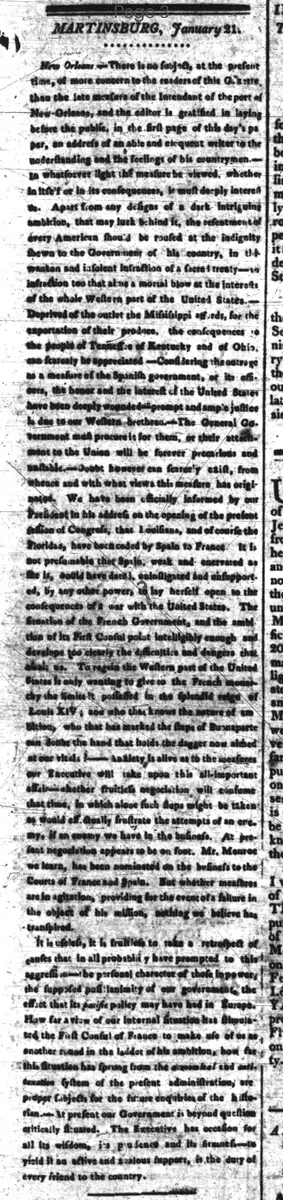
New Orleans. There is no subject, at the present time, of more concern to the readers of this Gazette than the late measure of the Intendant of the port of New-Orleans—and the editor is gratified in laying before the public, in the first page of this day's paper, an address of an able and eloquent writer to the understanding and the feelings of his countrymen.—In whatever light the measure be viewed, whether in itself or in its consequences, it must deeply interest us. Apart from any designs of a dark, intriguing ambition, that may lurk behind it, the resentment of every American should be roused at the indignity offered to the Government of his country, in this wanton and insolent infraction of a sacred treaty—in infraction too that aims a mortal blow at the interests of the whole Western part of the United States. Deprived of the outlet the Mississippi affords, for the exportation of their produce, the consequences to the people of Tennessee, of Kentucky and of Ohio, can scarcely be appreciated. Considering the outrage as a measure of the Spanish government, or its officers, the honor and the interest of the United States have been deeply wounded—a prompt and ample justice is due to our Western brethren. The General Government must procure it for them, or their attachment to the Union will be forever precarious and unstable. No doubt however can scarcely exist, from whence and with what views this measure has originated. We have been officially informed by our President in his address on the opening of the present session of Congress, that Louisiana, and of course the Floridas, have ceded by Spain to France. It is not presumable that Spain, weak and enervated as she is, could have dared, uninfatuated and unsupported by any other power, to lay herself open to the consequences of war with the United States. The situation of the French Government and the ambition of its First Consul point intelligibly enough and develope too clearly the difficulties and dangers that wait now a reason the Western part of the United States. Is only wanting to give to the French monarchy the limit it possessed in the splendid reign of Louis XIV and who that knows the nature of ambition who that has marked the steps of Bonaparte can doubt the hand that holds the dagger now aimed at our vitals? Anxiety is alive as to the measures our Executive will take upon this all-important affair—whether fruitless negociation will consume that time, in which alone such steps might be taken as would effectually frustrate the attempts of an enemy we have in the business. At present negociation appears to be on foot. Mr. Monroe we learn, has been nominated on the business to the Courts of France and Spain. But whether measures are in agitation, providing for the event of a failure in the object of his mission, nothing we believe has transpired.
It is useless, it is fruitless to take retrospect of causes that in all probability have prompted to this aggression—the personal character of those in power, the supposed pusillanimity of our government the effect that its pacific policy may have had in Europe. How far a view of our internal situation has stimulated the First Consul of France to make use of us as another round in the ladder of his ambition, how far this delusion has sprung from the contract and anti-taxation system of the present administration, are proper subjects for the future enquiries of the historian. At present our Government is beyond question critically situated. The Executive has occasion for all its wisdom, its prudence and its firmness—to yield it an active and zealous support, is the duty of every friend to the country.
What sub-type of article is it?
What keywords are associated?
What entities or persons were involved?
Where did it happen?
Domestic News Details
Primary Location
New Orleans
Event Date
January 21
Key Persons
Outcome
infraction of treaty wounding u.s. honor and interests; potential economic harm to tennessee, kentucky, ohio via loss of mississippi export outlet; risk of unstable union attachment; ongoing negotiations with france and spain.
Event Details
The Intendant of New Orleans port enacted a measure infringing on a sacred treaty, closing access and striking at Western U.S. interests. Linked to Spain's cession of Louisiana and Floridas to France, seen as Bonaparte's ambition to expand French territory. U.S. President informed Congress; Mr. Monroe nominated for negotiations; calls for firm executive action to prevent war and secure justice.