Thank you for visiting SNEWPapers!
Sign up free
Letter to Editor
March 3, 1790
Gazette Of The United States
New York, New York County, New York
What is this article about?
A Connecticut man writes to Mr. Fenno opposing the reduction of public debt interest from 6% to 4% as suggested in the Treasury Secretary's report. He argues for justice in honoring original contracts, obtaining fair creditor consent, and preserving national credit to ensure government stability.
Clipping
OCR Quality
98%
Excellent
Full Text
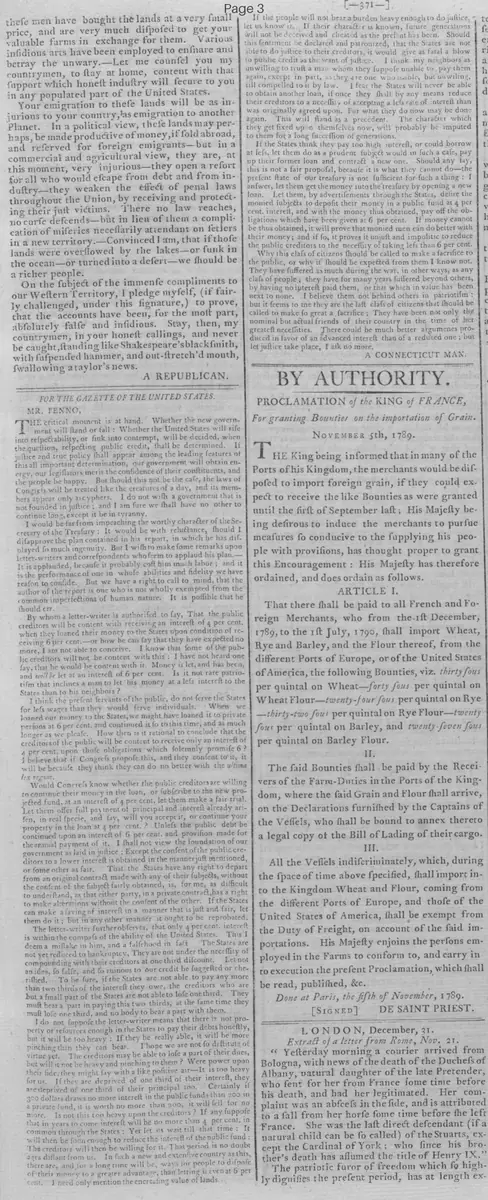
FOR THE GAZETTE OF THE UNITED STATES.
MR. FENNO,
The critical moment is at hand. Whether the new government will stand or fall: Whether the United States will rise into respectability, or sink into contempt, will be decided, when the question, respecting public credit, shall be determined. If justice and true policy shall appear among the leading features of this all important determination, our government will obtain energy, our legislators merit the confidence of their constituents, and the people be happy. But should this not be the case, the laws of Congress will be treated like the creatures of a day, and its members appear only as ciphers. I do not wish a government that is not founded in justice; and I am sure we shall have no other to continue long, except it be in tyranny.
I would be far from impeaching the worthy character of the Secretary of the Treasury: It would be with reluctance, should I disapprove the plan contained in his report, in which he has displayed so much ingenuity. But I wish to make some remarks upon it. It is applauded, because it probably cost him much labor; and it is the performance of one in whose abilities and fidelity we have reason to confide. But we have a right to call to mind, that the author of the report is one who is not wholly exempted from the common imperfections of human nature. It is possible that he should err.
By whom a letter-writer is authorised to say, That the public creditors will be content with receiving an interest of 4 per cent. when they loaned their money to the States upon condition of receiving 6 per cent.—or how he can say that they have expected no more, I am not able to conceive. I know that some of the public creditors will not be content with this: I have not heard one say, that he would be content with it. Money is let, and has been, and will be let at an interest of 6 per cent. Is it not rare patriotism that inclines a man to let his money at a less interest to the States than to his neighbors?
I think the present servants of the public, do not serve the States for less wages than they would serve individuals. When we loaned our money to the States, we might have loaned it to private persons at 6 per cent. and continued it so to this time, and as much longer as we please. How then is it rational to conclude that the creditors of the public will be content to receive only an interest of 4 per cent. upon those obligations which solemnly promise 6?
I believe that if Congress propose this, and they consent to it, it will be because they think they can do no better with the ultima lex regum.
Would Congress know whether the public creditors are willing to continue their money in the loan, or subscribe to the new projected fund, at an interest of 4 per cent. let them make a fair trial. Let them offer full payment of principal and interest already arisen, in real specie, and say, will you accept it, or continue your property in the loan at 4 per cent.? Unless the public debt be continued upon an interest of 6 per cent. and provision made for the annual payment of it, I shall not view the foundation of our government as laid in justice: Except the consent of the public creditors to a lower interest is obtained in the manner just mentioned, or some other as fair. That the States have any right to depart from an original contract made with any of their subjects, without the consent of the subject fairly obtained, is, for me, as difficult to understand, as that either party, in a private contract, has a right to make alterations without the consent of the other. If the States can make a saving of interest in a manner that is just and fair, let them do it; but in any other manner it ought to be reprobated.
The letter-writer further observes, that only 4 per cent. interest is within the compass of the ability of the United States. This I deem a mistake in him, and a falsehood in fact. The States are not yet reduced to bankruptcy. They are not under the necessity of compounding with their creditors at one third discount. Let not an idea, so false, and so ruinous to our credit be suggested or cherished. To be sure, if the States are not able to pay any more than two thirds of the interest they owe, the creditors who are but a small part of the States are not able to lose one third. They must bear a part in paying this two thirds, at the same time they must lose one third, and no body to bear a part with them.
I do not suppose the letter-writer means that there is not property or resources enough in the States to pay their debts honestly, but it will be too heavy: If they be really able, it will be more virtue yet. The creditors may be able to lose a part of their dues, but will it not be heavy and pinching to them? Were power upon their side, they might say with a like positive air—It is too heavy for us. If they are deprived of one third of their interest, they are deprived of one third of their principal too. Certainly if 300 dollars draws no more interest in the public funds than 200 in a private fund, it is worth no more than 200, it will sell for no more. Is not this too heavy upon the creditors? If any suppose that in years to come interest will be no more than 4 per cent, in common through the States: Yet let us wait till that time: It will then be soon enough to reduce the interest of the public fund: The creditors will then be willing for it. That period is no doubt a great ways distant from us. In such a new and extensive country as this, there are, and for a long time will be, ways for people to dispose of their money to a greater advantage, than letting it even at 6 per cent. I need only mention the increasing value of lands.
If the people will not bear a burden heavy enough to do justice, let us know it. If their character is known, future generations will not be deceived and cheated as the present has been. Should this sentiment be declared and patronized, that the States are not able to do justice to their creditors, it would give as fatal a blow to public credit as the want of justice. I think my neighbors as unwilling to trust a man whom they suppose unable to pay them again, except in part, as they are one who is able, but unwilling, till compelled to it by law. I fear the States will never be able to obtain another loan, if once they shall by any means reduce their creditors to a necessity of accepting a less rate of interest than was originally agreed upon. For what they do now may be done again. This will stand as a precedent. The character which they get fixed upon themselves now, will probably be imputed to them for a long succession of generations.
If the States think they pay too high interest, or could borrow at less, let them do as a prudent subject would in such a case, pay up their former loan and contract a new one. Should any say, this is not a fair proposal, because it is what they cannot do—the present state of our treasury is not sufficient for such a thing: I answer, let them get the money into the treasury by opening a new loan. Let them, by advertisements through the States, desire the monied subjects to deposit their money in a public fund at 4 per cent. interest, and with the money thus obtained, pay off the obligations which have been given at 6 per cent. If money cannot be thus obtained, it will prove that monied men can do better with their money; and if so, it proves it unjust and impolitic to reduce the public creditors to the necessity of taking less than 6 per cent.
Why this class of citizens should be called to make a sacrifice to the public, or why it should be expected from them I know not. They have suffered as much during the war, in other ways, as any class of people; they have for many years suffered beyond others, by having no interest paid them, or that which in value has been next to none. I believe them not behind others in patriotism: but it seems to me they are the last class of citizens that should be called to make so great a sacrifice; They have been not only the nominal but actual friends of their country in the time of her greatest necessities. There could be much better arguments produced in favor of an advanced interest than of a reduced one; but let justice take place, I ask no more.
A CONNECTICUT MAN.
MR. FENNO,
The critical moment is at hand. Whether the new government will stand or fall: Whether the United States will rise into respectability, or sink into contempt, will be decided, when the question, respecting public credit, shall be determined. If justice and true policy shall appear among the leading features of this all important determination, our government will obtain energy, our legislators merit the confidence of their constituents, and the people be happy. But should this not be the case, the laws of Congress will be treated like the creatures of a day, and its members appear only as ciphers. I do not wish a government that is not founded in justice; and I am sure we shall have no other to continue long, except it be in tyranny.
I would be far from impeaching the worthy character of the Secretary of the Treasury: It would be with reluctance, should I disapprove the plan contained in his report, in which he has displayed so much ingenuity. But I wish to make some remarks upon it. It is applauded, because it probably cost him much labor; and it is the performance of one in whose abilities and fidelity we have reason to confide. But we have a right to call to mind, that the author of the report is one who is not wholly exempted from the common imperfections of human nature. It is possible that he should err.
By whom a letter-writer is authorised to say, That the public creditors will be content with receiving an interest of 4 per cent. when they loaned their money to the States upon condition of receiving 6 per cent.—or how he can say that they have expected no more, I am not able to conceive. I know that some of the public creditors will not be content with this: I have not heard one say, that he would be content with it. Money is let, and has been, and will be let at an interest of 6 per cent. Is it not rare patriotism that inclines a man to let his money at a less interest to the States than to his neighbors?
I think the present servants of the public, do not serve the States for less wages than they would serve individuals. When we loaned our money to the States, we might have loaned it to private persons at 6 per cent. and continued it so to this time, and as much longer as we please. How then is it rational to conclude that the creditors of the public will be content to receive only an interest of 4 per cent. upon those obligations which solemnly promise 6?
I believe that if Congress propose this, and they consent to it, it will be because they think they can do no better with the ultima lex regum.
Would Congress know whether the public creditors are willing to continue their money in the loan, or subscribe to the new projected fund, at an interest of 4 per cent. let them make a fair trial. Let them offer full payment of principal and interest already arisen, in real specie, and say, will you accept it, or continue your property in the loan at 4 per cent.? Unless the public debt be continued upon an interest of 6 per cent. and provision made for the annual payment of it, I shall not view the foundation of our government as laid in justice: Except the consent of the public creditors to a lower interest is obtained in the manner just mentioned, or some other as fair. That the States have any right to depart from an original contract made with any of their subjects, without the consent of the subject fairly obtained, is, for me, as difficult to understand, as that either party, in a private contract, has a right to make alterations without the consent of the other. If the States can make a saving of interest in a manner that is just and fair, let them do it; but in any other manner it ought to be reprobated.
The letter-writer further observes, that only 4 per cent. interest is within the compass of the ability of the United States. This I deem a mistake in him, and a falsehood in fact. The States are not yet reduced to bankruptcy. They are not under the necessity of compounding with their creditors at one third discount. Let not an idea, so false, and so ruinous to our credit be suggested or cherished. To be sure, if the States are not able to pay any more than two thirds of the interest they owe, the creditors who are but a small part of the States are not able to lose one third. They must bear a part in paying this two thirds, at the same time they must lose one third, and no body to bear a part with them.
I do not suppose the letter-writer means that there is not property or resources enough in the States to pay their debts honestly, but it will be too heavy: If they be really able, it will be more virtue yet. The creditors may be able to lose a part of their dues, but will it not be heavy and pinching to them? Were power upon their side, they might say with a like positive air—It is too heavy for us. If they are deprived of one third of their interest, they are deprived of one third of their principal too. Certainly if 300 dollars draws no more interest in the public funds than 200 in a private fund, it is worth no more than 200, it will sell for no more. Is not this too heavy upon the creditors? If any suppose that in years to come interest will be no more than 4 per cent, in common through the States: Yet let us wait till that time: It will then be soon enough to reduce the interest of the public fund: The creditors will then be willing for it. That period is no doubt a great ways distant from us. In such a new and extensive country as this, there are, and for a long time will be, ways for people to dispose of their money to a greater advantage, than letting it even at 6 per cent. I need only mention the increasing value of lands.
If the people will not bear a burden heavy enough to do justice, let us know it. If their character is known, future generations will not be deceived and cheated as the present has been. Should this sentiment be declared and patronized, that the States are not able to do justice to their creditors, it would give as fatal a blow to public credit as the want of justice. I think my neighbors as unwilling to trust a man whom they suppose unable to pay them again, except in part, as they are one who is able, but unwilling, till compelled to it by law. I fear the States will never be able to obtain another loan, if once they shall by any means reduce their creditors to a necessity of accepting a less rate of interest than was originally agreed upon. For what they do now may be done again. This will stand as a precedent. The character which they get fixed upon themselves now, will probably be imputed to them for a long succession of generations.
If the States think they pay too high interest, or could borrow at less, let them do as a prudent subject would in such a case, pay up their former loan and contract a new one. Should any say, this is not a fair proposal, because it is what they cannot do—the present state of our treasury is not sufficient for such a thing: I answer, let them get the money into the treasury by opening a new loan. Let them, by advertisements through the States, desire the monied subjects to deposit their money in a public fund at 4 per cent. interest, and with the money thus obtained, pay off the obligations which have been given at 6 per cent. If money cannot be thus obtained, it will prove that monied men can do better with their money; and if so, it proves it unjust and impolitic to reduce the public creditors to the necessity of taking less than 6 per cent.
Why this class of citizens should be called to make a sacrifice to the public, or why it should be expected from them I know not. They have suffered as much during the war, in other ways, as any class of people; they have for many years suffered beyond others, by having no interest paid them, or that which in value has been next to none. I believe them not behind others in patriotism: but it seems to me they are the last class of citizens that should be called to make so great a sacrifice; They have been not only the nominal but actual friends of their country in the time of her greatest necessities. There could be much better arguments produced in favor of an advanced interest than of a reduced one; but let justice take place, I ask no more.
A CONNECTICUT MAN.
What sub-type of article is it?
Persuasive
Political
Ethical Moral
What themes does it cover?
Economic Policy
Politics
Morality
What keywords are associated?
Public Credit
Interest Rates
Public Debt
Justice
Creditors
Treasury Report
Government Stability
What entities or persons were involved?
A Connecticut Man.
Mr. Fenno
Letter to Editor Details
Author
A Connecticut Man.
Recipient
Mr. Fenno
Main Argument
the government should honor the original 6% interest rate on public debt without reducing it to 4% unless creditors fairly consent, as altering contracts unilaterally undermines justice, public credit, and the new government's stability.
Notable Details
References Secretary Of The Treasury's Report
Compares Public Loans To Private Ones At 6% Interest
Suggests Fair Trial By Offering Full Payment In Specie
Argues Against Forcing Sacrifice On Creditors Who Supported The War