Thank you for visiting SNEWPapers!
Sign up free
Sunbury American
Sunbury, Northumberland County, Pennsylvania
What is this article about?
English papers report growing anti-Catholic excitement over the Pope's recent movement establishing Catholic hierarchy in England. Lord John Russell's letter to the Bishop of Durham condemns it as insolent, vows to examine laws, but expresses greater alarm at internal Church of England practices mimicking Catholicism.
Clipping
OCR Quality
Full Text
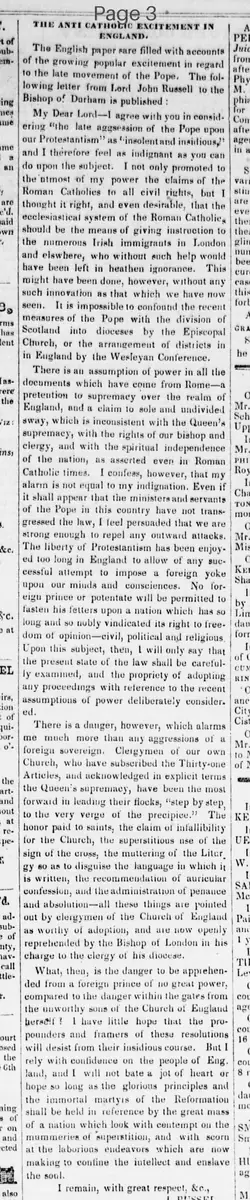
The English papers are filled with accounts of the growing popular excitement in regard to the late movement of the Pope. The following letter from Lord John Russell to the Bishop of Durham is published:
My Dear Lord—I agree with you in considering "the late aggression of the Pope upon our Protestantism" as "insolent and insidious," and I therefore feel as indignant as you can do upon the subject. I not only promoted to the utmost of my power the claims of the Roman Catholics to all civil rights, but I thought it right, and even desirable, that the ecclesiastical system of the Roman Catholics should be the means of giving instruction to the numerous Irish immigrants in London and elsewhere, who without such help would have been left in heathen ignorance. This might have been done, however, without any such innovation as that which we have now seen. It is impossible to confound the recent measures of the Pope with the division of Scotland into dioceses by the Episcopal Church, or the arrangement of districts in England by the Wesleyan Conference. There is an assumption of power in all the documents which have come from Rome—a pretension to supremacy over the realm of England, and a claim to sole and undivided sway, which is inconsistent with the Queen's supremacy, with the rights of our bishops and clergy, and with the spiritual independence of the nation, as asserted even in Roman Catholic times. I confess, however, that my alarm is not equal to my indignation. Even if it shall appear that the ministers and servants of the Pope in this country have not transgressed the law, I feel persuaded that we are strong enough to repel any outward attacks. The liberty of Protestantism has been enjoyed too long in England to allow of any successful attempt to impose a foreign yoke upon our minds and consciences. No foreign prince or potentate will be permitted to fasten his fetters upon a nation which has so long and so nobly vindicated its right to freedom of opinion—civil, political and religious Upon this subject, then, I will only say that the present state of the law shall be carefully examined, and the propriety of adopting any proceedings with reference to the recent assumptions of power deliberately considered.
There is a danger, however, which alarms me much more than any aggressions of a foreign sovereign. Clergymen of our own Church, who have subscribed the Thirty-nine Articles, and acknowledged in explicit terms the Queen's supremacy, have been the most forward in leading their flocks, "step by step, to the very verge of the precipice." The honor paid to saints, the claim of infallibility for the Church, the superstitious use of the sign of the cross, the muttering of the Liturgy so as to disguise the language in which it is written, the recommendation of auricular confession, and the administration of penance and absolution—all these things are pointed out by clergymen of the Church of England as worthy of adoption, and are now openly reprehended by the Bishop of London in his charge to the clergy of his diocese. What, then, is the danger to be apprehended from a foreign prince of no great power, compared to the danger within the gates from the unworthy sons of the Church of England herself? I have little hope that the propounders and framers of these resolutions will desist from their insidious course. But I rely with confidence on the people of England, and I will not bate a jot of heart or hope so long as the glorious principles and the immortal martyrs of the Reformation shall be held in reverence by the great mass of a nation which looks with contempt on the mummeries of superstition, and with scorn at the laborious endeavors which are now making to confine the intellect and enslave the soul.
What sub-type of article is it?
What keywords are associated?
What entities or persons were involved?
Where did it happen?
Foreign News Details
Primary Location
England
Key Persons
Outcome
the present state of the law shall be carefully examined, and the propriety of adopting any proceedings with reference to the recent assumptions of power deliberately considered; greater danger from within the church of england than from papal actions.
Event Details
English papers filled with accounts of popular excitement regarding the Pope's late movement. Lord John Russell agrees with Bishop of Durham that it is an insolent and insidious aggression on Protestantism. He supported Catholic civil rights and ecclesiastical instruction for Irish immigrants but opposes this innovation assuming supremacy over England, inconsistent with Queen's supremacy and national independence. He is indignant but confident in repelling it, relying on England's Protestant liberty. Greater alarm at Church of England clergymen promoting saint veneration, infallibility, superstitious practices, confession, and penance, as reprehended by Bishop of London. Relies on the people revering Reformation principles against superstition.