Thank you for visiting SNEWPapers!
Sign up free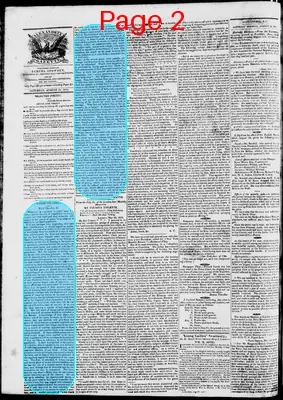
Editorial
August 21, 1830
Phenix Gazette
Alexandria, Virginia
What is this article about?
Editorial argues against educating black slaves and free persons in Southern States, claiming it would lead to rebellion, disrupt control, and destroy their ignorant happiness, while allowing oral religious instruction.
Clipping
OCR Quality
98%
Excellent
Full Text
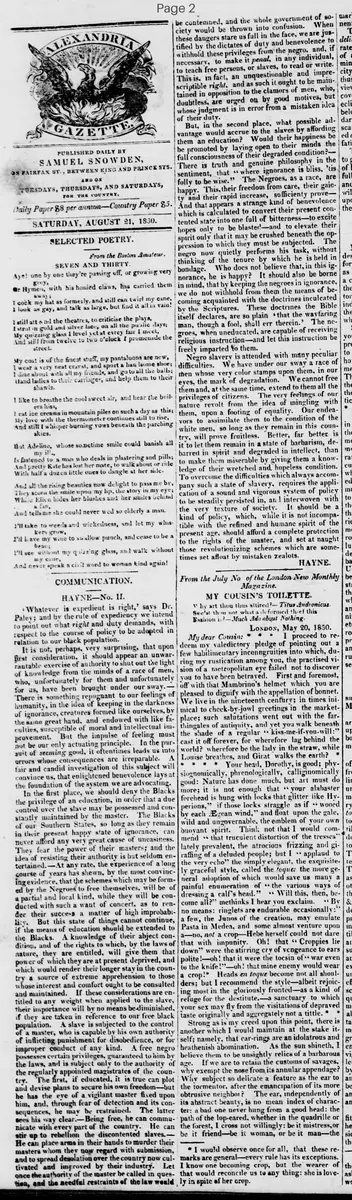
COMMUNICATION.
HAYNE-No. II.
Whatever is expedient is right, says Dr. Paley; and by the rule of expediency we intend to point out what right and duty demands, with respect to the course of policy to be adopted in relation to our black population.
It is not, perhaps, very surprising, that upon first consideration, it should appear an unwarrantable exercise of authority to shut out the light of knowledge from the minds of a race of men, who, unfortunately for them and unfortunately for us, have been brought under our sway. There is something repugnant to our feelings of humanity, in the idea of keeping in the darkness of ignorance, creatures formed like ourselves, by the same great hand, and endowed with like faculties, susceptible of moral and intellectual improvement. But the impulse of feeling must not be our only actuating principle. In the pursuit of seeming good, it oftentimes leads us into errors whose consequences are irreparable. A fair and candid investigation of this subject will convince us, that enlightened benevolence lays at the foundation of the system we are advocating.
In the first place, we should deny the Blacks the privilege of an education, in order that a due control over the slave may be possessed and constantly maintained by the master. The Blacks of our Southern States, so long as they remain in their present happy state of ignorance, can never afford any very great cause of uneasiness. They fear the power of their masters; and the idea of resisting their authority is but seldom entertained. At any rate, the experience of a long course of years has shewn, by the most convincing evidence, that the schemes which may be formed by the Negroes to free themselves, will be of a partial and local kind, while they will be conducted with such a want of concert, as to render their success a matter of high improbability. But this state of things cannot continue, if the means of education should be extended to the Blacks. A knowledge of their abject condition, and of the rights to which, by the laws of nature, they are entitled, will give them that power of which they are at present deprived, and which would render their longer stay in the country a source of extreme apprehension to those whose interest and comfort ought to be consulted and maintained. If these considerations are entitled to any weight when applied to the slave, their importance will by no means be diminished, if they are taken in reference to our free black population. A slave is subjected to the control of a master, who is capable by his own authority of inflicting punishment for disobedience, or for improper conduct of any kind. A free negro possesses certain privileges, guaranteed to him by the laws, and is subject only to the authority of the regularly appointed magistrates of the country. The first, if educated, it is true can plot and devise plans to secure his own freedom—but he has the eye of a vigilant master fixed upon him, and, through fear of detection and its consequences, he may be restrained. The latter sees his way clear. Being free, he can communicate with every part of the country. He can stir up to rebellion the discontented slaves. He can place arms in their hands to murder their masters whom they now regard with submission, and to spread desolation over the country now cultivated and improved by their industry. Let once the authority of the master be called in question, and the needful restraints of the law would be contemned, and the whole government of society would be thrown into confusion. When these dangers stare us full in the face, we are justified by the dictates of duty and benevolence to withhold these privileges from the negro, and, if necessary, to make it penal, in any individual, to teach free persons, or slaves, to read or write. This is, in fact, an unquestionable and imprescriptible right, and as such it ought to be maintained in opposition to the clamors of men, who, doubtless, are urged on by good motives, but whose judgment is in error from a mistaken idea of their duty.
But, in the second place, what possible advantage would accrue to the slaves by affording them an education? Would their happiness be promoted by laying open to their minds the full consciousness of their degraded condition? There is truth and genuine philosophy in the sentiment, that "where ignorance is bliss, 'tis folly to be wise." The Negroes, as a race, are happy. This, their freedom from care, their gaiety and their rapid increase, sufficiently prove. And that appears a strange kind of benevolence which is calculated to convert their present contented state into one full of bitterness—to excite hopes only to be blasted!—and to elevate their spirit only that it may be crushed beneath the oppression to which they must be subjected. The negro now quietly performs his task, without thinking of the tenure by which he is held in bondage. Who does not believe that, in this ignorance, he is happy? It should also be borne in mind, that by keeping the negroes in ignorance, we do not withhold from them the means of becoming acquainted with the doctrines inculcated by the Scriptures. These doctrines the Bible itself declares, are so plain that the wayfaring man, though a fool, shall not err therein. The negroes, when uneducated, are capable of receiving religious instruction—and let this instruction be freely imparted to them.
Negro slavery is attended with many peculiar difficulties. We have under our sway a race of men whose very color stamps upon them, in our eyes, the mark of degradation. We cannot free them and, at the same time, extend to them all the privileges of citizens. The very feelings of our nature revolt from the idea of mingling with them, upon a footing of equality. Our endeavors to assimilate them to the condition of the white men, so long as they remain in this country, will prove fruitless. Better, far better is it to let them remain in a state of barbarism, degraded in spirit and degraded in intellect, than to make them miserable by giving them a knowledge of their wretched and hopeless condition.
To overcome the difficulties which always accompany such a state of slavery, requires the application of a sound and vigorous system of policy to be steadily persisted in, and interwoven with the very texture of society. It should be a kind of policy, which, while it is not incompatible with the refined and humane spirit of the present age, should afford a complete protection to the rights of the master, and set at naught those revolutionizing schemes which are sometimes set afloat by mistaken zealots.
HAYNE.
HAYNE-No. II.
Whatever is expedient is right, says Dr. Paley; and by the rule of expediency we intend to point out what right and duty demands, with respect to the course of policy to be adopted in relation to our black population.
It is not, perhaps, very surprising, that upon first consideration, it should appear an unwarrantable exercise of authority to shut out the light of knowledge from the minds of a race of men, who, unfortunately for them and unfortunately for us, have been brought under our sway. There is something repugnant to our feelings of humanity, in the idea of keeping in the darkness of ignorance, creatures formed like ourselves, by the same great hand, and endowed with like faculties, susceptible of moral and intellectual improvement. But the impulse of feeling must not be our only actuating principle. In the pursuit of seeming good, it oftentimes leads us into errors whose consequences are irreparable. A fair and candid investigation of this subject will convince us, that enlightened benevolence lays at the foundation of the system we are advocating.
In the first place, we should deny the Blacks the privilege of an education, in order that a due control over the slave may be possessed and constantly maintained by the master. The Blacks of our Southern States, so long as they remain in their present happy state of ignorance, can never afford any very great cause of uneasiness. They fear the power of their masters; and the idea of resisting their authority is but seldom entertained. At any rate, the experience of a long course of years has shewn, by the most convincing evidence, that the schemes which may be formed by the Negroes to free themselves, will be of a partial and local kind, while they will be conducted with such a want of concert, as to render their success a matter of high improbability. But this state of things cannot continue, if the means of education should be extended to the Blacks. A knowledge of their abject condition, and of the rights to which, by the laws of nature, they are entitled, will give them that power of which they are at present deprived, and which would render their longer stay in the country a source of extreme apprehension to those whose interest and comfort ought to be consulted and maintained. If these considerations are entitled to any weight when applied to the slave, their importance will by no means be diminished, if they are taken in reference to our free black population. A slave is subjected to the control of a master, who is capable by his own authority of inflicting punishment for disobedience, or for improper conduct of any kind. A free negro possesses certain privileges, guaranteed to him by the laws, and is subject only to the authority of the regularly appointed magistrates of the country. The first, if educated, it is true can plot and devise plans to secure his own freedom—but he has the eye of a vigilant master fixed upon him, and, through fear of detection and its consequences, he may be restrained. The latter sees his way clear. Being free, he can communicate with every part of the country. He can stir up to rebellion the discontented slaves. He can place arms in their hands to murder their masters whom they now regard with submission, and to spread desolation over the country now cultivated and improved by their industry. Let once the authority of the master be called in question, and the needful restraints of the law would be contemned, and the whole government of society would be thrown into confusion. When these dangers stare us full in the face, we are justified by the dictates of duty and benevolence to withhold these privileges from the negro, and, if necessary, to make it penal, in any individual, to teach free persons, or slaves, to read or write. This is, in fact, an unquestionable and imprescriptible right, and as such it ought to be maintained in opposition to the clamors of men, who, doubtless, are urged on by good motives, but whose judgment is in error from a mistaken idea of their duty.
But, in the second place, what possible advantage would accrue to the slaves by affording them an education? Would their happiness be promoted by laying open to their minds the full consciousness of their degraded condition? There is truth and genuine philosophy in the sentiment, that "where ignorance is bliss, 'tis folly to be wise." The Negroes, as a race, are happy. This, their freedom from care, their gaiety and their rapid increase, sufficiently prove. And that appears a strange kind of benevolence which is calculated to convert their present contented state into one full of bitterness—to excite hopes only to be blasted!—and to elevate their spirit only that it may be crushed beneath the oppression to which they must be subjected. The negro now quietly performs his task, without thinking of the tenure by which he is held in bondage. Who does not believe that, in this ignorance, he is happy? It should also be borne in mind, that by keeping the negroes in ignorance, we do not withhold from them the means of becoming acquainted with the doctrines inculcated by the Scriptures. These doctrines the Bible itself declares, are so plain that the wayfaring man, though a fool, shall not err therein. The negroes, when uneducated, are capable of receiving religious instruction—and let this instruction be freely imparted to them.
Negro slavery is attended with many peculiar difficulties. We have under our sway a race of men whose very color stamps upon them, in our eyes, the mark of degradation. We cannot free them and, at the same time, extend to them all the privileges of citizens. The very feelings of our nature revolt from the idea of mingling with them, upon a footing of equality. Our endeavors to assimilate them to the condition of the white men, so long as they remain in this country, will prove fruitless. Better, far better is it to let them remain in a state of barbarism, degraded in spirit and degraded in intellect, than to make them miserable by giving them a knowledge of their wretched and hopeless condition.
To overcome the difficulties which always accompany such a state of slavery, requires the application of a sound and vigorous system of policy to be steadily persisted in, and interwoven with the very texture of society. It should be a kind of policy, which, while it is not incompatible with the refined and humane spirit of the present age, should afford a complete protection to the rights of the master, and set at naught those revolutionizing schemes which are sometimes set afloat by mistaken zealots.
HAYNE.
What sub-type of article is it?
Slavery Abolition
Moral Or Religious
What keywords are associated?
Negro Education
Slave Control
Ignorance Bliss
Racial Policy
Southern Blacks
Religious Instruction
What entities or persons were involved?
Dr. Paley
Blacks
Masters
Free Negroes
Editorial Details
Primary Topic
Opposition To Educating Black Population
Stance / Tone
Pro Slavery Advocacy For Maintaining Ignorance
Key Figures
Dr. Paley
Blacks
Masters
Free Negroes
Key Arguments
Deny Education To Maintain Master Control Over Slaves
Educated Blacks Would Recognize Rights And Rebel
Free Blacks Could Incite Slave Rebellions
Ignorance Preserves Black Happiness And Prevents Bitterness
Religious Instruction Possible Without Literacy
Cannot Assimilate Blacks As Equals In Society