Thank you for visiting SNEWPapers!
Sign up free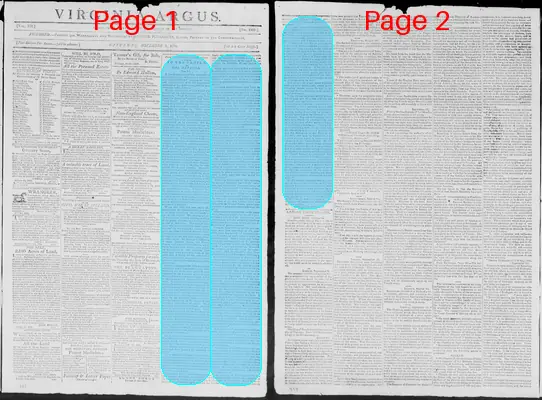
Virginia Argus
Richmond, Virginia
What is this article about?
This editorial, part of a series defending administration policies, argues for a cautious approach to establishing a U.S. navy. It reviews constitutional powers, early leaders' views favoring agriculture over extensive trade, historical examples of naval pitfalls, Washington's recommendations for militia over navy, and Virginia's 1800 instructions against naval augmentation.
Merged-components note: Direct textual continuation of the editorial 'The Defence No. XI' from the National Intelligencer across page break, originally labeled as story on page 2.
Clippings
1 of 2
OCR Quality
Full Text
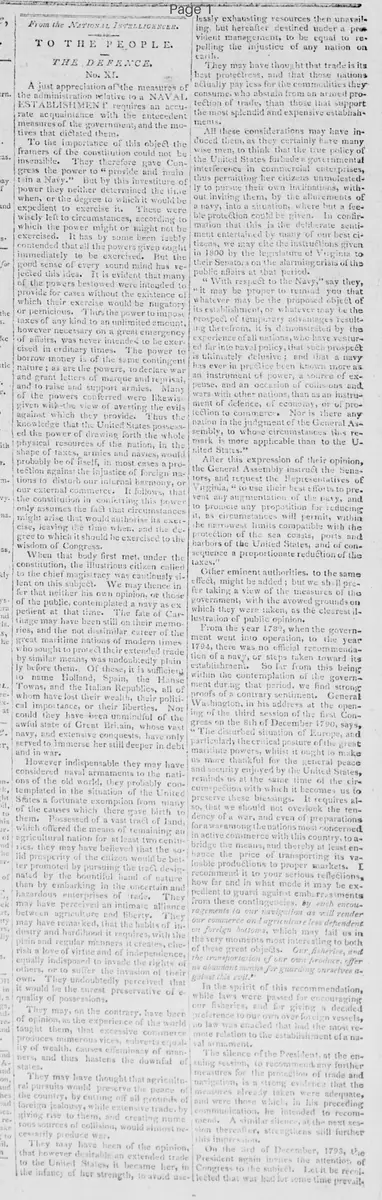
TO THE PEOPLE.
THE DEFENCE.
No. XI.
A just appreciation of the measures of the administration relative to a NAVAL, ESTABLISHMENT requires an accurate acquaintance with the antecedent measures of the government, and the motives that dictated them. To the importance of this object the framers of the constitution could not be insensible. They therefore gave Congress the power to "provide and maintain a Navy." But by this investiture of power they neither determined the time when, or the degree to which it would be expedient to exercise it. These were wisely left to circumstances, according to which the power might or might not be exercised. It has by some been feebly contended that all the powers given ought immediately to be exercised. But the good sense of every sound mind has rejected this idea. It is evident that many of the powers bestowed were intended to provide for cases without the existence of which their exercise would be nugatory or pernicious. Thus the power to impose taxes of any kind to an unlimited amount, however necessary on a great emergency of affairs, was never intended to be exercised in ordinary times. The power to borrow money is of the same contingent nature; as are the powers, to declare war and grant letters of marque and reprisal, and to raise and support armies. Many of the powers conferred were likewise given with the view of averting the evils against which they provide. Thus the knowledge that the United States possessed the power of drawing forth the whole physical resources of the nation, in the shape of taxes, armies and navies, would probably be of itself, in most cases a protection against the injustice of foreign nations to disturb our internal harmony, or our external commerce. It follows, that the constitution in conferring this power only assumes the fact that circumstances might arise that would authorise its exercise, leaving the time when, and the degree to which it should be exercised to the wisdom of Congress.
When that body first met, under the constitution, the illustrious citizen called to the chief magistracy was cautiously silent on this subject. We may thence infer that neither his own opinion, or those of the public, contemplated a navy as expedient at that time. The fate of Carthage may have been still on their memories, and the not dissimilar career of the great maritime nations of modern times who sought to protect their extended trade by similar means, was undoubtedly plainly before them. Of these, it is sufficient to name Holland, Spain, the Hanse Towns, and the Italian Republics, all of whom have lost their wealth, their political importance, or their liberties. Nor could they have been unmindful of the awful state of Great Britain, whose vast navy, and extensive conquests, have only served to immerse her still deeper in debt and in war.
However indispensable they may have considered naval armaments to the nations of the old world, they probably contemplated in the situation of the United States a fortunate exemption from many of the causes which there gave birth to them. Possessed of a vast tract of land, which offered the means of remaining an agricultural nation for at least two centuries, they may have believed that the solid prosperity of the citizen would be better promoted by pursuing the trade designated by the bountiful hand of nature than by embarking in the uncertain and hazardous enterprises of trade. They may have perceived an intimate alliance between agriculture and liberty. They may have remarked, that the habits of industry and hardihood it requires, with the plain and regular manners it creates, cherish a love of virtue and of independence, equally indisposed to invade the rights of others, or to suffer the invasion of their own. They undoubtedly perceived that it would be the surest preservative of equality of possessions.
They may, on the contrary, have been of the opinion, as the experience of the world taught them, that excessive commerce produces numerous vices, subverts equality of wealth, causes effeminacy of manners, and thus hastens the downfall of states.
They may have thought that agricultural pursuits would preserve the peace of the country, by cutting off all grounds of foreign jealousy, while extensive trade, by giving rise to them, and creating numerous sources of collision, would almost necessarily produce war.
They may have been of the opinion, that however desirable an extended trade to the United States, it became her, in the infancy of her strength, to avoid uselessly exhausting resources then unavailing, but hereafter destined under a provident management, to be equal to repelling the injustice of any nation on earth.
They may have thought that trade is its best protectress, and that those nations actually pay less for the commodities they consume, who abstain from an armed protection of trade, than those that support the most splendid and expensive establishments.
All these considerations may have induced them, as they certainly have many wise men, to think that the true policy of the United States forbade a governmental interference in commercial enterprises, thus permitting her citizens unmolestedly to pursue their own inclinations, without inviting them, by the allurements of a navy, into a situation, where but a feeble protection could be given. In confirmation that this is the deliberate sentiment entertained by many of our best citizens, we may cite the instructions given in 1800 by the legislature of Virginia to their Senators on the alarming crisis of the public affairs at that period.
" With respect to the Navy," say they, "it may be proper to remind you that whatever may be the proposed object of its establishment, or whatever may be the prospect of temporary advantages resulting therefrom, it is demonstrated by the experience of all nations, who have ventured far into naval policy, that such prospect is ultimately delusive; and that a navy has ever in practice been known more as an instrument of power, a source of expense, and an occasion of collisions and wars with other nations, than as an instrument of defence, of economy, or of protection to commerce. Nor is there any nation in the judgment of the General Assembly, to whose circumstances this remark is more applicable than to the United States."
After this expression of their opinion, the General Assembly instruct the Senators, and request the Representatives of Virginia, " to use their best efforts to prevent any augmentation of the navy, and to promote any proposition for reducing it, as circumstances will permit, within the narrowest limits compatible with the protection of the sea coasts, ports and harbors of the United States, and of consequence a proportionate reduction of the taxes."
Other eminent authorities. to the same effect, might be added; but we shall prefer taking a view of the measures of the government, with the avowed grounds on which they were taken, as the clearest illustration of public opinion.
From the year 1789, when the government went into operation, to the year 1794, there was no official recommendation of a navy, or steps taken toward its establishment. So far from this being within the contemplation of the government during that period. we find strong proofs of a contrary sentiment. General Washington, in his address at the opening of the third session of the first Congress on the 8th of December 1790, says, "The disturbed situation of Europe, and particularly the critical posture of the great maritime powers, whilst it ought to make us more thankful for the general peace and security enjoyed by the United States, reminds us at the same time of the circumstances with which it becomes us to preserve these blessings. It requires also, that we should not overlook the tendency of a war, and even of preparations for war among the nations most concerned in active commerce with this country, to abridge the means, and thereby at least enhance the price of transporting its valuable productions to proper markets. I recommend it to your serious reflections, how far and in what mode it may be expedient to guard against embarrassments from these contingencies, by such encouragements to our navigation as will render our commerce and agriculture less dependent on foreign bottom, which may fail us in the very moments most interesting to both of these great objects. Our fisheries, and the transportation of our own produce, offer us abundant means for guarding ourselves against this evil."
In the spirit of this recommendation, while laws were passed for encouraging our fisheries, and for giving a decided preference to our own over foreign vessels, no law was enacted that had the most remote relation to the establishment of a naval armament.
The silence of the President, at the ensuing session, to recommend any further measures for the protection of trade and navigation, is a strong evidence that the measures already taken were adequate, and were those which, in his preceding communication. he intended to recommend, A similar silence, at the next session thereafter, strengthens still further this impression.
On the 3rd of December, 1793, the President again invites the attention, of Congress to the subject, Let it be recollected that war had for some time prevailed between France and England, and other nations with whom we hold intimate relations.
"I cannot," says he, "recommend to your notice the measures for the fulfillment of our duties to the rest of the world, without again pressing upon you the necessity of placing ourselves in a condition of complete defence, and of exacting from them the fulfillment of their duties towards us.
The United States ought not to indulge a persuasion that, contrary to the order of human events, they will for ever keep at a distance those painful appeals to arms with which the history of every other nation abounds. There is a rank due to the United States among nations, which will be withheld, if not absolutely lost, by the reputation of weakness. If we desire to avoid insult, we must be able to repel it; if we desire to secure peace, one of the most powerful instruments of our rising prosperity, it must be known, that we are at all times ready for war."
The means, by which these desirable ends are to be secured, are stated in the following words, which do not, in the remotest degree, recognise as necessary a naval armament.
"The documents which will be presented to you, will shew the amount, and kinds of arms and military stores, now on our magazines & arsenals; and yet an addition even to these supplies cannot with prudence be neglected: as it would leave nothing to the uncertainty of procuring warlike apparatus in the moment of public danger. Nor can such arrangements, with such objects, be exposed to the censure or jealousy of the warmest friends of republican government. They are incapable of abuse in the hands of the militia, who ought to possess a pride in being the depository of the force of the republic, and may be trained to a degree of energy, equal to every military exigency of the United States. But it is an enquiry which cannot be too solemnly pursued, whether the act, "more effectually to provide for the national defence by establishing a uniform militia throughout the United States," has organised them so as to produce their full effect; whether your own experience in the several states has not detected some imperfections in the scheme; and whether a material feature in an improvement of it ought not to be, to afford an opportunity for the study of those branches of the military art, which can scarcely ever be attained by practice alone?"
In this earnest language, does our great patriot urge, on his country, as the best security for peace, the necessity of being prepared at all times for war—not by establishing a vast navy too apt to embroil us in premature hostilities—but by training the militia "to a degree of energy, equal to every military exigency;" and by filling our magazines with arms and military stores.
(Subject to be continued.)
What sub-type of article is it?
What keywords are associated?
What entities or persons were involved?
Editorial Details
Primary Topic
Cautious Establishment Of A U.S. Navy
Stance / Tone
Defensive Of Gradual Naval Policy And Militia Focus
Key Figures
Key Arguments