Thank you for visiting SNEWPapers!
Sign up free
Portland Gazette, And Maine Advertiser
Portland, Cumberland County, Maine
What is this article about?
Proceedings of the Massachusetts Legislature in early June 1816, covering Senate and House sessions: committee appointments on various topics, inauguration of Governor John Brooks and Lt. Governor William Phillips, election of councillors, Governor's address on government principles, re-election of state officials, and a public escort for the new Governor.
Merged-components note: Continuation of the Massachusetts Legislature proceedings report, including the apparent fragment which completes the inauguration narrative; original story label corrected to domestic_news.
Clippings
1 of 2
OCR Quality
Full Text
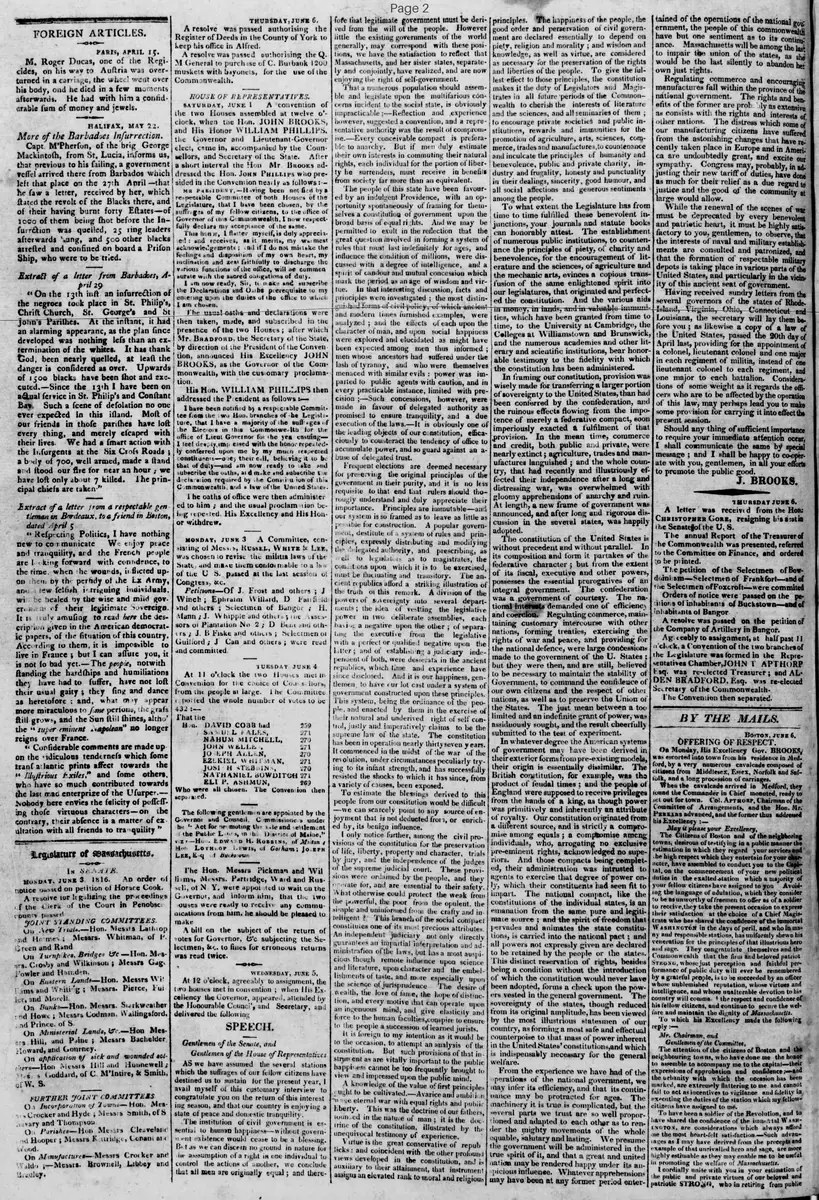
IN SENATE.
MONDAY, JUNE 3, 1816. An order of notice passed on petition of Horace Cook. A resolve for legalizing the proceedings of the Clerk of the Court in Penobscot county passed.
JOINT STANDING COMMITTEES.
On New Trials.—Hon. Messrs Lathrop and Holmes; Messrs. Whitman, of P. Green and Rand.
On Turnpikes, Bridges &c.—Hon. Messrs. Crosby and Wilkinson; Messrs Gage, Fowler and Harden.
On Eastern Lands—Hon. Messrs Williams and Whiting: Messrs. Pierce, Fuller, and Morell.
On Banks—Hon. Messrs. Starkweather and Howe; Messrs Codman, Wallingsford, and Prince, of S.
On Ministerial Lands, &c.—Hon Messrs. Hill, and Paine; Messrs Bachelder, Howard, and Gourney.
On application of sick and wounded soldiers—Hon Messers Hill and Hunnewell; Messrs. Goddard, of C. M'Intire, & Smith, of W. S.
FURTHER JOINT COMMITTEES
On Incorporation of Towns—Hon. Messrs. Crocker and Hyde; Messrs Smith, of S. avary and Thompson.
On Parishes—Hon Messrs Cleaveland and Hooper; Messrs K. turidge, Conant and Wood.
On Manufactures—Messrs Crocker and Waldo;—Messrs. Brownell, Libbey and Braasley.
THURSDAY: JUNE 6.
A resolve was passed authorising the Register of Deeds in the County of York to keep his office in Alfred.
A resolve was passed authorising the Q. M General to purchase of C. Burbank 1200 muskets with bayonets, for the use of the Commonwealth.
HOUSE OF REPRESENTATIVES
SATURDAY, JUNE 1. A CONVENTION Of the two Houses assembled at twelve o'clock, when the Hon. JOHN BROOKS and His Honor WILLIAM PHILLIPS, the Governor and Lieutenant-Governor elect, came in, accompanied by the Counsellors, and Secretary of the State. After a short interval the Hon Mr Brooks addressed the Hon. John Phillips who presided in the Convention nearly as follows: —
MR. PRESIDENT, Having been notified by a respectable Committee of both Houses of the Legislature, that I have been chosen, by the suffrages of my fellow citizens, to the office of Governor of this Commonwealth, I now respectfully declare my acceptance of the same. This honor, I flatter myself, is duly appreciated: and receives, as it merits, my warmest acknowledgements; and if I do not mistake the feelings and disposition of my own heart, my inclination and zeal faithfully to discharge the various functions of the office, will be commensurate with the sacred obligations of duty. I am now ready, Sir, to make and subscribe the Declarations and Oaths prerequisite to my entering upon the duties of the office to which I am chosen.
The usual oaths and declarations were then taken, made, and subscribed in the presence of the two Houses; after which Mr. Bradford, the Secretary of the State, by direction of the President of the Convention, announced His Excellency JOHN BROOKS, as the Governor of the Commonwealth, with the customary proclamation.
His Hon. WILLIAM PHILLIPS then addressed the President as follows: —
I have been notified by a respectable Committee from the two Hon. branches of the Legislature, that I have a majority of the suffrages of the Electors in this Commonwealth for the office of Lieut Governor for the year ensuing—I feel deeply, impressed with the honor repeatedly conferred upon me by my much respected constituents—obey their call, believing it to be that of duty—and am now ready to take and subscribe the oaths, and make and subscribe the declaration required by the Constitution of this Commonwealth, and Law of the United States.
The oaths of office were then administered to him; and the usual proclamation being repeated, His Excellency and His Honor withdrew.
Monday, June 3. A Committee, consisting of Mess.rs, Russell, White & Lee, was chosen to revise the militia laws of the State, and make them conformable to a law of the U S., passed at the last session of Congress, &c.
Petitions—Of J. Frost and others; J Winch; Ephraim Willard, D Fanfield and others; Selectmen of Bangor; H. Mann; J. Whipple and others; the Assessors of Plantation No 2; D Bent and others; J. B Fiske and others; Selectmen of Guilford; J Can and others; were read and committed.
TUESDAY JUNE 4
At 11 o'clock the two Houses met in Convention for the choice of Councillors from the people at large. The Committee reported the whole number of votes to be 432 :—
That the Hon. DAVID COBB had 259
SAMUEL FALES, 271
NAHUM MITCHELL, 270
JOHN WELLES 271
JOSEPH ALLEN, 270
EZEKIEL WHITMAN. 271
JOSIAH STEVENS, 270
NATHANIEL BOWDITCH 271
ELI P. ASHMUN, 269
Who were all chosen. The Convention then separated.
The following gentlemen are appointed by the Governor and Council, Commissioners under the "Act for promoting the sale and settlement of the Public Lands, in the District of Maine," viz?—Hon. EDWARD H. ROBBINS, of Milton Hon LOTHROP LEWIS, of Gorham; JOSEPH LEE, Esq Buckstown
The Hon. Messrs Pickman and Williams, Messrs. Partridge, Ward and Russell, of N. Y. were appointed to wait on the Governor, and inform him, that the two Houses were ready to receive any communications from him, he should be pleased to make.
A bill on the subject of the return of votes for Governor, &c subjecting the Selectmen, &c. to fines for erroneous returns was read twice.
WEDNESDAY, JUNE 5.
At 12 o'clock, agreeably to assignment, the two houses met in convention; when His Excellency the Governor, appeared, attended by the Honourable Council, and Secretary, and delivered the following
SPEECH
Gentlemen of the Senate, and Gentlemen of the House of Representatives
AS we have assumed the several stations which the suffrages of our fellow citizens have destined us to sustain for the present year, I avail myself of this customary interview to congratulate you on the return of this interesting season, and that our country is enjoying a state of peace and domestic tranquility.
The institution of civil government is essential to human happiness—without government existence would cease to be a blessing. But as we can discern no ground in nature for the assumption of a right in one individual to control the actions of another, we conclude that all men are originally equal; and therefore that legitimate government must be derived from the will of the people. However little the existing governments of the world generally, may correspond with these positions, we have the satisfaction to reflect that Massachusetts, and her sister states, separately and conjointly, have realized, and are now enjoying the right of self-government.
That a numerous population should assemble and legislate upon the multifarious concerns incident to the social state, is obviously impracticable;—Reflection and experience however, suggested a convention, and a representative authority was the result of compromise.—Every conceivable compact is preferable to anarchy. But if men duly estimate their own interests in commuting their natural rights, each individual for the portion of liberty he surrenders, must receive in benefits from society far more than an equivalent.
The people of this state have been favoured by an indulgent Providence, with an opportunity spontaneously of framing for themselves a constitution of government upon the broad basis of equal rights. And we may be permitted to exult in the reflection that the great question involved in forming a system of rules that must last indefinitely for ages, and influence the condition of millions, were discussed with a degree of intelligence, and a spirit of candour and mutual concession which mark the period as an age of wisdom and virtue. In that interesting discussion, facts and principles were investigated; the most distinguished feelings of ancient and modern times furnished examples, were analyzed; and the effects of each upon the character of man, and upon social happiness were explored and elucidated as might have been expected among men thus informed; men whose ancestors had suffered under the lash of tyranny, and who were themselves menaced with similar evils: power was imparted to public agents with caution, and in every practicable instance, limited with precision; Such concessions, however, were made in favour of delegated authority as promised to ensure tranquility, and a due execution of the laws.—It is obviously one of the leading objects of our constitution, efficaciously to counteract the tendency of office to accumulate power, and so guard against an abuse of delegated trust.
Frequent elections are deemed necessary for preserving the original principles of the government in their purity, and it is no less requisite to that end that rulers should thoroughly understand and duly appreciate their importance. Principles are immutable—and our system is so framed as to leave as little as possible for construction. A popular government, destitute of a system of rules and principles, expressly distributing and modifying the delegated authority, and prescribing, as well to legislators as to magistrates, the conditions upon which it is to be exercised, must be fluctuating and transitory. The ancient republics afford a striking illustration of the truth of this remark. A division of the powers of sovereignty into several departments; the idea of vesting the legislative power in two deliberate assemblies, each having a negative upon the other; of separating the executive from the legislative with a perfect or qualified negative upon the latter; and of establishing a judiciary independent of both, were desiderata in the ancient republics, which time and experience have since disclosed. And it is our happiness, gentlemen, to have our lot cast under a system of government constructed upon these principles.
This system, being the ordinance of the people, and enacted by them in the exercise of their natural and underived right of self control, justly and imperatively claims to be the supreme law of the state. The constitution has been in operation nearly thirty seven years. It commenced in the midst of the war of the revolution, under circumstances peculiarly trying to its infant strength, and has successfully resisted the shocks to which it has since, from a variety of causes, been exposed.
To estimate the blessings derived to this people from our constitution would be difficult—we can scarcely point to any source of enjoyment that is not deducted from, or enriched by, its benign influence. I only notice further, among the civil provisions of the constitution for the preservation of life, liberty, property and character, trials by jury, and the independence of the judges of the supreme judicial court. These provisions were ordained by the people, and they operate for, and are essential to their safety. What otherwise could protect the weak from the powerful, the poor from the opulent, the simple and uninformed from the crafty and intelligent? This branch of the social compact constitutes one of its most precious attributes. An independent judiciary not only directly guarantees an impartial interpretation and administration of the laws, but has a most auspicious though remote influence upon science and literature, upon character and the embellishments of taste, and more especially upon the science of jurisprudence. The desire of wealth, the love of fame, the hope of distinction, and every motive that can operate upon an ingenuous mind, and give elasticity and force to the human faculties, conspire to ensure to the people a succession of learned jurists.
It is foreign to my intention as it would be to the occasion, to attempt an analysis of the constitution. But such provisions of that instrument as are vitally important to the public happiness cannot be too frequently brought to view and impressed upon the public mind. A knowledge of the value of first principles ought to be cultivated.—Avarice and ambition wage eternal war with equal rights and public liberty. This was the doctrine of our fathers, founded in the nature of man; it is the doctrine of the constitution, illustrated by the unequivocal testimony of experience.
Virtue is the great conservative of republics: and coincident with the other profound views developed in the constitution, and is auxiliary to their attainment, that instrument assigns an elevated rank to moral and religious principles. The happiness of the people, the good order and preservation of civil government are declared essentially to depend on piety, religion and morality; and wisdom and knowledge, as well as virtue, are considered as necessary for the preservation of the rights and liberties of the people. To give the fullest effect to those principles, the constitution makes it the duty of Legislators and Magistrates in all future periods of the Commonwealth to cherish the interests of literature and the sciences, and all seminaries of them; to encourage private societies and public institutions, rewards and immunities for the promotion of agriculture, arts, sciences, commerce, trades and manufactures, to countenance and inculcate the principles of humanity and benevolence, public and private charity, industry and frugality, honesty and punctuality in their dealings, sincerity, good humour, and all social affections and generous sentiments among the people.
To what extent the Legislature has from time to time fulfilled these benevolent injunctions, your journals and statute books can honorably attest. The establishment of numerous public institutions, to countenance the principles of piety, of charity and benevolence, for the encouragement of literature and the sciences, of agriculture and the mechanic arts, evinces a copious transfusion of the same enlightened spirit into our legislatures, that originated and perfected the constitution. And the various aids in money, in lands, and in valuable immunities, which have been granted from time to time, to the University at Cambridge, the Colleges at Williamstown and Brunswick, and the numerous academies and other literary and scientific institutions, bear honorable testimony to the fidelity with which the constitution has been administered.
In framing our constitution, provision was wisely made for transferring a larger portion of sovereignty to the United States, than had been conferred by the confederation, and the ruinous effects flowing from the impotence of merely a federative compact, soon imperiously exacted a fulfilment of that provision. In the mean time, commerce and credit, both public and private, were nearly extinct; agriculture, trades and manufactures languished; and the whole country, that had recently and illustriously effected their independence after a long and distressing war, was overwhelmed with gloomy apprehensions of anarchy and ruin. At length, a new frame of government was announced, and after long and rigorous discussion in the several states, was happily adopted.
The constitution of the United States is without precedent and without parallel. In its composition and form it partakes of the federative character; but from the extent of its fiscal, executive and other powers, possesses the essential prerogatives of an integral government. The confederation was a government of courtesy. The national interests demanded one of efficiency and coercion. Regulating commerce, maintaining customary intercourse with other nations, forming treaties, exercising the rights of war and peace, and providing for the national defence, were large concessions made to the government of the U. States; but they were then, and are still, believed to be necessary to maintain the stability of Government, to command the confidence of our own citizens and the respect of other nations, as well as to preserve the Union of the States. The just mean between a too limited and an indefinite grant of power, was assiduously sought, and the result cheerfully submitted to the test of experiment.
In whatever degree the American systems of government may have been derived in their exterior forms from pre-existing models, their origin is essentially dissimilar. The British constitution, for example, was the product of feudal times; and the people of England were supposed to receive privileges from the hands of a king, as though power was primitively and inherently an attribute of royalty. Our constitution originated from a different source, and is strictly a compromise among equals; a compromise among individuals, who, arrogating no exclusive pre-eminent rights, acknowledged no superiors. And those compacts being completed, their administration was intrusted to agents to exercise that degree of power only, which their constituents had seen fit to impart. The national compact, like the constitutions of the individual states, is an emanation from the same pure and legitimate source; and the spirit of freedom that pervades and animates the state constitutions, is carried into the national pact; and all powers not expressly given are declared to be retained by the people or the states. This distinct reservation of rights, besides being a condition without the introduction of which the constitution would never have been adopted, forms a check upon the powers vested in the general government. The sovereignty of the states, though reduced from its original amplitude, has been viewed by the most illustrious statesmen of our country, as forming a most safe and effectual counterpoise to that mass of power inherent in the United States' constitution, and which is indispensably necessary for the general welfare.
From the experience we have had of the operations of the national government, we may infer its efficiency, and that its continuance may be protracted for ages. The machinery it is true is complicated, but the several parts we trust are so well proportioned and adapted to each other as to render the mighty movements of the whole equable, salutary and lasting. We presume the government will be administered in the true spirit of it, and that a great and united nation may be rendered happy under its auspicious influence. Whatever apprehensions may have been at any former period entertained of the operations of the national government, the people of this commonwealth have but one sentiment as to its continuance. Massachusetts will be among the last to impair the union of the states, as she would be the last silently to abandon her own just rights.
Regulating commerce and encouraging manufactures fall within the province of the national government. The rights and benefits of the former are probably as extensive as consists with the rights and interests of other nations. The distress which some of our manufacturing citizens have suffered from the astonishing changes that have recently taken place in Europe and in America are undoubtedly great, and excite our sympathy. Congress may, probably, in adjusting their new tariff of duties, have done as much for their relief as a due regard to justice and the good of the community at large would allow.
While the renewal of the scenes of war must be deprecated by every benevolent and patriotic heart, it must be highly satisfactory to you, gentlemen, to observe, that the interests of naval and military establishments are consulted and patronized, and that the formation of respectable military depots is taking place in various parts of the United States, and particularly in the vicinity of this ancient seat of government.
Having received sundry letters from the several governors of the states of Rhode Island Virginia Ohio. Connecticut and Louisiana, the secretary will lay them before you; as likewise a copy of a law of the United States, passed the 20th day of April last, providing for the appointment of a colonel, lieutenant colonel and one major in each regiment of militia, instead of one lieutenant colonel to each regiment, and one major to each battalion. Considerations of some weight as it regards the officers who are to be affected by the operation of this law, may perhaps lead you to make some provision for carrying it into effect the present session.
Should any thing of sufficient importance to require your immediate attention occur I shall communicate the same by special message; and I shall be happy to co-operate with you, gentlemen, in all your efforts to promote the public good.
J. BROOKS.
THURSDAY JUNE 6.
A letter was received from the Hon. CHRISTOPHER GORE, resigning his seat in the Senate of the U. S.
The annual Report of the Treasurer of the Commonwealth was presented, referred to the Committee on Finance, and ordered to be printed.
The petition of the Selectmen of Bowdoinham—Selectmen of Frankfort—and of the Selectmen of Foxcroft were committed
Orders of notice were passed on the petitions of inhabitants of Buckstown and of inhabitants of Bangor
A resolve was passed on the petition of the Company of Artillery in Bangor.
Agreeably to assignment, at half past 11 o'clock, a Convention of the two branches of the Legislature was formed in the Representatives Chamber, JOHN T APTHORP Esq. was re-elected Treasurer: and ALDEN BRADFORD, Esq. was re-elected Secretary of the Commonwealth—
The Convention then separated.
BY THE MAILS.
Boston, JUNE 6.
OFFERING OF RESPECT.
On Monday, His Excellency Gov. BROOKS was escorted into town from his residence in Medford, by a very numerous cavalcade composed of citizens from Middlesex, Essex, Norfolk and Suffolk, and a long procession of carriages.
When the cavalcade arrived in Medford, they found the Commander in Chief mounted, ready to set out for town. Col. Aphthorp, Chairman of the Committee of Arrangements, and the Hon. Mr. Perkins advanced, and the former thus addressed his Excellency :—
May it please your Excellency,
The Citizens of Boston and of the neighbouring towns, desirous of testifying in a public manner the estimation in which they regard your services and the high respect which they entertain for your character, have assembled to conduct you to the Capital, on the commencement of your new political duties in the exalted station which a majority of your fellow citizens have assigned to you. Avoiding the language of adulation, which they consider to be as unworthy of freemen to offer as of a soldier to receive, they take the present occasion to express their satisfaction at the choice of a Chief Magistrate who has shared the confidence of the immortal Washington in the days of peril, and who in many and responsible stations, has uniformly shewn his veneration for the principles of that illustrious hero and sage. They congratulate themselves and the Commonwealth that the tried and beloved patriot STRONG, whose just perception and faithful performance of public duty will ever be remembered by a grateful people, is to be succeeded by an officer whose unblemished reputation, whose virtues and intelligence, and whose unalterable devotion to his country will command the respect and confidence of his fellow citizens, and continue to secure the welfare and maintain the dignity of Massachusetts.
To which his Excellency made the following reply :—
Mr. Chairman, and Gentlemen of the Committee,
The attention of the citizens of Boston and the neighbouring towns, who have done me the honor to assemble to accompany me to the capital—their expressions of approbation and confidence; and the urbanity with which the occasion has been marked, are extremely flattering to me. and cannot fail to act as incentives to vigilance and fidelity in executing the duties of the station which my fellow-citizens have assigned to me.
To have been a soldier of the Revolution, and to have shared the confidence of the immortal WASHINGTON, are considerations which always afford me the most heart-felt satisfaction.—Such advantages as I may have derived from the precepts and example of that unrivalled hero and sage, are more highly estimable as they may enable me to be useful in promoting the welfare of Massachusetts.
I cordially unite with you in your estimation of the public and private virtues of our beloved and patriotic STRONG, who in retiring from public life, carries with him the best wishes of his fellow citizens.
He dies, carries with him the best wishes of a grateful people.
His Excellency was on horseback, in full uniform, and attended by Colonels Sumner and Sargent, whom he has appointed his aides-de-camp.
What sub-type of article is it?
What keywords are associated?
What entities or persons were involved?
Where did it happen?
Domestic News Details
Primary Location
Massachusetts
Event Date
June 1 6, 1816
Key Persons
Outcome
john brooks inaugurated as governor; william phillips as lt. governor; councillors elected including david cobb (259 votes), samuel fales (271), nahum mitchell (270), john welles (271), joseph allen (270), ezekiel whitman (271), josiah stevens (270), nathaniel bowditch (271), eli p. ashmun (269); john t. apthorp re-elected treasurer; alden bradford re-elected secretary; various committees appointed; resolutions passed on deeds office, muskets purchase, militia laws revision; christopher gore resigns u.s. senate seat.
Event Details
The Massachusetts Legislature convened in early June 1816 for sessions in Senate and House of Representatives. Activities included passing orders, resolves, and petitions; appointing joint standing and further committees on topics like new trials, turnpikes, eastern lands, banks, ministerial lands, sick soldiers, town incorporations, parishes, and manufactures; inauguration of Governor John Brooks and Lt. Governor William Phillips with oaths; election of nine councillors by convention; Governor's lengthy speech on constitutional principles, government, national union, commerce, manufactures, and military; re-election of state treasurer and secretary; report of treasurer; various petitions committed; public escort and address for new Governor Brooks from Medford to Boston.