Thank you for visiting SNEWPapers!
Sign up free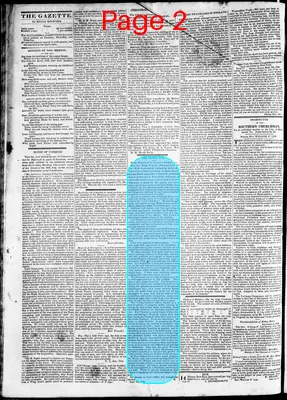
Alexandria Gazette
Alexandria, Alexandria County, District Of Columbia
What is this article about?
A letter from Fort Smith, Arkansas, dated August 8, 1834, reports on the U.S. Dragoons' expedition in the Indian War: Gen. Leavenworth died of illness in the Cross Timbers; widespread bilious remittent fever among troops; Col. Dodge advanced with half his command; Pawnees stole 150 horses; additional sickness and death at Fort Gibson. Published September 9, 1834.
Clipping
OCR Quality
Full Text
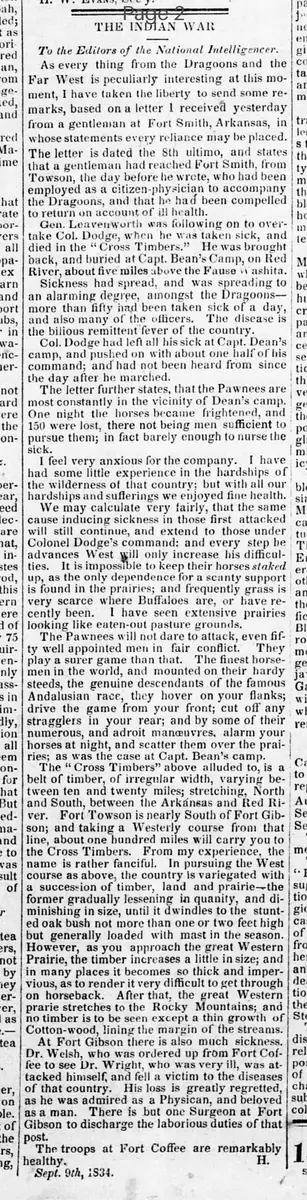
To the Editors of the National Intelligencer.
As every thing from the Dragoons and the Far West is peculiarly interesting at this moment, I have taken the liberty to send some remarks, based on a letter I received yesterday from a gentleman at Fort Smith, Arkansas, in whose statements every reliance may be placed.
The letter is dated the 8th ultimo, and states that a gentleman had reached Fort Smith, from Towson, the day before he wrote, who had been employed as a citizen-physician to accompany the Dragoons, and that he had been compelled to return on account of ill health.
Gen. Leavenworth was following on to overtake Col. Dodge, when he was taken sick. and died in the " Cross Timbers." He was brought back. and buried at Capt. Bean's Camp. on Red River, about five miles above the False Washita.
Sickness had spread, and was spreading to an alarming degree, amongst the Dragoons—more than fifty had been taken sick of a day, and also many of the officers. The disease is the bilious remittent fever of the country.
Col. Dodge had left all his sick at Capt. Dean's camp, and pushed on with about one half of his command; and had not been heard from since the day after he marched.
The letter further states, that the Pawnees are most constantly in the vicinity of Dean's camp. One night the horses became frightened, and 150 were lost. there not being men sufficient to pursue them; in fact barely enough to nurse the sick.
I feel very anxious for the company. I have had some little experience in the hardships of the wilderness of that country; but with all our hardships and sufferings we enjoyed fine health. We may calculate very fairly, that the same cause inducing sickness in those first attacked will still continue, and extend to those under Colonel Dodge's command: and every step he advances West will only increase his difficulties. It is impossible to keep their horses staked up, as the only dependence for a scanty support is found in the prairies; and frequently grass is very scarce where Buffaloes are, or have recently been. I have seen extensive prairies looking like eaten-out pasture grounds.
The Pawnees will not dare to attack, even fifty well appointed men in fair conflict. They play a surer game than that. The finest horsemen in the world, and mounted on their hardy steeds, the genuine descendants of the famous Andalusian race, they hover on your flanks drive the game from your front; cut off any stragglers in your rear; and by some of their numerous, and adroit manœuvres, alarm your horses at night, and scatter them over the prairies; as was the case at Capt. Bean's camp.
The " Cross Timbers" above alluded to, is a belt of timber, of irregular width, varying between ten and twenty miles; stretching. North and South, between the Arkansas and Red River. Fort Towson is nearly South of Fort Gibson: and taking a Westerly course from that line, about one hundred miles will carry you to the Cross Timbers. From my experience, the name is rather fanciful. In pursuing the West course as above, the country is variegated with a succession of timber, land and prairie—the former gradually lessening in quantity, and diminishing in size. uptil it dwindles to the stunted oak bush not more than one or two feet high but generally loaded with mast in the season. However, as you approach the great Western Prairie, the timber increases a little in size; and in many places it becomes so thick and impervious, as to render it very difficult to get through on horseback. After that. the great Western prarie stretches to the Rocky Mountains; and no timber is to be seen except a thin growth of Cotton-wood. lining the margin of the streams
At Fort Gibson there is also much sickness Dr. Welsh. who was ordered up from Fort Coffee to see Dr. Wright, who was very ill, was attacked himself. and fell a victim to the diseases of that country. His loss is greatly regretted. as he was admired as a Physician, and beloved as a man. There is but one Surgeon at Fort Gibson to discharge the laborious duties of that post.
The troops at Fort Coffee are remarkably healthy.
H.
; Sept. 9th, 1834.
What sub-type of article is it?
What keywords are associated?
What entities or persons were involved?
Where did it happen?
Domestic News Details
Primary Location
Fort Smith, Arkansas
Event Date
8th Ultimo; Sept. 9th, 1834
Key Persons
Outcome
gen. leavenworth died and was buried at capt. bean's camp; over 50 dragoons sick per day with bilious remittent fever; 150 horses lost to pawnees; dr. welsh died at fort gibson.
Event Details
Letter reports on Dragoons' campaign: Leavenworth died en route to join Dodge; widespread sickness forced Dodge to leave sick behind and advance with half command; Pawnees harassing by stealing horses; sickness also at Fort Gibson where Dr. Welsh died treating Dr. Wright; troops healthy at Fort Coffee.