Thank you for visiting SNEWPapers!
Sign up free
Norfolk Gazette And Publick Ledger
Norfolk, Virginia
What is this article about?
During the French Revolution, the Countess of C--- loses her family to violence and the guillotine. She descends into madness after childbirth, believing the horrors were fever dreams and her relatives are safe in Switzerland awaiting Louis XVI's restoration. Her delusion brings her comfort, and she lives happily on her estate, corresponding with the imagined exiles.
Clipping
OCR Quality
Full Text
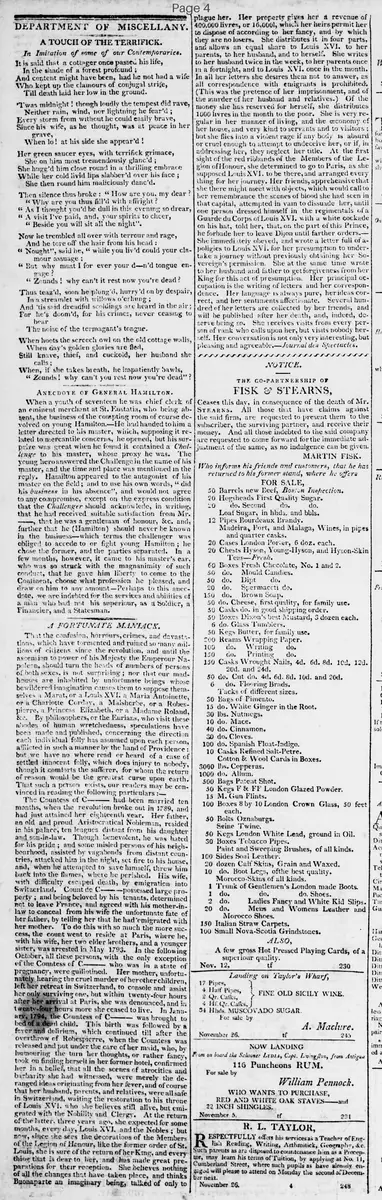
That in the confusion, horrours, crimes, and devastations, which have tormented and ruined so many millions of citizens since the revolution, and until the ascension to power of his Majesty the Emperor Napoleon, should turn the heads of numbers of persons of both sexes, is not surprising; nor that our mad-houses are inhabited by unfortunate beings whose bewildered imagination causes them to suppose themselves a Marat, or a Louis XVI. a Maria Antoinette, or a Charlotte Corday, a Malesherbe, or a Robespierre, a Princess Elizabeth, or a Madame Roland, &c. By philosophers, or the curious, who visit these abodes of human wretchedness, speculations have been made and published, concerning the direction each individual folly has assumed upon each person, afflicted in such a manner by the hand of Providence: but we have no where read or heard of a case of settled innocent folly, which does injury to nobody, though it comforts the sufferer, for whom the return of reason would be the greatest curse upon earth.
That such a person exists, our readers may be convinced in reading the following particulars:--
The Countess of C--- had been married ten months, when the revolution broke out in 1789, and had just attained her eighteenth year. Her father, an old and proud Aristocratical Nobleman, resided in his palace, ten leagues distant from his daughter and son-in-law. Though benevolent, he was hated for his pride; and some misguided persons of his neighbourhood, assisted by vagabonds from distant countries, attacked him in the night, set fire to his house, and, when he attempted to save himself, threw him back into the flames, where he perished. His wife, with difficulty escaped death, by emigration into Switzerland. Count de C--- possessed large property; and being beloved by his tenants, determined not to leave France, and agreed with his mother-in-law to conceal from his wife the unfortunate fate of her father, by telling her that he had emigrated with her mother. To do this with so much the more success, the count went to reside at Paris, where he, with his wife, her two elder brothers, and a younger sister, was arrested in May 1793. In the following October, all these persons, with the only exception of the Countess of C--- who was in a state of pregnancy, were guillotined. Her mother, unfortunately hearing the cruel murder of her other children, left her retreat in Switzerland, to console and assist her only surviving one, but within twenty-four hours after her arrival at Paris, she was denounced, and in twenty-four hours more she ceased to live. In January, 1794, the Countess of C--- was brought to bed of a dead child. This birth was followed by a fever and delirium, which continued till after the overthrow of Robespierre, when the Countess was released and put under the care of her maid, who, by humouring the turn her thoughts, or rather fancy, took on finding herself in her former hotel, confirmed her in a belief, that all the scenes of atrocities and barbarity she had witnessed, were merely the deranged ideas originating from her fever, and of course that her husband, parents, and relatives, were all safe in Switzerland, waiting the restoration to his throne of Louis XVI. who she believes still alive, but emigrated with the Nobility and Clergy. At the return of the latter, three years ago, she expected for some months, every day, Louis XVI. and the Nobles; but now, since she sees the decorations of the Members of the Legion of Honour, like the former order of St. Louis, she is sure of the return of her King, and every thing that is dear to her, and has made great preparations for their reception. She believes nothing of all the changes that have taken place, and thinks Buonaparte an imaginary being, talked of only to plague her. Her property gives her a revenue of 400,000 livres, or 16,000l. which her heirs permit her to dispose of according to her fancy, and by which they are no losers. She distributes it in four parts, and allows an equal share to Louis XVI. to her parents, to her husband, and to herself. She writes to her husband twice in the week, to her parents once in a fortnight, and to Louis XVI. once in the month. In all her letters she desires them not to answer, as all correspondence with emigrants is prohibited. (This was the pretence of her imprisonment, and of the murder of her husband and relatives.) Of the money she has reserved for herself, she distributes 1000 livres in the month to the poor. She is very regular in her manner of living, and the oeconomy of her house, and very kind to servants and to visitors; but she flies into a violent rage if any body is absurd or cruel enough to attempt to undeceive her, or if, in addressing her, they neglect her title. At the first sight of the red ribbands of the Members of the Legion of Honour, she determined to go to Paris, as she supposed Louis XVI. to be there, and arranged every thing for her journey. Her friends, apprehensive that she there might meet with objects, which would call to her remembrance the scenes of blood she had seen in that capital, attempted in vain to dissuade her, until one person dressed himself in the regimentals of a Garde du Corps of Louis XVI. with a white cockade on his hat, told her, that, on the part of this Prince, he forbade her to leave Dijon until farther orders. She immediately obeyed, and wrote a letter full of apologies to Louis XVI. for her presumption to undertake a journey without previously obtaining her Sovereign's permission. She at the same time wrote to her husband and father to get forgiveness from her King for this act of presumption. Her principal occupation is the writing of letters and her correspondence. Her language is always pure, her ideas correct, and her sentiments affectionate. Several hundred of her letters are collected by her friends, and will be published after her death, and, indeed, deserve being so. She receives visits from every person of rank who calls upon her, but visits nobody herself. Her conversation is not only very interesting, but pleasing and agreeable.--Journal des Spectacles.
What sub-type of article is it?
What themes does it cover?
What keywords are associated?
What entities or persons were involved?
Where did it happen?
Story Details
Key Persons
Location
France, Paris, Dijon, Switzerland
Event Date
1789 To 1794, Three Years Ago
Story Details
The Countess of C--- endures family losses during the French Revolution, including her father's murder, relatives' guillotining, and mother's execution. Post-childbirth delirium leads to a delusion that the horrors were fever-induced dreams, with her family safe in Switzerland awaiting Louis XVI's return. She lives comfortably in this belief, managing her estate and corresponding with the imagined exiles.