Thank you for visiting SNEWPapers!
Sign up free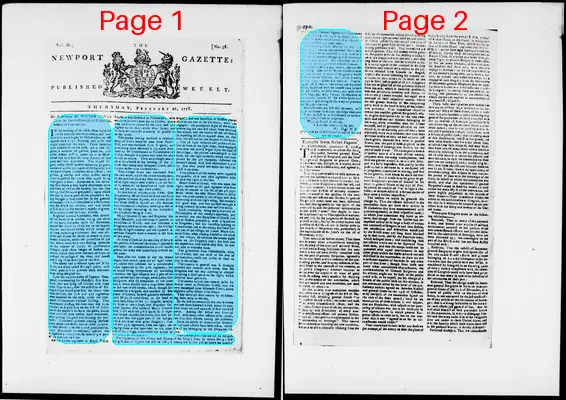
The Newport Gazette
Newport, Newport County, Rhode Island
What is this article about?
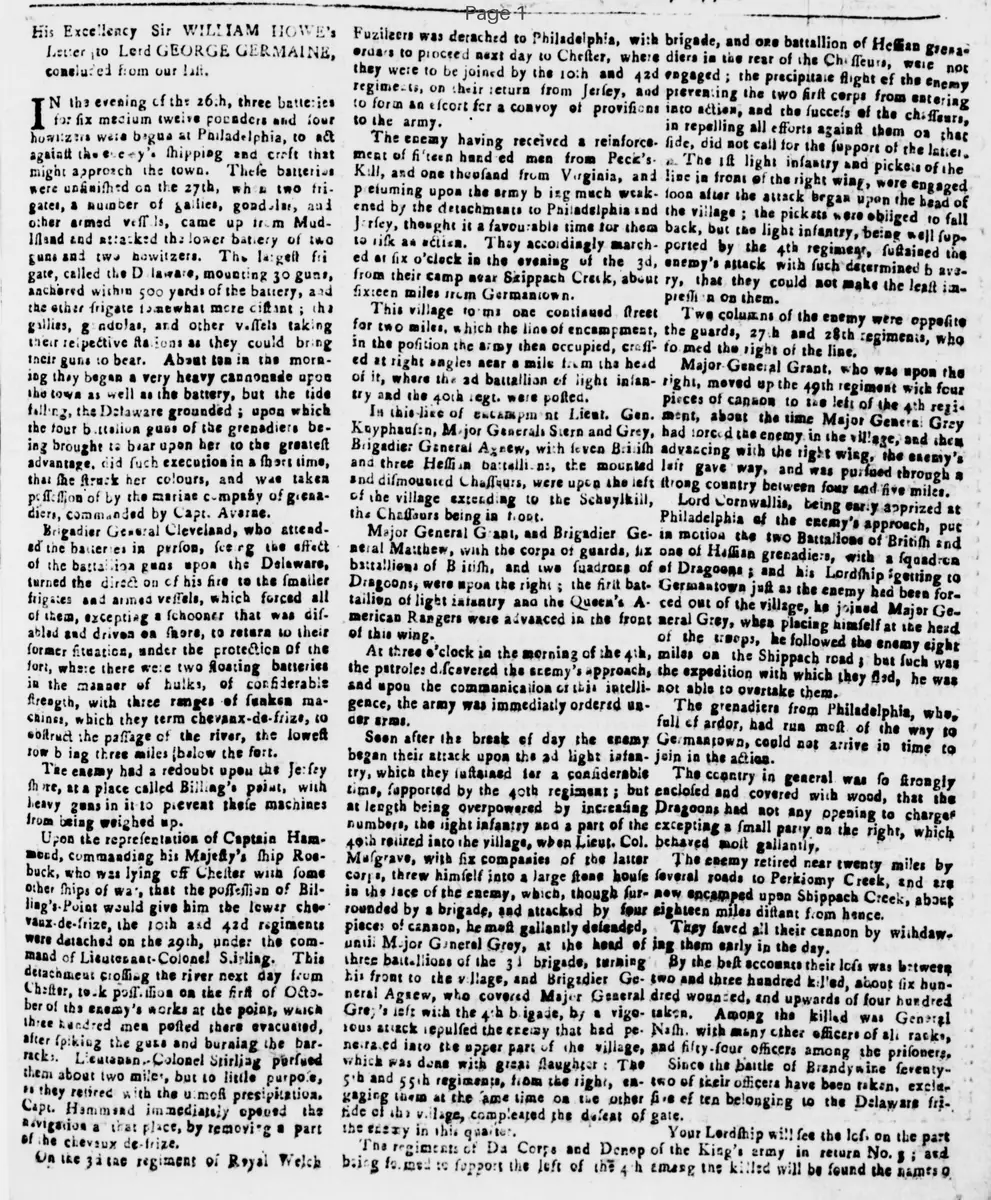
Sir William Howe's letter to Lord George Germaine describes British military actions in October 1777: constructing batteries at Philadelphia, capturing the frigate Delaware, seizing Billing's Point to clear river obstructions, and defeating American forces at the Battle of Germantown, resulting in heavy enemy losses including General Nash.
Merged-components note: These two components form the complete letter from Sir William Howe to Lord George Germaine, continued across pages, with sequential reading orders and identical topic.
Clippings
1 of 2
OCR Quality
Full Text
Letter to Lord GEORGE GERMAINE,
concluded from our last.
On the evening of the 26th, three batteries
for six medium twelve pounders and four
howitzers were begun at Philadelphia, to act
against the enemy's shipping and craft that
might approach the town. These batteries
were unfinished on the 27th, when two frigates,
a number of galleys, gondolas, and
other armed vessels, came up from Mud
Island and attacked the lower battery of two
guns and two howitzers. The largest frigate,
called the Delaware, mounting 30 guns,
anchored within 200 yards of the battery, and
the other frigate was not much more distant: the
galleys, gondolas, and other vessels taking
their respective stations as they could bring
their guns to bear. About ten in the morning
they began a very heavy cannonade upon
the town as well as the battery, but the tide
failing, the Delaware grounded; upon which
the four battalion guns of the grenadiers being
brought to bear upon her to the greatest
advantage, did such execution in a short time,
that she struck her colours, and was taken
possession of by the marine company of officers,
commanded by Capt. Amslie.
Brigadier General Cleves, who attended
the batteries in person, seeing the effect
of the battalion guns upon the Delaware,
turned the direction of his fire to the smaller
frigates and armed vessels, which forced all
of them, excepting a schooner that was disabled
and driven on shore, to return to their
former situations, under the protection of the
fort, where there were two floating batteries
in the manner of hulks, of considerable
strength, with three ranges of sunken machines,
which they term chevaux-de-frise, to
obstruct the passage of the river, the lowest
now being three miles below the fort.
The enemy had a redoubt upon the Jersey
shore, at a place called Billing's point, with
heavy guns in it to prevent these machines
from being weighed up.
Upon the representation of Captain Hammond,
commanding his Majesty's Ship Roebuck,
who was lying off Chester with some
other Ships of war, that the possession of Billing's
Point would give him the lower chevaux-de-frise.
the 33rd and 42nd regiments
were detached on the 29th, under the command
of Lieutenant-Colonel Stirling. This
detachment crossing the river next day from
Chester, took possession on the 1st of October
of the enemy's works at the point, which
three hundred men posted there evacuated,
after spiking the guns and burning the barracks.
Lieutenant-Colonel Stirling pursued
them about two miles, but to little purpose,
they retired with the utmost precipitation.
Capt. Hammond immediately opened the
navigation at that place, by removing part
of the chevaux de-frise.
On the same day the regiment of Royal Welch
Fuzileers was detached to Philadelphia, with
orders to proceed next day to Chester, where
they were to be joined by the 33rd and 42nd
regiments, on their return from Jersey, and
to form an escort for a convoy of provisions
to the army.
The enemy having received a reinforcement
of fifteen hundred men from Peek's
Kill, and one thousand from Virginia, and
presuming upon the army being much weakened
by the detachments to Philadelphia and
Jersey, thought it a favourable time for them
to risk an action. They accordingly marched
at six o'clock in the evening of the 3d,
from their camp near Skippack Creek, about
sixteen miles from Germantown.
This village forms one continued street
for two miles, which the line of encampment,
in the position the army then occupied, crossed
at right angles near a mile from the head
of it, where the 2nd battalion of light infantry
and the 40th regt. were posted.
In this line of encampment Lieutenant Gen.
Knyphausen, Major Generals Stern and Grey.
Brigadier General Agnew, with seven British
and three Hessian battalions, the mounted
and dismounted Chasseurs, were upon the left
of the village extending to the Schuylkill,
the Chasseurs being in front.
Major General Grant, and Brigadier General
Matthew, with the corps of guards, two
battalions of British, and two squadrons of
Dragoons; were upon the right; the first battalion
of light infantry and the Queen's American
Rangers were advanced in the front
of this wing.
At three o'clock in the morning of the 4th,
the patrols discovered the enemy's approach,
and upon the communication giving intelligence,
the army was immediately ordered under
arms.
Soon after the break of day the enemy
began their attack upon the 2nd light infantry,
which they sustained for a considerable
time, supported by the 40th regiment; but at
length being overpowered by increasing numbers,
the light infantry and a part of the
40th retired into the village, when Lieut. Col.
Musgrave, with six companies of the latter
corps, threw himself into a large stone house
in the face of the enemy, which, though surrounded
by a brigade, and attacked by four
pieces of cannon, he most gallantly defended,
until Major General Grey, at the head of three
battalions of the 3rd brigade, turning
his front to the village, and Brigadier General
Agnew, who covered Major General
Grey's left with the 4th brigade, by a vigorous
attack repulsed the enemy that had penetrated
into the upper part of the village,
which was done with great slaughter: The
52nd and 55th regiments, from the right, engaging
them at the same time on the other side
of the village, completed the defeat of
the enemy on this quarter.
The regiments of De Borre and De Kop of the King's army in return No. 5 and being formed to support the left of the 4th brigade, and one battalion of Hessian grenadiers
in the rear of the Chasseurs, were not
engaged; the precipitate flight of the enemy
preventing the two first corps from entering
into action, and the success of the chasseurs,
in repelling all efforts against them on that
side, did not call for the support of the latter.
On the right. The 1st light infantry and pickets of the
line in front of the right wing, were engaged
soon after the attack began upon the head of
the village; the pickets were obliged to fall
back, but the light infantry, being well supported
by the 4th regiment, sustained the
enemy's attack with such determined obstinacy,
that they could not make the least impression
on them.
Two columns of the enemy were opposite
the guards, 27th and 28th regiments, who
formed the right of the line.
Major General Grant, who was upon the
right, moved up the 46th regiment with four
pieces of cannon to the left of the 4th regiment,
about the time Major General Grey
had forced the enemy in the village, and then
advancing with the right wing, the enemy's
left gave way, and was pursued through a
strong country between four and five miles.
Lord Cornwallis, being early apprised at
Philadelphia of the enemy's approach, put
in motion the two Battalions of British and
one of Hessian grenadiers, with a squadron
of Dragoons; and his Lordship getting to
Germantown just as the enemy had been forced
out of the village, he joined Major General
Grey, when placing himself at the head
of the troops, he followed the enemy eight
miles on the Skippack road; but such was
the expedition with which they fled, he was
not able to overtake them.
The grenadiers from Philadelphia, who,
full of ardor, had run most of the way to
Germantown, could not arrive in time to
join in the action.
The country in general was so strongly
enclosed and covered with wood, that the
Dragoons had not any opening to charge
excepting a small party on the right, which
behaved most gallantly.
The enemy retired near twenty miles by
several roads to Perkiomy Creek, and now
encamped upon Skippack Creek, about
eighteen miles distant from hence.
They saved all their cannon by withdrawing
them early in the day.
By the best accounts their loss was between
two and three hundred killed, about six hundred
wounded, and upwards of four hundred
taken. Among the killed was General
Nash, with many other officers of all ranks,
and fifty-four officers among the prisoners.
Since the battle of Brandywine seventy-two
of their officers have been taken, exclusive
of ten belonging to the Delaware frigate.
Slain in their quarters.
Your Lordship will see the loss, on the part
of the King's army in return No. 5: and
being the killed will be found the names of.
Brigadier General Agnew and Lieutenant Colonel Bird of the 10th regiment, both of whom were so much lamented by their fellow officers as
Lieutenant Colonel Walcot of the 5th regiment, is among the wounded, but I have the pleasure to report that he is now in a fair way of recovery though still confined by his wound which was in his thigh. His behaviour on this occasion does him infinite honour.
In his former engagements, the successes at least they have had against them are far better vouchers than any such casual conveyances of conduct. The General Officers, and of the bravery of the other officers and soldiers. The fatigues of a march exceeding one hundred miles, supported with the utmost cheerfulness by all ranks without tents, and with very little baggage, will, I hope, be esteemed as convincing proofs of the noble spirit and
emulation prevailing in the army to promote his Majesty's service.
Major Cuyler, my first Aid-de-Camp, will have the honour to deliver my dispatches, and I flatter myself is well informed to answer your Lordship's further enquiries.
With most perfect respect,
I have the honour to be, &c.
W. HOWE.
(For returns of killed and wounded see the last page.)
What sub-type of article is it?
What themes does it cover?
What keywords are associated?
What entities or persons were involved?
Where did it happen?
Story Details
Key Persons
Location
Philadelphia, Germantown, Schuylkill River, Jersey Shore
Event Date
October 1777
Story Details
British forces under Howe construct batteries at Philadelphia, capture the frigate Delaware on October 27, seize Billing's Point on October 1 to clear river obstacles, and repel American attack at Germantown on October 4, pursuing the retreating enemy with significant casualties inflicted.