Thank you for visiting SNEWPapers!
Sign up free
New Hampshire Statesman And State Journal
Concord, Merrimack County, New Hampshire
What is this article about?
The London Quarterly Review critiques the London Zoological Gardens' site and conditions, noting issues with damp London clay causing pond-like areas and humidity that lead to diseases in captive animals, contrasting their natural freedom with caged life. It suggests improvements like larger, drier, ventilated dens. Despite faults, the establishment is approved by good judges.
Clipping
OCR Quality
Full Text
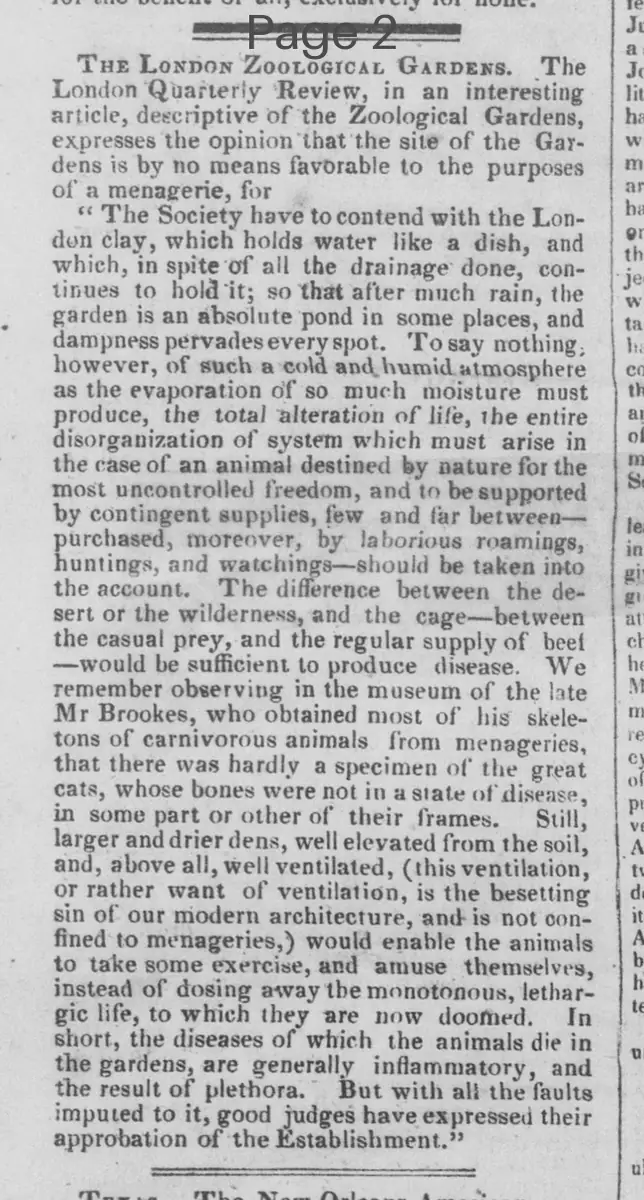
"The Society have to contend with the London clay, which holds water like a dish, and which, in spite of all the drainage done, continues to hold it; so that after much rain, the garden is an absolute pond in some places, and dampness pervades every spot. To say nothing, however, of such a cold and humid atmosphere as the evaporation of so much moisture must produce, the total alteration of life, the entire disorganization of system which must arise in the case of an animal destined by nature for the most uncontrolled freedom, and to be supported by contingent supplies, few and far between—purchased, moreover, by laborious roamings, huntings, and watchings—should be taken into the account. The difference between the desert or the wilderness, and the cage—between the casual prey, and the regular supply of beef—would be sufficient to produce disease. We remember observing in the museum of the late Mr. Brookes, who obtained most of his skeletons of carnivorous animals from menageries, that there was hardly a specimen of the great cats, whose bones were not in a state of disease in some part or other of their frames. Still larger and drier dens, well elevated from the soil, and, above all, well ventilated, (this ventilation, or rather want of ventilation, is the besetting sin of our modern architecture, and is not confined to menageries,) would enable the animals to take some exercise, and amuse themselves, instead of dosing away the monotonous, lethargic life, to which they are now doomed. In short, the diseases of which the animals die in the gardens, are generally inflammatory, and the result of plethora." But with all the faults imputed to it, good judges have expressed their approbation of the Establishment.
What sub-type of article is it?
What themes does it cover?
What keywords are associated?
What entities or persons were involved?
Where did it happen?
Story Details
Key Persons
Location
London Zoological Gardens
Story Details
Critique of the Zoological Gardens' damp site causing humidity and diseases in animals due to contrast with natural freedom; observation of diseased skeletons from menageries; suggestions for better housing; diseases are inflammatory from plethora.