Thank you for visiting SNEWPapers!
Sign up free
The Columbus Commercial
Columbus, Lowndes County, Mississippi
What is this article about?
Vast undeveloped coal fields in Oklahoma and iron ore projects in Virginia offer potential riches amid financial stress. Historical examples show panics birthed fortunes for Tiffany & Co. (1871), Stanford (1857), Cooke (1873-93), and Gould (1857-73), turning crises into opportunities for success.
Clipping
OCR Quality
Full Text
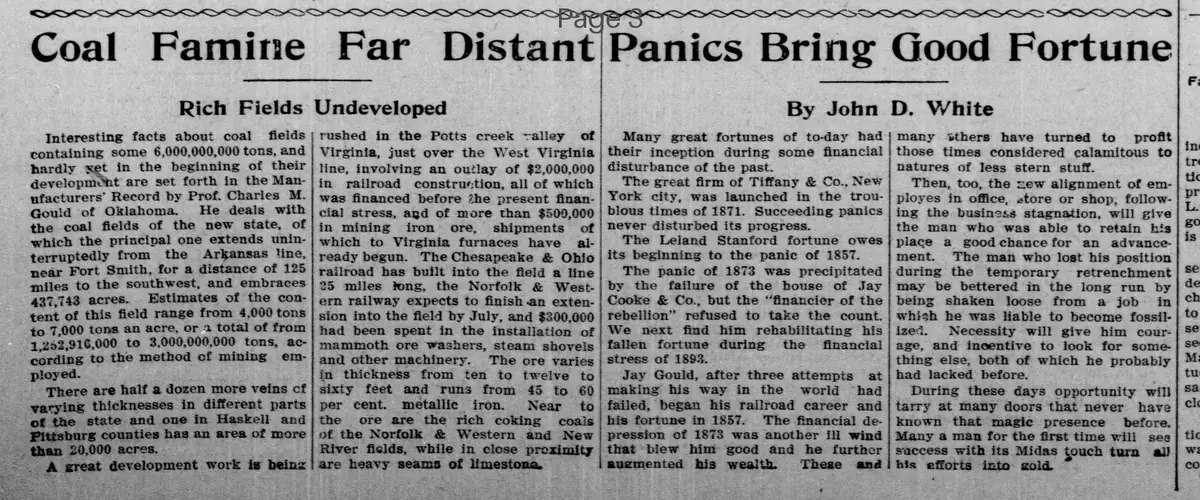
By John D. White
Interesting facts about coal fields containing some 6,000,000,000 tons, and hardly yet in the beginning of their development are set forth in the Manufacturers' Record by Prof. Charles M. Gould of Oklahoma. He deals with the coal fields of the new state, of which the principal one extends uninterruptedly from the Arkansas line, near Fort Smith, for a distance of 125 miles to the southwest, and embraces 437,743 acres. Estimates of the content of this field range from 4,000 tons to 7,000 tons an acre, or a total of from 1,252,916,000 to 3,000,000,000 tons, according to the method of mining employed.
There are half a dozen more veins of varying thicknesses in different parts of the state and one in Haskell and Pittsburg counties has an area of more than 20,000 acres.
A great development work is being rushed in the Potts creek valley of Virginia, just over the West Virginia line, involving an outlay of $2,000,000 in railroad construction, all of which was financed before the present financial stress, and of more than $500,000 in mining iron ore, shipments of which to Virginia furnaces have already begun. The Chesapeake & Ohio railroad has built into the field a line 25 miles long, the Norfolk & Western railway expects to finish an extension into the field by July, and $300,000 had been spent in the installation of mammoth ore washers, steam shovels and other machinery. The ore varies in thickness from ten to twelve to sixty feet and runs from 45 to 60 per cent. metallic iron. Near to the ore are the rich coking coals of the Norfolk & Western and New River fields, while in close proximity are heavy seams of limestone.
Many great fortunes of to-day had their inception during some financial disturbance of the past.
The great firm of Tiffany & Co., New York city, was launched in the troublous times of 1871. Succeeding panics never disturbed its progress.
The Leland Stanford fortune owes its beginning to the panic of 1857.
The panic of 1873 was precipitated by the failure of the house of Jay Cooke & Co., but the "financier of the rebellion" refused to take the count.
We next find him rehabilitating his fallen fortune during the financial stress of 1893.
Jay Gould, after three attempts at making his way in the world had failed, began his railroad career and his fortune in 1857. The financial depression of 1873 was another ill wind that blew him good and he further augmented his wealth. These and many others have turned to profit those times considered calamitous to natures of less stern stuff.
Then, too, the new alignment of employees in office, store or shop, following the business stagnation, will give the man who was able to retain his place a good chance for an advancement. The man who lost his position during the temporary retrenchment may be bettered in the long run by being shaken loose from a job in which he was liable to become fossilized. Necessity will give him courage, and incentive to look for something else, both of which he probably had lacked before.
During these days opportunity will tarry at many doors that never have known that magic presence before.
Many a man for the first time will see success with its Midas touch turn all his efforts into gold.
What sub-type of article is it?
What themes does it cover?
What keywords are associated?
What entities or persons were involved?
Where did it happen?
Story Details
Key Persons
Location
Oklahoma, Virginia
Story Details
Article by John D. White presents facts on vast undeveloped coal fields in Oklahoma containing billions of tons and iron ore development in Potts Creek Valley, Virginia, financed before financial stress. It highlights how past panics launched fortunes for Tiffany & Co. in 1871, Leland Stanford in 1857, Jay Cooke after 1873 and 1893, and Jay Gould in 1857 and 1873, suggesting opportunities arise during economic downturns for advancement and success.