Thank you for visiting SNEWPapers!
Sign up free
Story
October 23, 1867
The Southern Enterprise
Greenville, Greenville County, South Carolina
What is this article about?
A traveler's memorable visit to Stratford-on-Avon on July 14th, touring Shakespeare's church tomb and bust, family graves, New Place site, grammar school, and Anne Hathaway's cottage, with reflections on the Bard's life and legacy.
Clipping
OCR Quality
98%
Excellent
Full Text
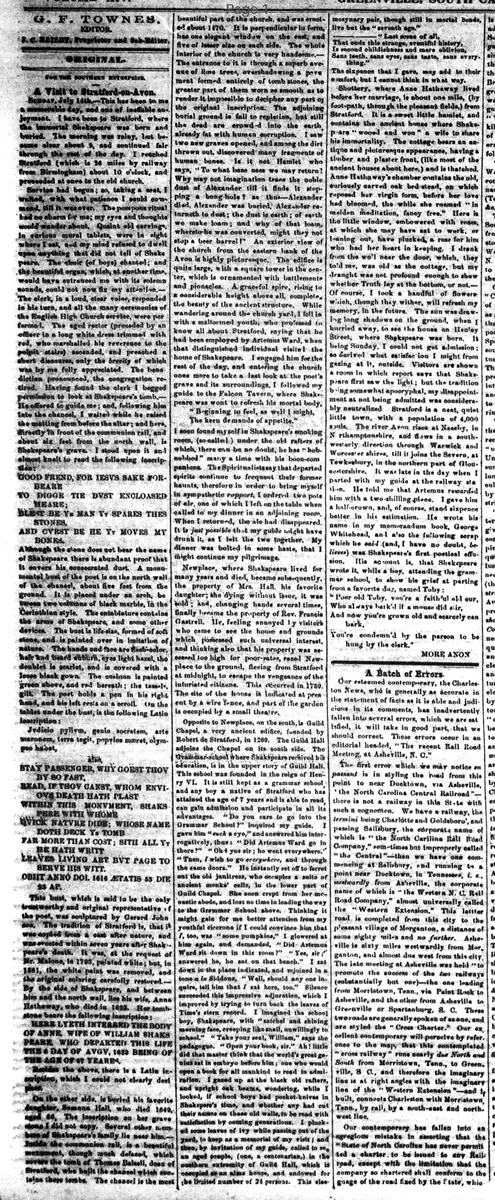
A Visit to Stratford-on-Avon.
-Sugar, July 14th. This has been to me a memorable day and one of ineffable enjoyment. I have been to Stratford, where the immortal Shakespeare was born and buried. The morning was rainy, but became clear about 9, and continued fair through the rest of the day. I reached Stratford (which is 26 miles by railway from Birmingham) about 10 o'clock, and proceeded at once to the old church.
Service had begun: so, taking a seat, I waited with what patience I could command, till it was over. The pompous ritual had no charm for me; my eyes and thoughts could wander about. Quaint old carvings, in curious mural tablets, were in sight where I sat, and my mind refused to dwell on anything that did not tell of Shakespeare. The choir (of boys) chanted; and the beautiful organ, which, at another time, would have entranced me with its solemn sounds, could not now fix my attention.
The clerk, in a loud, clear voice, responded in his turn, and all the many ceremonies of the English High Church service, were performed. The aged rector (preceded by an officer in a long white dress trimmed with gold, who marshalled his reverence to the pulpit stairs) ascended, and preached a short discourse, only the brevity of which was by me fully appreciated. The benediction pronounced, the congregation retired. Having found the clerk I begged permission to look at Shakespeare's tomb.
He offered to guide me; and, following him into the chancel, I waited while he raised the matting from before the altar; and here, directly in front of the communion rail, and about six feet from the north wall, is Shakespeare's grave. I stood upon it and almost knelt to read the following inscription:
GOOD FRIEND, FOR JESUS SAKE FORBEARE
TO DIGGE THE DUST ENCLOSED HEARE:
BLEST BE YE MAN YT SPARES THES STONES,
AND CURST BE HE YT MOVES MY BONES.
Although the stone does not bear the name of Shakespeare, there is abundant proof that it covers his consecrated dust. A monumental bust of the poet is on the north wall of the chancel about five feet from the ground. It is placed under an arch, between two coffins of black marble, in the Corinthian style. The entablature contains the arms of Shakespeare, and some other devices. This bust is life-size, formed of soft stone, and is painted over in imitation of nature. The hands and face are flesh-color, hair and beard auburn, eyes light hazel, the doublet is scarlet, and is covered with a loose black gown. The cushion is painted green above, and red beneath; the tassel gilt. The poet holds a pen in his right hand, and his left rests on a scroll. (In the tablet under the bust, is the following Latin inscription:
Jvdicio pylivm, genio socratem, arte waronem, terra tegit, popylos macret, olympos baoet,
STAY PASSENGER, WHY GOEST THOU BY SO FAST
READ, IF THOU CANST, WHOM ENVI OVS DEATH HATH PLAST
WITHIN THIS MONVMENT, SHAKS PERE WITH WHOME
QVICK NATVRE DIDE; WHOSE NAME DOTH DECK Y. TOMB
FAR MORE THAN COST: SITH ALL YT HE HATH WRITI
LEAVES LIVING ART BVT PAGE TO SERVE HIS WITT.
OBIT ANNO DOI. 1616 AETATIS 53 DIE 23 AP.
This bust, which is said to be the only trustworthy and original representative of the poet, was sculptured by Gerard Johnson. The tradition of Stratford is, that it was copied from a cast after nature, and was erected within seven years after Shakespeare's death. It was, at the request of Mr. Malone, in 1793, painted white; but, in 1864, the white paint was removed, and the original coloring carefully restored.
By the side of Shakespeare, and between him and the north wall, lies his wife, Anne Hathaway, who died in 1623. Her tombstone bears the following inscription:
HERE LYETH INTERRED THE BODY OF ANNE, WIFE OF WILLIAM SHAKS PEARE. WHO DEPARTEI THIS LIFE THE 6 DAY OF AVGV, 1623 BEING OF THE AGE OF 67 YEARE.
Besides the above, there is a Latin inscription, which I could not clearly decipher.
On the other side, is buried his favorite daughter, Susanna Hall, who died 1649, aged 66. The inscription on her grave stone I did not copy. Several other members of Shakespeare's family lie near him.
Inside the communion rail, in a beautiful monument, though much defaced, which covers the tomb of Thomas Balsall, dean of Stratford, who built this chancel which contains these tombs. The chancel is the most beautiful part of the church, and was erected about 1470. It is perpendicular in form, has one elegant window on the east; and five of lesser size on each side. The whole interior of the church is very handsome.
The entrance to it is through a superb avenue of lime trees, overshadowing a pavement formed entirely of tomb stones, the greater part of them worn so smooth as to render it impossible to decipher any part of the original inscription. The adjoining burial ground is full to repletion, but still the dead are crowded into the earth already fat with human corruption. I saw two new graves opened, and among the dirt thrown out, discovered many fragments of human bones. Is it not Hamlet who says, "To what base uses we may return! Why may not imagination trace the noble dust of Alexander till it finds it stopping a bung-hole? Ne'er such--Alexander died, Alexander was buried, Alexander returneth to dust; the dust is earth; of earth we make loam; and why of that loam, whereto he was converted, might they not stop a beer barrel!" An exterior view of the church from the eastern bank of the Avon is highly picturesque. The edifice is quite large, with a square tower in the center, which is ornamented with battlements and pinnacles. A graceful spire, rising to a considerable height above all, completes the beauty of the ancient structure. While wandering around the church yard, I fell in with a malformed youth, who professed to know all about Stratford, saying that he had been employed by Artemus Ward, when that distinguished individual visited the home of Shakespeare. I engaged him for the rest of the day, and entering the church once more to take a last look at the poet's grave and its surroundings, followed my guide to the Falcon Tavern, where Shakespeare was wont to refresh his mortal body.
"Beginning to feel, as well I might,
The keen demands of appetite."
I soon found myself in Shakespeare's smoking room, (so called) under the old rafters of which, there can be no doubt, he has "hob-nobbed" many a time with his boon companions. The Spiritualists say that departed spirits continue to frequent their former haunts, therefore in order to bring myself in sympathetic rapport, I ordered two pots of ale, one of which I left on the table when called to my dinner in an adjoining room. When I returned, the ale had disappeared. It is just possible that my guide might have drunk it, as I left the two together. My dinner was bolted in some haste, that I might continue my pilgrimage.
New Place, where Shakespeare lived for many years and died, became subsequently the property of Mrs. Hall, his favorite daughter; she dying without issue, it was sold; and, changing hands several times, finally became the property of Rev. Francis Gastrell. He, feeling annoyed by visitors who came to see the house and grounds which possessed such universal interest, and thinking also that his property was assessed too high for poor-rates, razed New Place to the ground, fleeing from Stratford at midnight, to escape the vengeance of the infuriated citizens. This occurred in 1759. The site of the house is indicated at present by a wire fence, and part of the garden is occupied by a small theatre.
Opposite to New Place, on the south, is Guild Chapel, a very ancient edifice, founded by Robert de Stratford, in 1269. The Guild Hall adjoins the Chapel on its south side. The Grammar school where Shakespeare received his education, is in the upper story of Guild Hall. This school was founded in the reign of Henry VI. It is still kept as a grammar school and any boy a native of Stratford who has attained the age of 7 years and is able to read, can gain admission and participate in all its advantages. "Do you care to go into the Grammar School?" inquired my guide. I gave him "such an eye," and answered him interrogatively, thus: "Did Artemus Ward go in there?" "Oh! yes sir; he went everywhere." "Then, I wish to go everywhere, and through the same doors." He instantly set off to ferret out the old janitress, who occupies a suite of ancient monks' cells, in the lower part of Guild Chapel. She soon crept from her monastic abode, and lost no time in leading the way to the Grammar School above. Thinking it might gain for me better attention from my youthful cicerone if I could convince him that I, too, was "some pumpkins," I glowered at him again, and demanded, "Did Artemus Ward sit down in this room?" "Yes, sir; answered he, he sat on that bench." I sat down in the place indicated, and rejoined in a tone a la Siddons, "Well, should any one inquire, tell him that I sat here, too." Silence succeeded this impressive adjuration, which I improved by trying to turn back the leaves of Time's stern record. I imagined the school boy, Shakespeare, with "satchel and shining morning face, creeping like a snail, unwillingly to school." "Take your seat, William," says the pedagogue. "Open your book, sir." Ah! little did that master think that the world's great genius sat in embryo before him; one who would open a book for all mankind to read in admiration. I gazed up at the black old rafters, and upright oak beams, wondering, while I looked, if school boys had pocket-knives in Shakespeare's time, and whether any had cut their names on those old walls, to be read with satisfaction by coming generations. I plucked some leaves of ivy while passing out of the yard, to keep as a memorial of my visit; and then, by invitation of my guide, called to see an aged couple, (one, a centenarian,) in the southern extremity of Guild Hall, which is occupied as an alms house, and endowed for the limited number of 24 persons. This eleemosynary pair, though still in mortal bonds live but the "seventh age."
"Last scene of all,
That ends this strange, eventful history,
Is second childishness and mere oblivion,
Sans teeth, sans eyes, sans taste, sans everything."
The sixpence that I gave, may add to their comfort, but I cannot think in what way.
Shottery, where Anne Hathaway lived before her marriage, is about one mile, (by foot-path, through the pleasant fields,) from Stratford. It is a sweet little hamlet, and contains the ancient house where Shakespeare "wooed and won" wife to share his immortality. The cottage bears an antique and picturesque appearance, having a timber and plaster front, (like most of the ancient houses about here,) and is thatched. Anne Hathaway's chamber contains the old, curiously carved oak bedstead, on which reposed her virgin form, before her love had bloomed, the while she roamed "in maiden meditation, fancy free." Here is the little window, embowered with roses, at which she may have sat to work, or leaning out, have plucked a rose for him who had her heart in keeping. I drank from the well near the door, which, they told me, was older than the cottage, but my draught was not profound enough to show whether Truth lay at the bottom, or not. Of course, I took a handful of flowers--which, though they wither, will refresh my memory in the future. The sun was drawing long shadows on the ground, when I hurried away, to see the house on Henley Street, where Shakespeare was born. It being Sunday, I could not get admission; so derived what satisfaction I might from gazing at it, outside. Visitors are shown a room in which report says that Shakespeare first saw the light; but the tradition being somewhat apocryphal, my disappointment at not being admitted was considerably neutralized. Stratford is a neat, quiet little town, with a population of 4,000 souls. The river Avon rises at Naseby, in Northamptonshire, and flows in a southwesterly direction through Warwick and Worcester shires, till it joins the Severn, at Tewkesbury, in the northern part of Gloucester. shire. It was late in the day, when I parted with my guide at the railway station. He told me that Artemus rewarded him with a two-shilling piece. I gave him a half-crown, and, of course, stand sixpence better in his estimation. I wrote his name in my memorandum book, George Whitehead, and also the following scrap which he said (and, I have no doubt, believes) was Shakespeare's first poetical effusion.
His account is, that Shakespeare wrote it, while a boy, attending the grammar school, to show "his grief at parting from a favorite dog, named Toby:
"Poor old Toby, you're a faithful old cur,
Who always bark'd if a mouse did stir,
And now you're grown old and scarcely can bark."
You're condemn'd by the parson to be hung by the clerk.
MORE ANON.
-Sugar, July 14th. This has been to me a memorable day and one of ineffable enjoyment. I have been to Stratford, where the immortal Shakespeare was born and buried. The morning was rainy, but became clear about 9, and continued fair through the rest of the day. I reached Stratford (which is 26 miles by railway from Birmingham) about 10 o'clock, and proceeded at once to the old church.
Service had begun: so, taking a seat, I waited with what patience I could command, till it was over. The pompous ritual had no charm for me; my eyes and thoughts could wander about. Quaint old carvings, in curious mural tablets, were in sight where I sat, and my mind refused to dwell on anything that did not tell of Shakespeare. The choir (of boys) chanted; and the beautiful organ, which, at another time, would have entranced me with its solemn sounds, could not now fix my attention.
The clerk, in a loud, clear voice, responded in his turn, and all the many ceremonies of the English High Church service, were performed. The aged rector (preceded by an officer in a long white dress trimmed with gold, who marshalled his reverence to the pulpit stairs) ascended, and preached a short discourse, only the brevity of which was by me fully appreciated. The benediction pronounced, the congregation retired. Having found the clerk I begged permission to look at Shakespeare's tomb.
He offered to guide me; and, following him into the chancel, I waited while he raised the matting from before the altar; and here, directly in front of the communion rail, and about six feet from the north wall, is Shakespeare's grave. I stood upon it and almost knelt to read the following inscription:
GOOD FRIEND, FOR JESUS SAKE FORBEARE
TO DIGGE THE DUST ENCLOSED HEARE:
BLEST BE YE MAN YT SPARES THES STONES,
AND CURST BE HE YT MOVES MY BONES.
Although the stone does not bear the name of Shakespeare, there is abundant proof that it covers his consecrated dust. A monumental bust of the poet is on the north wall of the chancel about five feet from the ground. It is placed under an arch, between two coffins of black marble, in the Corinthian style. The entablature contains the arms of Shakespeare, and some other devices. This bust is life-size, formed of soft stone, and is painted over in imitation of nature. The hands and face are flesh-color, hair and beard auburn, eyes light hazel, the doublet is scarlet, and is covered with a loose black gown. The cushion is painted green above, and red beneath; the tassel gilt. The poet holds a pen in his right hand, and his left rests on a scroll. (In the tablet under the bust, is the following Latin inscription:
Jvdicio pylivm, genio socratem, arte waronem, terra tegit, popylos macret, olympos baoet,
STAY PASSENGER, WHY GOEST THOU BY SO FAST
READ, IF THOU CANST, WHOM ENVI OVS DEATH HATH PLAST
WITHIN THIS MONVMENT, SHAKS PERE WITH WHOME
QVICK NATVRE DIDE; WHOSE NAME DOTH DECK Y. TOMB
FAR MORE THAN COST: SITH ALL YT HE HATH WRITI
LEAVES LIVING ART BVT PAGE TO SERVE HIS WITT.
OBIT ANNO DOI. 1616 AETATIS 53 DIE 23 AP.
This bust, which is said to be the only trustworthy and original representative of the poet, was sculptured by Gerard Johnson. The tradition of Stratford is, that it was copied from a cast after nature, and was erected within seven years after Shakespeare's death. It was, at the request of Mr. Malone, in 1793, painted white; but, in 1864, the white paint was removed, and the original coloring carefully restored.
By the side of Shakespeare, and between him and the north wall, lies his wife, Anne Hathaway, who died in 1623. Her tombstone bears the following inscription:
HERE LYETH INTERRED THE BODY OF ANNE, WIFE OF WILLIAM SHAKS PEARE. WHO DEPARTEI THIS LIFE THE 6 DAY OF AVGV, 1623 BEING OF THE AGE OF 67 YEARE.
Besides the above, there is a Latin inscription, which I could not clearly decipher.
On the other side, is buried his favorite daughter, Susanna Hall, who died 1649, aged 66. The inscription on her grave stone I did not copy. Several other members of Shakespeare's family lie near him.
Inside the communion rail, in a beautiful monument, though much defaced, which covers the tomb of Thomas Balsall, dean of Stratford, who built this chancel which contains these tombs. The chancel is the most beautiful part of the church, and was erected about 1470. It is perpendicular in form, has one elegant window on the east; and five of lesser size on each side. The whole interior of the church is very handsome.
The entrance to it is through a superb avenue of lime trees, overshadowing a pavement formed entirely of tomb stones, the greater part of them worn so smooth as to render it impossible to decipher any part of the original inscription. The adjoining burial ground is full to repletion, but still the dead are crowded into the earth already fat with human corruption. I saw two new graves opened, and among the dirt thrown out, discovered many fragments of human bones. Is it not Hamlet who says, "To what base uses we may return! Why may not imagination trace the noble dust of Alexander till it finds it stopping a bung-hole? Ne'er such--Alexander died, Alexander was buried, Alexander returneth to dust; the dust is earth; of earth we make loam; and why of that loam, whereto he was converted, might they not stop a beer barrel!" An exterior view of the church from the eastern bank of the Avon is highly picturesque. The edifice is quite large, with a square tower in the center, which is ornamented with battlements and pinnacles. A graceful spire, rising to a considerable height above all, completes the beauty of the ancient structure. While wandering around the church yard, I fell in with a malformed youth, who professed to know all about Stratford, saying that he had been employed by Artemus Ward, when that distinguished individual visited the home of Shakespeare. I engaged him for the rest of the day, and entering the church once more to take a last look at the poet's grave and its surroundings, followed my guide to the Falcon Tavern, where Shakespeare was wont to refresh his mortal body.
"Beginning to feel, as well I might,
The keen demands of appetite."
I soon found myself in Shakespeare's smoking room, (so called) under the old rafters of which, there can be no doubt, he has "hob-nobbed" many a time with his boon companions. The Spiritualists say that departed spirits continue to frequent their former haunts, therefore in order to bring myself in sympathetic rapport, I ordered two pots of ale, one of which I left on the table when called to my dinner in an adjoining room. When I returned, the ale had disappeared. It is just possible that my guide might have drunk it, as I left the two together. My dinner was bolted in some haste, that I might continue my pilgrimage.
New Place, where Shakespeare lived for many years and died, became subsequently the property of Mrs. Hall, his favorite daughter; she dying without issue, it was sold; and, changing hands several times, finally became the property of Rev. Francis Gastrell. He, feeling annoyed by visitors who came to see the house and grounds which possessed such universal interest, and thinking also that his property was assessed too high for poor-rates, razed New Place to the ground, fleeing from Stratford at midnight, to escape the vengeance of the infuriated citizens. This occurred in 1759. The site of the house is indicated at present by a wire fence, and part of the garden is occupied by a small theatre.
Opposite to New Place, on the south, is Guild Chapel, a very ancient edifice, founded by Robert de Stratford, in 1269. The Guild Hall adjoins the Chapel on its south side. The Grammar school where Shakespeare received his education, is in the upper story of Guild Hall. This school was founded in the reign of Henry VI. It is still kept as a grammar school and any boy a native of Stratford who has attained the age of 7 years and is able to read, can gain admission and participate in all its advantages. "Do you care to go into the Grammar School?" inquired my guide. I gave him "such an eye," and answered him interrogatively, thus: "Did Artemus Ward go in there?" "Oh! yes sir; he went everywhere." "Then, I wish to go everywhere, and through the same doors." He instantly set off to ferret out the old janitress, who occupies a suite of ancient monks' cells, in the lower part of Guild Chapel. She soon crept from her monastic abode, and lost no time in leading the way to the Grammar School above. Thinking it might gain for me better attention from my youthful cicerone if I could convince him that I, too, was "some pumpkins," I glowered at him again, and demanded, "Did Artemus Ward sit down in this room?" "Yes, sir; answered he, he sat on that bench." I sat down in the place indicated, and rejoined in a tone a la Siddons, "Well, should any one inquire, tell him that I sat here, too." Silence succeeded this impressive adjuration, which I improved by trying to turn back the leaves of Time's stern record. I imagined the school boy, Shakespeare, with "satchel and shining morning face, creeping like a snail, unwillingly to school." "Take your seat, William," says the pedagogue. "Open your book, sir." Ah! little did that master think that the world's great genius sat in embryo before him; one who would open a book for all mankind to read in admiration. I gazed up at the black old rafters, and upright oak beams, wondering, while I looked, if school boys had pocket-knives in Shakespeare's time, and whether any had cut their names on those old walls, to be read with satisfaction by coming generations. I plucked some leaves of ivy while passing out of the yard, to keep as a memorial of my visit; and then, by invitation of my guide, called to see an aged couple, (one, a centenarian,) in the southern extremity of Guild Hall, which is occupied as an alms house, and endowed for the limited number of 24 persons. This eleemosynary pair, though still in mortal bonds live but the "seventh age."
"Last scene of all,
That ends this strange, eventful history,
Is second childishness and mere oblivion,
Sans teeth, sans eyes, sans taste, sans everything."
The sixpence that I gave, may add to their comfort, but I cannot think in what way.
Shottery, where Anne Hathaway lived before her marriage, is about one mile, (by foot-path, through the pleasant fields,) from Stratford. It is a sweet little hamlet, and contains the ancient house where Shakespeare "wooed and won" wife to share his immortality. The cottage bears an antique and picturesque appearance, having a timber and plaster front, (like most of the ancient houses about here,) and is thatched. Anne Hathaway's chamber contains the old, curiously carved oak bedstead, on which reposed her virgin form, before her love had bloomed, the while she roamed "in maiden meditation, fancy free." Here is the little window, embowered with roses, at which she may have sat to work, or leaning out, have plucked a rose for him who had her heart in keeping. I drank from the well near the door, which, they told me, was older than the cottage, but my draught was not profound enough to show whether Truth lay at the bottom, or not. Of course, I took a handful of flowers--which, though they wither, will refresh my memory in the future. The sun was drawing long shadows on the ground, when I hurried away, to see the house on Henley Street, where Shakespeare was born. It being Sunday, I could not get admission; so derived what satisfaction I might from gazing at it, outside. Visitors are shown a room in which report says that Shakespeare first saw the light; but the tradition being somewhat apocryphal, my disappointment at not being admitted was considerably neutralized. Stratford is a neat, quiet little town, with a population of 4,000 souls. The river Avon rises at Naseby, in Northamptonshire, and flows in a southwesterly direction through Warwick and Worcester shires, till it joins the Severn, at Tewkesbury, in the northern part of Gloucester. shire. It was late in the day, when I parted with my guide at the railway station. He told me that Artemus rewarded him with a two-shilling piece. I gave him a half-crown, and, of course, stand sixpence better in his estimation. I wrote his name in my memorandum book, George Whitehead, and also the following scrap which he said (and, I have no doubt, believes) was Shakespeare's first poetical effusion.
His account is, that Shakespeare wrote it, while a boy, attending the grammar school, to show "his grief at parting from a favorite dog, named Toby:
"Poor old Toby, you're a faithful old cur,
Who always bark'd if a mouse did stir,
And now you're grown old and scarcely can bark."
You're condemn'd by the parson to be hung by the clerk.
MORE ANON.
What sub-type of article is it?
Journey
Biography
Historical Event
What themes does it cover?
Exploration
What keywords are associated?
Stratford On Avon
Shakespeare Tomb
Anne Hathaway Cottage
Holy Trinity Church
New Place
Grammar School
Literary Pilgrimage
What entities or persons were involved?
William Shakespeare
Anne Hathaway
Susanna Hall
George Whitehead
Artemus Ward
Where did it happen?
Stratford On Avon
Story Details
Key Persons
William Shakespeare
Anne Hathaway
Susanna Hall
George Whitehead
Artemus Ward
Location
Stratford On Avon
Event Date
July 14th
Story Details
A visitor tours Shakespeare's grave, bust, and family tombs in Holy Trinity Church; visits the site of New Place, Guild Chapel, and grammar school; explores Anne Hathaway's cottage in Shottery; reflects on Shakespeare's life and legacy with guide George Whitehead.