Thank you for visiting SNEWPapers!
Sign up free
The Wilmington Morning Star
Wilmington, New Hanover County, North Carolina
What is this article about?
1943 agricultural experiments showed fertilizer placement methods significantly affected cotton plant stands and yields, with band methods doubling plants compared to under-seed placement due to lower soluble salts. Nitrogen sidedressing increased yields on Coastal Plain and Piedmont soils, varying by source and type.
Clipping
OCR Quality
Full Text
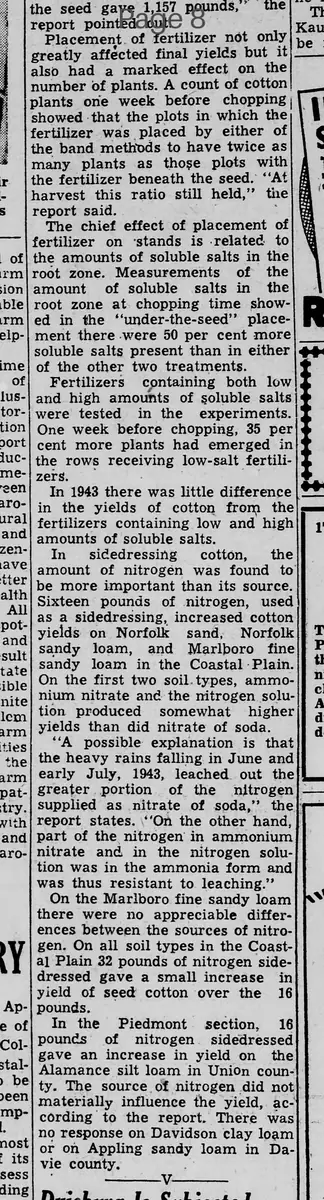
The chief effect of placement of fertilizer on stands is related to the amounts of soluble salts in the root zone. Measurements of the amount of soluble salts in the root zone at chopping time showed in the "under-the-seed" placement there were 50 per cent more soluble salts present than in either of the other two treatments.
Fertilizers containing both low and high amounts of soluble salts were tested in the experiments. One week before chopping, 35 per cent more plants had emerged in the rows receiving low-salt fertilizers.
In 1943 there was little difference in the yields of cotton from the fertilizers containing low and high amounts of soluble salts.
In sidedressing cotton, the amount of nitrogen was found to be more important than its source. Sixteen pounds of nitrogen, used as a sidedressing, increased cotton yields on Norfolk sand, Norfolk sandy loam, and Marlboro fine sandy loam in the Coastal Plain.
On the first two soil types, ammonium nitrate and the nitrogen solution produced somewhat higher yields than did nitrate of soda.
"A possible explanation is that the heavy rains falling in June and early July, 1943, leached out the greater portion of the nitrogen supplied as nitrate of soda," the report states. "On the other hand, part of the nitrogen in ammonium nitrate and in the nitrogen solution was in the ammonia form and was thus resistant to leaching."
On the Marlboro fine sandy loam there were no appreciable differences between the sources of nitrogen. On all soil types in the Coastal Plain 32 pounds of nitrogen side-dressed gave a small increase in yield of seed cotton over the 16 pounds.
In the Piedmont section, 16 pounds of nitrogen sidedressed gave an increase in yield on the Alamance silt loam in Union county. The source of nitrogen did not materially influence the yield, according to the report. There was no response on Davidson clay loam or on Appling sandy loam in Davie county.
What sub-type of article is it?
What keywords are associated?
Where did it happen?
Domestic News Details
Primary Location
Coastal Plain And Piedmont Sections
Event Date
1943
Outcome
band fertilizer placement doubled cotton plants and maintained yields; under-seed placement had 50% more soluble salts reducing stands. low-salt fertilizers increased emergence by 35%. nitrogen sidedressing (16-32 lbs) boosted yields on norfolk sand, norfolk sandy loam, marlboro fine sandy loam, and alamance silt loam; no response on davidson clay loam or appling sandy loam.
Event Details
Experiments tested fertilizer placement (band vs. under-seed) effects on cotton stands and yields, linking under-seed method to higher soluble salts. Low vs. high salt fertilizers compared. Sidedressing nitrogen sources (ammonium nitrate, nitrogen solution, nitrate of soda) evaluated on Coastal Plain soils (Norfolk sand, Norfolk sandy loam, Marlboro fine sandy loam) and Piedmont soils (Alamance silt loam in Union County, Davidson clay loam, Appling sandy loam in Davie County), with leaching impacts from 1943 rains noted.