Thank you for visiting SNEWPapers!
Sign up free
Editorial
December 17, 1807
The Enquirer
Richmond, Henrico County, Virginia
What is this article about?
An open letter in the Richmond Enquirer congratulates James Monroe on his return from Britain and warns him against aligning with John Randolph's minority faction opposing the Jefferson administration, citing Randolph's pro-British stances and unpopularity, urging support for republican principles and Madison.
Clipping
OCR Quality
98%
Excellent
Full Text
THE ENQUIRER.
RICHMOND, DECEMBER 17, 1807.
To JAMES MUNROE, Esq.
Late Minister to the Court of G. Britain.
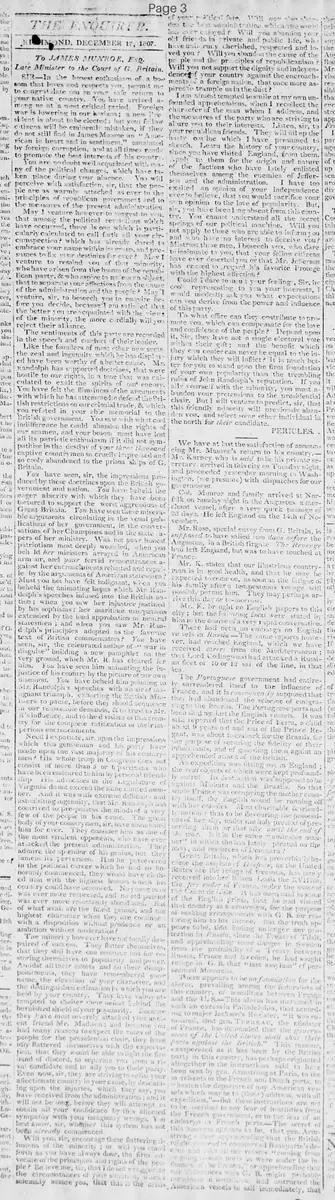
SIR--In the honest enthusiasm of a bosom that loves and respects you, permit me to congratulate you on your safe return to your native country. You have arrived among us at a most critical period. Foreign war is lowering in our horizon; a new President is about to be elected: but your fellow citizens will be eminently mistaken, if they do not still find in James Munroe an "American in heart and in sentiment." untainted by foreign corruption, and at all times ready to promote the best interests of his country.
You are no doubt well acquainted with many of the political changes, which have taken place during your absence. You will perceive with satisfaction, sir, that the people are as warmly attached as ever to the principles of republican government and to the measures of the present administration.
May I venture however to suggest to you, that among the political revolutions which have occurred, there is one which is particularly calculated to call forth all your circumspection? which has already dared to embrace your name within its grasp, and presumes to fix your destinies for ever? May I venture to remind you of that minority, who have arisen from the bosom of the republican party, & who aspire to no less an object, than to separate your affections from the cause of the administration and the people? May I venture, sir, to beseech you to enquire before you decide. because I am satisfied that the better you are acquainted with the views of the minority, the more cordially will you reject their alliance.
The sentiments of this party are recorded in the speech and conduct of their leader. Like the founders of most other new sects the zeal and ingenuity which he has displayed have been worthy of a better cause. Mr. Randolph has supported doctrines, that were hostile to our rights, in a tone that was calculated to exalt the spirits of our enemy.
You have felt the flimsiness of the arguments with which he has attempted to defend the British restrictions on our colonial trade, & which you refuted in your able memorial to the British government. You saw with what cool indifference he could abandon the rights of our seamen, and your bosom must have lost all its patriotic enthusiasm if it did not sympathise in the destiny of your three thousand captive countrymen so cruelly impressed and so cooly abandoned to the prison ships of G. Britain.
You have seen, sir, the impressions produced by these doctrines upon the British government and nation. You have beheld the eager alacrity with which they have been tortured to support the worst aggressions of Great Britain. You have seen these miserable arguments circulating in the venal publications of her government, in the conversations of her Champions and in the state papers of her ministry. Was not your honest patriotism most deeply wounded, when you beheld her ministers arrayed in American armour, and your fervid remonstrances against her encroachments rebutted and repelled by the arguments of American statesmen?
Must you not have felt indignant, when you beheld the animating hopes which Mr. Randolph's speeches infused into the British nation: when you saw her injustice justified by his sophisms; her maritime usurpations extended by the loud approbation of neutral statesmen; and when you saw Mr. Randolph's principles adopted as the favorite text of British commentators? You have seen, sir, the celebrated author of "war in disguise" building a new pamphlet on the very ground, which Mr. R. has cleared for him. You have seen him animating the injustice of his country by the picture of our own disunion. You have beheld him pointing to Mr. Randolph's speeches with an arrogant triumph, exhorting the British Ministers to pause, before they should acquiesce in our reasonable demands, & to trust to Mr. R's influence, and to the division of this country for the complete ratification of their imperious encroachments.
Need I expatiate, sir, upon the impressions which this gentleman and his party have made upon the vast majority of his countrymen? His whole troop in Congress does not consist of more than 5 or 6 partizans who have been endeared to him by personal friendship his advocates in the legislature of Virginia do not exceed the same limited number. And it was with extreme difficulty and astonishing ingenuity, that Mr. Randolph has contrived to prepossess the minds of a very few of the people in his cause. The great body of your countrymen, sir, have abandoned him for ever. They consider him as one of the most virulent opponents, who have ever attacked the present administration. They admire the splendor of his genius, but they lament its perversion. Had he persevered in the political career which he had so honorably commenced, they would have clothed him with the highest honors which his country could have bestowed. No young man was ever more respected, and no true patriot was ever more reluctantly abandoned. But of what avail are the finest genius, and the highest character when they are combined with a disposition without prudence or an ambition without moderation?
The minority however have not totally despaired of success. They flatter themselves, that they still have one resource left for restoring themselves to popularity and power. Amidst all their efforts and their disappointments, they have remembered your name, the elevation of your character, and the distinguished estimation in which you are held by your country. They have vainly attempted to shelter their retreat behind "the burnished shield of your popularity. Because they have most severely attacked your ancient friend Mr. Madison; and because you had many reasons to expect the votes of the people for the presidential chair, they have idly flattered themselves with the expectation, that they would be able to light the fire brand of discord, to separate you from a rival candidate and to ally you to their party.
Even now, sir, they are striving to enlist your affectionate country in your cause, by descanting upon the injuries, which they say, you have received from the administration; and it will not be long, before they will attempt to obtain all your confidence by this affected sympathy with your imaginary wrongs. You best know, sir, whether this system has not been already commenced.
Will you, sir, encourage these flattering illusions of the minority; or will you stand forth as you have always done, the firm advocate of the principles and rights of the people? Believe me, sir, that I do not exaggerate the circumstances of your situation, when I solemnly assure you, that this is the crisis of your political fate. Will you co-operate with the best administration which the world has ever enjoyed? Will you abandon your old friends in private and public life, who have uniformly cherished, respected and loved you? Will you abandon the cause of the people and the principles of republicanism? Will you not support the dignity and independence of your country against the encroachments of a foreign nation, that once more aspires to trample us in the dust?
I am almost tempted to smile at my own unfounded apprehensions, when I recollect the character of the man whom I address, and the measures of the party who are striving to allure you to their interests. Listen, sir, to your republican friends. They will fill up the hasty outline which I have presumed to sketch. Learn the history of your country, since you have visited England, from them. Apply to them for the origin and nature of the factions who have lately enlisted themselves amongst the enemies of Jefferson and the administration. I have too exalted an opinion of your independence ever to believe, that you would sacrifice your own opinion to the love of popularity. But, sir, you have been long absent from this country. You cannot understand all the secret springs of our political machine. Will you not apply to those who are able to inform you and who have no interest to deceive you?
Mistrust those men, I beseech you, who dare to insinuate to you, that your fellow citizens have ever deserted you or that Mr. Jefferson has ceased to regard his favorite Protege with the highest affection?
Could I dare to intrude upon your feelings, Sir., by coolly representing to you your interests, I would modestly ask you what expectations can you derive from the power and influence of this party. To what office can they contribute to promote you. which can compensate for the love and confidence of the people? Depend upon it, Sir, they have not a single electoral vote within their gift: and the benefit which they can confer can never be equal to the injury which they will inflict? It is much better for you to stand upon the firm foundation of your own popularity than the trembling ruins of John Randolph's reputation. If you ally yourself with the minority, you must abandon your pretensions to the presidential chair. But I will venture to predict. sir, that this friendly minority will previously abandon you, and select some other individual in the north for their candidate.
PERICLES.
RICHMOND, DECEMBER 17, 1807.
To JAMES MUNROE, Esq.
Late Minister to the Court of G. Britain.
SIR--In the honest enthusiasm of a bosom that loves and respects you, permit me to congratulate you on your safe return to your native country. You have arrived among us at a most critical period. Foreign war is lowering in our horizon; a new President is about to be elected: but your fellow citizens will be eminently mistaken, if they do not still find in James Munroe an "American in heart and in sentiment." untainted by foreign corruption, and at all times ready to promote the best interests of his country.
You are no doubt well acquainted with many of the political changes, which have taken place during your absence. You will perceive with satisfaction, sir, that the people are as warmly attached as ever to the principles of republican government and to the measures of the present administration.
May I venture however to suggest to you, that among the political revolutions which have occurred, there is one which is particularly calculated to call forth all your circumspection? which has already dared to embrace your name within its grasp, and presumes to fix your destinies for ever? May I venture to remind you of that minority, who have arisen from the bosom of the republican party, & who aspire to no less an object, than to separate your affections from the cause of the administration and the people? May I venture, sir, to beseech you to enquire before you decide. because I am satisfied that the better you are acquainted with the views of the minority, the more cordially will you reject their alliance.
The sentiments of this party are recorded in the speech and conduct of their leader. Like the founders of most other new sects the zeal and ingenuity which he has displayed have been worthy of a better cause. Mr. Randolph has supported doctrines, that were hostile to our rights, in a tone that was calculated to exalt the spirits of our enemy.
You have felt the flimsiness of the arguments with which he has attempted to defend the British restrictions on our colonial trade, & which you refuted in your able memorial to the British government. You saw with what cool indifference he could abandon the rights of our seamen, and your bosom must have lost all its patriotic enthusiasm if it did not sympathise in the destiny of your three thousand captive countrymen so cruelly impressed and so cooly abandoned to the prison ships of G. Britain.
You have seen, sir, the impressions produced by these doctrines upon the British government and nation. You have beheld the eager alacrity with which they have been tortured to support the worst aggressions of Great Britain. You have seen these miserable arguments circulating in the venal publications of her government, in the conversations of her Champions and in the state papers of her ministry. Was not your honest patriotism most deeply wounded, when you beheld her ministers arrayed in American armour, and your fervid remonstrances against her encroachments rebutted and repelled by the arguments of American statesmen?
Must you not have felt indignant, when you beheld the animating hopes which Mr. Randolph's speeches infused into the British nation: when you saw her injustice justified by his sophisms; her maritime usurpations extended by the loud approbation of neutral statesmen; and when you saw Mr. Randolph's principles adopted as the favorite text of British commentators? You have seen, sir, the celebrated author of "war in disguise" building a new pamphlet on the very ground, which Mr. R. has cleared for him. You have seen him animating the injustice of his country by the picture of our own disunion. You have beheld him pointing to Mr. Randolph's speeches with an arrogant triumph, exhorting the British Ministers to pause, before they should acquiesce in our reasonable demands, & to trust to Mr. R's influence, and to the division of this country for the complete ratification of their imperious encroachments.
Need I expatiate, sir, upon the impressions which this gentleman and his party have made upon the vast majority of his countrymen? His whole troop in Congress does not consist of more than 5 or 6 partizans who have been endeared to him by personal friendship his advocates in the legislature of Virginia do not exceed the same limited number. And it was with extreme difficulty and astonishing ingenuity, that Mr. Randolph has contrived to prepossess the minds of a very few of the people in his cause. The great body of your countrymen, sir, have abandoned him for ever. They consider him as one of the most virulent opponents, who have ever attacked the present administration. They admire the splendor of his genius, but they lament its perversion. Had he persevered in the political career which he had so honorably commenced, they would have clothed him with the highest honors which his country could have bestowed. No young man was ever more respected, and no true patriot was ever more reluctantly abandoned. But of what avail are the finest genius, and the highest character when they are combined with a disposition without prudence or an ambition without moderation?
The minority however have not totally despaired of success. They flatter themselves, that they still have one resource left for restoring themselves to popularity and power. Amidst all their efforts and their disappointments, they have remembered your name, the elevation of your character, and the distinguished estimation in which you are held by your country. They have vainly attempted to shelter their retreat behind "the burnished shield of your popularity. Because they have most severely attacked your ancient friend Mr. Madison; and because you had many reasons to expect the votes of the people for the presidential chair, they have idly flattered themselves with the expectation, that they would be able to light the fire brand of discord, to separate you from a rival candidate and to ally you to their party.
Even now, sir, they are striving to enlist your affectionate country in your cause, by descanting upon the injuries, which they say, you have received from the administration; and it will not be long, before they will attempt to obtain all your confidence by this affected sympathy with your imaginary wrongs. You best know, sir, whether this system has not been already commenced.
Will you, sir, encourage these flattering illusions of the minority; or will you stand forth as you have always done, the firm advocate of the principles and rights of the people? Believe me, sir, that I do not exaggerate the circumstances of your situation, when I solemnly assure you, that this is the crisis of your political fate. Will you co-operate with the best administration which the world has ever enjoyed? Will you abandon your old friends in private and public life, who have uniformly cherished, respected and loved you? Will you abandon the cause of the people and the principles of republicanism? Will you not support the dignity and independence of your country against the encroachments of a foreign nation, that once more aspires to trample us in the dust?
I am almost tempted to smile at my own unfounded apprehensions, when I recollect the character of the man whom I address, and the measures of the party who are striving to allure you to their interests. Listen, sir, to your republican friends. They will fill up the hasty outline which I have presumed to sketch. Learn the history of your country, since you have visited England, from them. Apply to them for the origin and nature of the factions who have lately enlisted themselves amongst the enemies of Jefferson and the administration. I have too exalted an opinion of your independence ever to believe, that you would sacrifice your own opinion to the love of popularity. But, sir, you have been long absent from this country. You cannot understand all the secret springs of our political machine. Will you not apply to those who are able to inform you and who have no interest to deceive you?
Mistrust those men, I beseech you, who dare to insinuate to you, that your fellow citizens have ever deserted you or that Mr. Jefferson has ceased to regard his favorite Protege with the highest affection?
Could I dare to intrude upon your feelings, Sir., by coolly representing to you your interests, I would modestly ask you what expectations can you derive from the power and influence of this party. To what office can they contribute to promote you. which can compensate for the love and confidence of the people? Depend upon it, Sir, they have not a single electoral vote within their gift: and the benefit which they can confer can never be equal to the injury which they will inflict? It is much better for you to stand upon the firm foundation of your own popularity than the trembling ruins of John Randolph's reputation. If you ally yourself with the minority, you must abandon your pretensions to the presidential chair. But I will venture to predict. sir, that this friendly minority will previously abandon you, and select some other individual in the north for their candidate.
PERICLES.
What sub-type of article is it?
Partisan Politics
Foreign Affairs
What keywords are associated?
James Monroe
John Randolph
Republican Administration
British Encroachments
Presidential Election
Political Factions
What entities or persons were involved?
James Monroe
John Randolph
Mr. Madison
Mr. Jefferson
British Government
Editorial Details
Primary Topic
Warning James Monroe Against John Randolph's Minority Faction
Stance / Tone
Cautionary Support For Jefferson Administration
Key Figures
James Monroe
John Randolph
Mr. Madison
Mr. Jefferson
British Government
Key Arguments
Randolph's Doctrines Aid British Aggressions
Randolph Unpopular Among Americans
Minority Seeks To Exploit Monroe's Popularity Against Administration
Monroe Should Align With Republican Principles And Friends
Alliance With Minority Would Harm Monroe's Presidential Prospects