Thank you for visiting SNEWPapers!
Sign up free
Editorial
August 23, 1788
The Kentucke Gazette
Lexington, Fayette County, Kentucky
What is this article about?
An editorial by PHILOPATRIA proposing materials and principles for framing a constitution for the Kentucke Country, emphasizing separation from Virginia, natural rights, religious freedom, moral duties, and support for education including the Transylvania Seminary.
Clipping
OCR Quality
95%
Excellent
Full Text
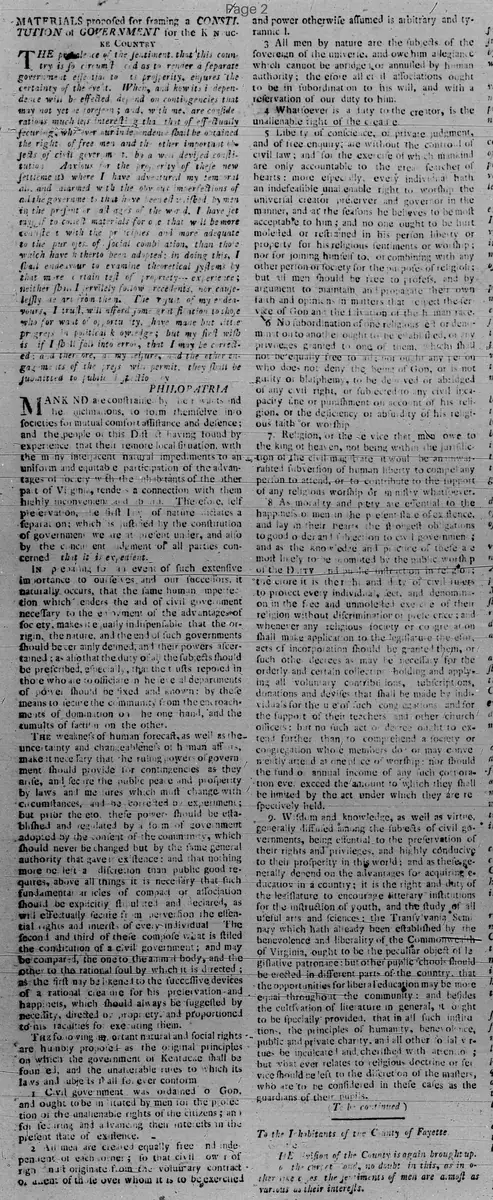
MATERIALS proposed for framing a CONSTITUTION of GOVERNMENT for the KENTUCKE COUNTRY
The prevalence of the sentiment, that this country is so circumstanced as to render a separate government essential to its prosperity, ensures the certainty of the event. When, and how its independence will be effected depend on contingencies that may not yet be foreseen; and, with me, are considerations much less interesting than that of effectually securing, whenever our independence shall be obtained, the rights of free men and the other important objects of civil government, by a well devised constitution. Anxious for the prosperity of these new settlements where I have adventured my temporal all, and alarmed with the many obvious imperfections of all the governments that have hitherto been adopted: in doing this, I shall endeavour to examine theoretical systems by that more certain test of veracity---experience; neither blindly servilely follow precedents, nor causelessly depart from them. The fruit of my endeavors, I trust, will afford some gratification to those who for want of opportunity have made but little progress in political knowledge; but my first wish is if I fall into error, that I may be corrected: and therefore, as my leisure, and the other engagements of the press will permit, they shall be submitted to public inspection.
PHILOPATRIA
Men, by the powerful instincts of nature, are prompted to associate themselves into societies for mutual comfort assistance and defence; and the people of this District having found by experience that their remote local situation, with the many interjacent natural impediments to a uniform and equitable participation of the advantages of society with the inhabitants of the other part of Virginia, renders a connection with them highly inconvenient and useless. The preservation, therefore, of the first law of nature dictates a separation; which is justified by the constitution of government we are at present under, and also by the consent and agreement of all parties concerned that it is expedient.
In preparing to an event of such extensive importance to ourselves, and our successors, it naturally occurs, that the same human imperfection which renders the aid of civil government necessary to the enjoyment of the advantages of society, makes it equally indispensable that the origin, the nature, and the end of such governments should be plainly defined, and their powers ascertained; as also that the duty of all the subjects should be prescribed, especially, that the trusts reposed in those who are to administer the several departments of power should be fixed and known: by these means to secure the community from the encroachments of domination on the one hand, and the tumults of faction on the other.
The weakness of human forecast, as well as the uncertainty and changeableness of human affairs, make it necessary that the ruling powers of government should provide for contingencies as they arise, and secure the public peace and property by laws and measures which must change with circumstances, and be corrected by experience; but prior to these, these powers should be established and regulated by a form of government adopted by the consent of the community, which should never be changed but by the same general authority that gave it existence: and that nothing more be left to discretion than public good requires, above all things it is necessary that such fundamental articles of compact or association should be explicitly ruled and declared, as will effectually secure from perversion the essential rights and interests, of every individual. The second and third of these compose what is called the constitution of a civil government; and may be compared, the one to the animal body, and the other to the rational soul by which it is directed; as the first may be likened to the successive devices of a rational creature for his preservation and happiness, which should always be suggested by necessity, directed by propriety. and proportioned to his faculties for executing them.
The following important natural and social rights are, humbly proposed as the original principles on which the government of Kentucke shall be founded, and the unalterable rules to which its laws and subjects shall ever conform
1. Civil government was ordained by God, and ought to be instituted by men for the protection of the inalienable rights of the citizens; and for securing and advancing their interests in the present state of existence.
2. All men are created equally free and independent of each other; so that civil power can originate only from the voluntary contract of those over whom it is to be exercised and power otherwise assumed is arbitrary and tyrannical.
3. All men by nature are the subjects of the sovereign of the universe. and owe him allegiance which cannot be abridged or annulled by human authority: therefore all civil associations ought to be in subordination to his will, and with a reservation of our duty to him.
4. Whatsoever is a duty to the creator, is the unalienable right of the creature.
5. Liberty of conscience, of private judgment, and of free enquiry; are without the control of civil law; and for the exercise of which mankind are only accountable to the great searcher of hearts: more especially, every individual hath an indefeasible unalienable right to worship the universal creator preserver and governor in the manner, and at the seasons he believes to be most acceptable to him; and no one ought to be hurt. molested or restrained in his person liberty or property for his religious sentiments or worship; nor for joining himself to, or combining with any other person or society for the purpose of religion; but all men should be free to profess, and by argument to maintain, and propagate their own faith and opinions on matters that concern their view of God and the salvation of the human race.
6. No subordination of one sect or denomination to another ought to be established, on any privileges granted to one of them, which shall not be equally free to all others not only who do not deny the being of God, or is not guilty of blasphemy, to be deprived or abridged of any civil right, or subjected to any civil incapacity fine or punishment on account of his religion, or the deficiency or absurdity of his religious faith or worship
7. Religion, or the service that men owe to the king of heaven, not being within the jurisdiction of the civil magistrate it would be an unwarrantted subversion of human liberty to compel any person to attend, or to contribute to the support of any religious worship or ministry whatsoever.
8. As morality and piety are essential to the happiness of men in the present state of existence, and lay in their hearts the strongest obligations to good order and subjection to civil government; and as the knowledge and practice of these are most likely to be promoted by the public worship of the Deity and public instruction in religion; therefore it is the duty of civil rulers to protect every individual sect, and denomination in the free and unmolested exercise of their religion without discrimination or preference; and whenever any religious society or congregation shall make application to the legislature therefor, acts of incorporation should be granted them, or, such other devices as may be necessary for the orderly and certain collection holding and applying all voluntary contributions, subscriptions, donations and devises that shall be made by individuals for the use of such congregations and for the support of their teachers and other church officers: but no such act or decree ought to extend further than, to comprehend a society or congregation whose members do or may conveniently attend at one place of worship: nor should the fund or annual income of any such corporation ever exceed the amount to which they shall be limited by the act under which they are respectively held.
9. Industry and knowledge, as well as virtue, generally diffused among the subjects of civil governments, being essential to the preservation of their rights and privileges, and highly conducive to their prosperity in this world; and as the legislature generally depend on the advantages for acquiring education in a country; it is the right and duty of the legislature to encourage literary institutions for the instruction of youth, and the study of all useful arts and sciences: the Transylvania Seminary which hath already been established by the benevolence and liberality of the Commonwealth of Virginia, ought to be the peculiar object of legislative patronage: but other public schools should be erected in different parts of the country. that the opportunities for liberal education may be more equal throughout the community: and besides the cultivation of literature in general, it ought to be peculiarly provided, that in all such institutions, the principles of humanity, benevolence, public and private charity, and all other social virtues be inculcated and cherished with attention; but whatever relates to religious doctrine or service should be left to the discretion of the masters, who are to be considered in these cases as the guardians of their pupils.
(To be continued)
The prevalence of the sentiment, that this country is so circumstanced as to render a separate government essential to its prosperity, ensures the certainty of the event. When, and how its independence will be effected depend on contingencies that may not yet be foreseen; and, with me, are considerations much less interesting than that of effectually securing, whenever our independence shall be obtained, the rights of free men and the other important objects of civil government, by a well devised constitution. Anxious for the prosperity of these new settlements where I have adventured my temporal all, and alarmed with the many obvious imperfections of all the governments that have hitherto been adopted: in doing this, I shall endeavour to examine theoretical systems by that more certain test of veracity---experience; neither blindly servilely follow precedents, nor causelessly depart from them. The fruit of my endeavors, I trust, will afford some gratification to those who for want of opportunity have made but little progress in political knowledge; but my first wish is if I fall into error, that I may be corrected: and therefore, as my leisure, and the other engagements of the press will permit, they shall be submitted to public inspection.
PHILOPATRIA
Men, by the powerful instincts of nature, are prompted to associate themselves into societies for mutual comfort assistance and defence; and the people of this District having found by experience that their remote local situation, with the many interjacent natural impediments to a uniform and equitable participation of the advantages of society with the inhabitants of the other part of Virginia, renders a connection with them highly inconvenient and useless. The preservation, therefore, of the first law of nature dictates a separation; which is justified by the constitution of government we are at present under, and also by the consent and agreement of all parties concerned that it is expedient.
In preparing to an event of such extensive importance to ourselves, and our successors, it naturally occurs, that the same human imperfection which renders the aid of civil government necessary to the enjoyment of the advantages of society, makes it equally indispensable that the origin, the nature, and the end of such governments should be plainly defined, and their powers ascertained; as also that the duty of all the subjects should be prescribed, especially, that the trusts reposed in those who are to administer the several departments of power should be fixed and known: by these means to secure the community from the encroachments of domination on the one hand, and the tumults of faction on the other.
The weakness of human forecast, as well as the uncertainty and changeableness of human affairs, make it necessary that the ruling powers of government should provide for contingencies as they arise, and secure the public peace and property by laws and measures which must change with circumstances, and be corrected by experience; but prior to these, these powers should be established and regulated by a form of government adopted by the consent of the community, which should never be changed but by the same general authority that gave it existence: and that nothing more be left to discretion than public good requires, above all things it is necessary that such fundamental articles of compact or association should be explicitly ruled and declared, as will effectually secure from perversion the essential rights and interests, of every individual. The second and third of these compose what is called the constitution of a civil government; and may be compared, the one to the animal body, and the other to the rational soul by which it is directed; as the first may be likened to the successive devices of a rational creature for his preservation and happiness, which should always be suggested by necessity, directed by propriety. and proportioned to his faculties for executing them.
The following important natural and social rights are, humbly proposed as the original principles on which the government of Kentucke shall be founded, and the unalterable rules to which its laws and subjects shall ever conform
1. Civil government was ordained by God, and ought to be instituted by men for the protection of the inalienable rights of the citizens; and for securing and advancing their interests in the present state of existence.
2. All men are created equally free and independent of each other; so that civil power can originate only from the voluntary contract of those over whom it is to be exercised and power otherwise assumed is arbitrary and tyrannical.
3. All men by nature are the subjects of the sovereign of the universe. and owe him allegiance which cannot be abridged or annulled by human authority: therefore all civil associations ought to be in subordination to his will, and with a reservation of our duty to him.
4. Whatsoever is a duty to the creator, is the unalienable right of the creature.
5. Liberty of conscience, of private judgment, and of free enquiry; are without the control of civil law; and for the exercise of which mankind are only accountable to the great searcher of hearts: more especially, every individual hath an indefeasible unalienable right to worship the universal creator preserver and governor in the manner, and at the seasons he believes to be most acceptable to him; and no one ought to be hurt. molested or restrained in his person liberty or property for his religious sentiments or worship; nor for joining himself to, or combining with any other person or society for the purpose of religion; but all men should be free to profess, and by argument to maintain, and propagate their own faith and opinions on matters that concern their view of God and the salvation of the human race.
6. No subordination of one sect or denomination to another ought to be established, on any privileges granted to one of them, which shall not be equally free to all others not only who do not deny the being of God, or is not guilty of blasphemy, to be deprived or abridged of any civil right, or subjected to any civil incapacity fine or punishment on account of his religion, or the deficiency or absurdity of his religious faith or worship
7. Religion, or the service that men owe to the king of heaven, not being within the jurisdiction of the civil magistrate it would be an unwarrantted subversion of human liberty to compel any person to attend, or to contribute to the support of any religious worship or ministry whatsoever.
8. As morality and piety are essential to the happiness of men in the present state of existence, and lay in their hearts the strongest obligations to good order and subjection to civil government; and as the knowledge and practice of these are most likely to be promoted by the public worship of the Deity and public instruction in religion; therefore it is the duty of civil rulers to protect every individual sect, and denomination in the free and unmolested exercise of their religion without discrimination or preference; and whenever any religious society or congregation shall make application to the legislature therefor, acts of incorporation should be granted them, or, such other devices as may be necessary for the orderly and certain collection holding and applying all voluntary contributions, subscriptions, donations and devises that shall be made by individuals for the use of such congregations and for the support of their teachers and other church officers: but no such act or decree ought to extend further than, to comprehend a society or congregation whose members do or may conveniently attend at one place of worship: nor should the fund or annual income of any such corporation ever exceed the amount to which they shall be limited by the act under which they are respectively held.
9. Industry and knowledge, as well as virtue, generally diffused among the subjects of civil governments, being essential to the preservation of their rights and privileges, and highly conducive to their prosperity in this world; and as the legislature generally depend on the advantages for acquiring education in a country; it is the right and duty of the legislature to encourage literary institutions for the instruction of youth, and the study of all useful arts and sciences: the Transylvania Seminary which hath already been established by the benevolence and liberality of the Commonwealth of Virginia, ought to be the peculiar object of legislative patronage: but other public schools should be erected in different parts of the country. that the opportunities for liberal education may be more equal throughout the community: and besides the cultivation of literature in general, it ought to be peculiarly provided, that in all such institutions, the principles of humanity, benevolence, public and private charity, and all other social virtues be inculcated and cherished with attention; but whatever relates to religious doctrine or service should be left to the discretion of the masters, who are to be considered in these cases as the guardians of their pupils.
(To be continued)
What sub-type of article is it?
Constitutional
Moral Or Religious
Education
What keywords are associated?
Kentucke Constitution
Civil Rights
Religious Liberty
Separation From Virginia
Transylvania Seminary
Moral Duties
Education Reform
What entities or persons were involved?
Philopatria
Kentucke Country
Virginia
Transylvania Seminary
Editorial Details
Primary Topic
Proposing Principles For Kentucke Constitution
Stance / Tone
Advocacy For Securing Rights Through A Well Devised Constitution
Key Figures
Philopatria
Kentucke Country
Virginia
Transylvania Seminary
Key Arguments
Separation From Virginia Justified By Geography And Consent
Civil Government Must Define Origins, Powers, And Duties To Prevent Encroachments
Fundamental Rights Include Equality, Subordination To Divine Will, And Religious Liberty
No Compulsion In Religion Or Support For Worship
Legislature Duty To Protect Religions And Encourage Education