Thank you for visiting SNEWPapers!
Sign up free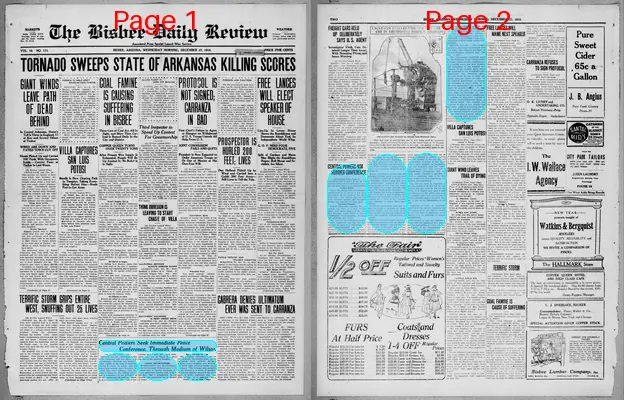
Bisbee Daily Review
Bisbee, Cochise County, Arizona
What is this article about?
On December 26, 1916, Germany and allies replied to President Wilson's peace note, proposing an immediate conference of belligerents in a neutral city to discuss peace, while deferring future war prevention until after the current conflict. Reactions in Washington view it as progress but lacking specific terms; Entente sees it as evasive.
Merged-components note: Merging article and its continuation on Central Powers' peace proposal.
Clippings
1 of 2
OCR Quality
Full Text
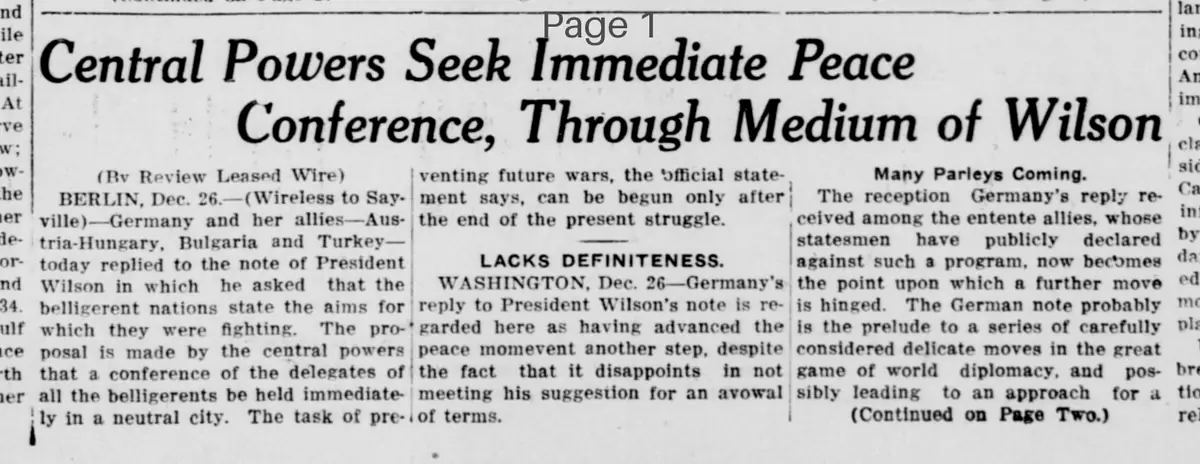
(By Review Leased Wire)
BERLIN, Dec. 26.-(Wireless to Sayville)-Germany and her allies-Austria-Hungary, Bulgaria and Turkey-today replied to the note of President Wilson in which he asked that the belligerent nations state the aims for which they were fighting. The proposal is made by the central powers that a conference of the delegates of all the belligerents be held immediately in a neutral city. The task of preventing future wars, the official statement says, can be begun only after the end of the present struggle.
LACKS DEFINITENESS.
WASHINGTON, Dec. 26-Germany's reply to President Wilson's note is regarded here as having advanced the peace movement another step, despite the fact that it disappoints in not meeting his suggestion for an avowal of terms.
Many Parleys Coming.
The reception Germany's reply received among the entente allies, whose statesmen have publicly declared against such a program, now becomes the point upon which a further move is hinged. The German note probably is the prelude to a series of carefully considered delicate moves in the great game of world diplomacy, and possibly leading to an approach for a
(Continued on Page Two.)
CENTRAL POWERS ASK HURRIED CONFERENCE
(Continued From Page 1)
real discussion of peace terms on the grounds which all the belligerents may feel can place them at no disadvantage.
Wilson Silent.
This is the official view of Germany's representatives so far as it has been formulated on the basis of the unofficial text. The official copy has not been received tonight and President Wilson was keeping his mind open.
Neutrals Pleased.
Neutral diplomatic quarters here regarded the note as a step toward peace, and rather leaned to the view that Germany might follow it with a confidential communication of some sort outlining her terms.
The views of the entente embassies, frankly expressed, was that the note was not an answer to President Wilson's communication but rather a document for circulation in Germany and in neutral countries with the real intention to place the responsibility for continuing the war on the entente.
Among the Germanic diplomats the only view expressed was one of surprise that the reply had preceded receipt of the entente's response (Germany's original peace proposal on December 12.)
It was everywhere agreed that the principal sticking point was the lack of a definite statement of terms such as President Wilson asked and such as Lloyd-George declared the allies would require if they were not to put their "heads in a noose with the rope end in the hands of the Germans." It is not beyond the realm of diplomacy, however, to find a way to bridge that difficulty and Germany's failure is not regarded as a block to the negotiations, although it makes them more difficult.
Germany's declaration that she regards the work of securing the world against future wars the work to be taken up after the present conflict was ended, was regarded with diversity of opinion.
Officials who turned back and compared the statement with the phrases of President Wilson's note did not find the two out of harmony, nor in disagreement with the President's public utterances on a world league to preserve peace; yet, there was an indefinable opinion in official quarters that the ending of the war and the safeguarding of peace of the future were a joint problem so inseparable that one depended upon the other.
Those taking this view referred to Lloyd-George's declaration that the allies would consider it possible to enter a conference only if the Germans would first offer reparation, restitution and guarantees.
The German reply is regarded as not only failing to do this, but its suggestion that the work be left for the future, it is feared, may raise a difficult obstacle for the allied statesmen to surmount with their own people to whom a durable peace has been held out as one of the foundations of the war.
Unpopular as such a conclusion might be in the entente countries, the very enormity of the subject, viewed in the cold light of diplomacy, is regarded here as sufficient to require consideration.
One opinion is that one conference might bind the opponents in a solemn promise and pledge to carry out reorganization of the international balance and leave the actual details such as demobilization, limitation of armaments and the like for a separate conference untrammeled by the difficulties sure to surround the first meeting.
The difficulties which nearly broke up the first Hague conference were recalled today as an indication of what would confront the delegates.
BERLIN, Dec. 26. — The answer handed to American Ambassador Gerard today, also contains the reply of Austria-Hungary, Bulgaria and Turkey. It says:
"The high-minded suggestion made by the President of the United States to create a basis for the establishment of a lasting peace, has been received and considered by the imperial government in the friendly spirit which was expressed in the President's communication. The President points out that which he has at heart and leaves open the choice of road. To the imperial government, an immediate exchange of views seems to be the most appropriate road in order to reach the desired results. It begs therefore in the sense of the declarations made on December 12, which offered a hand for peace negotiations to propose an immediate meeting of delegates of the belligerent states, at a neutral place. The imperial government is also of the opinion that the great work of preventing further wars can be begun only after the end of the present struggle of the nations It will, when this moment shall have come, proceed with pleasure to collaborate with the United States in this exalted task."
What sub-type of article is it?
What keywords are associated?
What entities or persons were involved?
Where did it happen?
Foreign News Details
Primary Location
Berlin
Event Date
Dec. 26
Key Persons
Outcome
proposal for immediate peace conference in neutral city; deferral of future war prevention; mixed reactions, seen as progress but lacking specific terms and reparations.
Event Details
Germany and allies replied to Wilson's note proposing an immediate conference of belligerents in a neutral city to discuss peace, stating future war prevention can begin only after current war ends. Washington views it as advancing peace but disappointing for lacking terms avowal. Entente sees it as evasive, placing war continuation blame on them. Neutrals pleased, anticipate further communications.