Thank you for visiting SNEWPapers!
Sign up free
The Enquirer
Richmond, Henrico County, Virginia
What is this article about?
William Cobbett critiques the Prince Regent's speech to Parliament on December 30, 1812, expressing skepticism about progress in the Peninsular War, Russian resistance, American conflict, and other foreign affairs, while advocating for peace and questioning government policies.
Merged-components note: Continuation of Cobbett's Weekly Register commentary on political speech; relabeled from foreign_news to editorial as it is an opinion piece signed by Wm. COBBETT.
Clippings
1 of 2
OCR Quality
Full Text
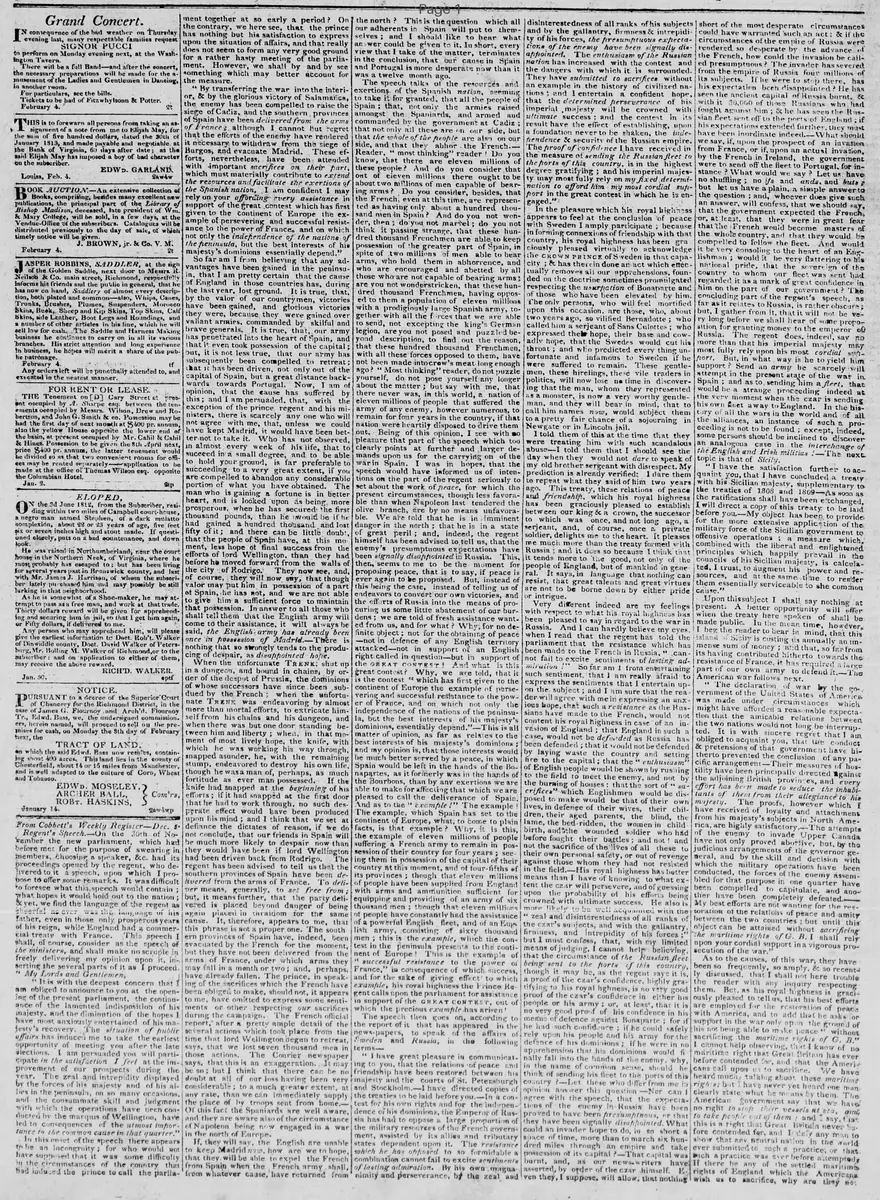
Regent's Speech.—On the 30th of November the new parliament, which had before met for the purpose of swearing in members, choosing a speaker, &c. had its proceedings opened by the regent, who delivered to it a speech, upon which I propose to offer some remarks. It was difficult to foresee what this speech would contain; what hopes it would hold out to the nation; & yet, we find the language of the regent as cheerless as the language of his father, even in those only prosperous years of his reign, while England had a commercial treaty with France. This speech I shall, of course, consider as the speech of the ministers, and shall make no scruple in freely delivering my opinion upon it, inserting the several parts of it as I proceed.
"My Lords and Gentlemen,
"It is with the deepest concern that I am obliged to announce to you at the opening of the present parliament, the continuance of the lamented indisposition of his majesty, and the diminution of the hopes I have most anxiously entertained of his majesty's recovery. The situation of public affairs has induced me to take the earliest opportunity of meeting you after the late elections. I am persuaded you will participate in the satisfaction I feel at the improvement of our prospects during the year. The zeal and intrepidity displayed by the forces of his majesty and of his allies in the peninsula, on so many occasions, and the consummate skill and judgment with which the operations have been conducted by the marquis of Wellington, have led to consequences of the utmost importance to the common cause in that quarter."
In this onset of the speech there appears to be an incongruity; for who would not have supposed that it was some difficulty in the circumstances of the country that had induced the prince to call the parliament together at so early a period? On the contrary, we here see, that the prince has nothing but his satisfaction to express upon the situation of affairs, and that really does not seem to form any very good ground for a rather hasty meeting of the parliament. However, we shall by and by see something which may better account for the measure.
"By transferring the war into the interior, & by the glorious victory of Salamanca, the enemy has been compelled to raise the siege of Cadiz, and the southern provinces of Spain have been delivered from the arms of France; although I cannot but regret that the efforts of the enemy have rendered it necessary to withdraw from the siege of Burgos, and evacuate Madrid. These efforts, nevertheless, have been attended with important sacrifices on their part, which must materially contribute to extend the resources and facilitate the exertions of the Spanish nation, I am confident I may rely on your affording every assistance in support of the great contest which has first given to the continent of Europe the example of persevering and successful resistance to the power of France and on which not only the independence of the nations of the peninsula, but the best interests of his majesty's dominions essentially depend."
So far am I from believing that any advantages have been gained in the peninsula, that I am pretty certain that the cause of England in those countries has, during the last year, lost ground. It is true, that, by the valor of our countrymen, victories have been gained, and glorious victories they were, because they were gained over valiant armies commanded by skilful and brave generals. It is true, that, our army has penetrated into the heart of Spain, and that it even took possession of the capital; but, it is not less true, that our army has subsequently been compelled to retreat; that it has been driven, not only out of the capital of Spain, but a great distance backwards towards Portugal. Now, I am of opinion, that the cause has suffered by this; and I am persuaded, that, with the exception of the prince regent and his ministers, there is scarcely any one who will not agree with me, that, unless we could have kept Madrid, it would have been better not to take it. Who has not observed, in almost every week of his life, that to succeed in a small degree, and to be able to hold your ground, is far preferable to succeeding to a very great extent, if you are compelled to abandon any considerable portion of what you have obtained. The man who is gaining a fortune is in better heart, and is looked upon as being more prosperous, when he has secured the first thousand pounds, than he would be if he had gained a hundred thousand and lost fifty of it; and there can be little doubt, that the people of Spain have, at this moment, less hope of final success from the efforts of lord Wellington, than they had before he moved forward from the walls of the city of Rodrigo. They now see, and, of course, they will now say, that though valor may put him in possession of a part of Spain, he has not, and we are not able to give him a sufficient force to maintain that possession. In answer to all those who shall tell them that the English army will come to their assistance, it will always be said, the English army has already been once in possession of Madrid. There is nothing that so strongly tends to the producing of despair, as disappointed hope. When the unfortunate Trenck, shut up in a dungeon, and bound in chains, by order of the despot of Prussia, the dominions of whose successors have since been subdued by the French; when the unfortunate Trenck was endeavoring by almost more than mortal efforts, to extricate himself from his chains and his dungeon, and when there was but one door standing between him and liberty; when, in that moment of most lively hope, the knife, with which he was working his way through, snapped asunder, he, with the remaining stump, endeavored to destroy his own life, though he was a man of, perhaps, as much fortitude as ever man possessed. If the knife had snapped at the beginning of his efforts; if it had snapped at the first door that he had to work through, no such desperate effect would have been produced upon his mind; and I think that we set at defiance the dictates of reason, if we do not conclude, that our friends in Spain will be much more likely to despair now than they would have been if lord Wellington had been driven back from Rodrigo. The regent has been advised to tell us that the southern provinces of Spain have been delivered from the arms of France. To deliver means, generally, to set free from; but it means further, that the party delivered is placed beyond danger of being again placed in thraldom for the same cause. It, therefore, appears to me, that this phrase is not a proper one. The southern provinces of Spain have, indeed, been evacuated by the French for the moment, but they have not been delivered from the arms of France, under which arms they may fall in a month or two; and, perhaps, have already fallen. The prince, in speaking of the sacrifices which the French have been obliged to make, should not, it appears to me, have omitted to express some sentiments or other respecting our sacrifices during the campaign. The French official report, after a pretty ample detail of the several actions which took place from the time that lord Wellington begun to retreat, says, that we lost seven thousand men in those actions. The Courier newspaper says, that this is an exaggeration. It may be so; but I think that there can be no doubt at all of our loss having been very considerable; to a much greater extent, at any rate, than we can immediately supply the place of by troops sent from home.—Of this fact the Spaniards are well aware, and they are aware also of the circumstance of Napoleon being now engaged in a war in the north of Europe. If, they will say, the English are unable to keep Madrid now, how are we to hope, that they will be able to expel the French from Spain when the French army shall, from whatever cause, have returned from the north? This is the question which all our adherents in Spain will put to themselves; and I should like to hear what answer could be given to it. In short, every view that I take of the matter, terminates in the conclusion, that our cause in Spain and Portugal is more desperate now than it was a twelve month ago.
The speech talks of the resources and exertions of the Spanish nation, seeming to take it for granted, that all the people of Spain; that, not only the armies raised amongst the Spaniards, and armed and commanded by the government at Cadiz; that not only all these are on our side, but that the whole of the people are also on our side, and that they abhor the French.—Reader, "most thinking" reader! Do you know, that there are eleven millions of these people? And do you consider that out of eleven millions there ought to be about two millions of men capable of bearing arms? Do you consider, besides, that the French, even at this time, are represented as having only about a hundred thousand men in Spain? And do you not wonder, then; do you not marvel; do you not think it passing strange, that these hundred thousand Frenchmen are able to keep possession of the greater part of Spain, in spite of two millions of men able to bear arms, who hold them in abhorrence, and who are encouraged and abetted by all those who are not capable of bearing arms; are you not wonderstricken, that these hundred thousand Frenchmen, having opposed to them a population of eleven millions with a prodigiously large Spanish army, together with all the forces that we are able to send, not excepting the king's German legion, are you not posed and puzzled beyond description, to find out the reason, that these hundred thousand Frenchmen, with all these forces opposed to them, have not been made into crow's meat long enough ago? "Most thinking" reader, do not puzzle yourself, do not pose yourself any longer about the matter; but say with me, that there never was, in this world, a nation of eleven millions of people that suffered the army of any enemy, however numerous, to remain for four years in the country, if that nation were heartily disposed to drive them out. Being of this opinion, I see with no pleasure that part of the speech which too clearly points at further and larger demands upon us for the carrying on of the war in Spain. I was in hopes, that the speech would have informed us of intentions on the part of the regent seriously to set about the work of peace, for which the present circumstances, though less favorable than when Napoleon last tendered the olive branch, are by no means unfavorable. We are told that he is in imminent danger in the north; that he is in a state of great peril; and, indeed, the regent himself has been advised to tell us, that the enemy's presumptuous expectations have been signally disappointed in Russia. This, then, seems to me to be the moment for proposing peace, that is to say, if peace is ever again to be proposed. But, instead of this being the case, instead of telling us of endeavors to convert our own victories, and the efforts of Russia into the means of procuring us some little abatement of our burdens; we are told of fresh assistance wanted from us, and for what? Why, for no definite object; not for the obtaining of peace—not in defence of any English territory attacked—not in support of an English right called in question—but in support of the GREAT CONTEST! And what is this great contest? Why, we are told, that it is the contest "which has first given to the continent of Europe the example of persevering and successful resistance to the power of France, and on which not only the independence of the nations of the peninsula, but the best interests of his majesty's dominions, essentially depend."—This is all matter of opinion, as far as relates to the best interests of his majesty's dominions; and my opinion is, that those interests would be much better served by a peace, in which Spain would be left in the hands of the Bonapartes, as it formerly was in the hands of the Bourbons, than by any exertions we are able to make for affecting that which we are pleased to call the deliverance of Spain. And as to the "example!" The example! The example, which Spain has set to the continent of Europe, what, to come to plain facts, is that example? Why, it is this, the example of eleven millions of people suffering a French army to remain in possession of their country for four years; seeing them in possession of the capital of their country at this moment, and of four-fifths of its provinces; though that eleven millions of people have been supplied from England with arms and ammunition sufficient for equipping and providing of an army of sixty thousand men; though that eleven millions of people have constantly had the assistance of a powerful English fleet, and of an English army, consisting of sixty thousand men; this is the example, which the contest in the peninsula presents to the continent of Europe! This is the example of "successful resistance to the power of France," in consequence of which success, and for the sake of giving effect to which example, his royal highness the Prince Regent calls upon the parliament for assistance in support of the GREAT CONTEST, out of which the precious example has arisen!
The speech then goes on, according to the report of it that has appeared in the news-papers, to speak of the affairs of Sweden and Russia, in the following terms—
"I have great pleasure in communicating to you, that the relations of peace and friendship have been restored between his majesty and the courts of St. Petersburgh and Stockholm.—I have directed copies of the treaties to be laid before you.—In a contest for his own rights and for the independence of his dominions, the Emperor of Russia has had to oppose a large proportion of the military resources of the French government, assisted by its allies and tributary states dependent upon it. The resistance which he has opposed to so formidable a combination cannot fail to excite sentiments of lasting admiration. By his own magnanimity and perseverance, by the zeal and disinterestedness of all ranks of his subjects and by the gallantry, firmness & intrepidity of his forces, the presumptuous expectations of the enemy have been signally disappointed. The enthusiasm of the Russian nation has increased with the contest and the dangers with which it is surrounded. They have submitted to sacrifices without an example in the history of civilized nations; and I entertain a confident hope, that the determined perseverance of his imperial majesty will be crowned with ultimate success; and the contest in its result have the effect of establishing, upon a foundation never to be shaken, the independence & security of the Russian empire. The proof of confidence I have received in the measure of sending the Russian fleet to the ports of this country, is in the highest degree gratifying; and his imperial majesty may most fully rely on my fixed determination to afford him my most cordial support in the great contest in which he is engaged."
In the pleasure which his royal highness appears to feel at the conclusion of peace with Sweden I amply participate; because in forming connexions of friendship with that country, his royal highness has been graciously pleased virtually to acknowledge the Crown Prince of Sweden in that capacity; & has therein done an act which effectually removes all our apprehensions, founded on the doctrine sometimes promulgated respecting the usurpation of Bonaparte and of those who have been elevated by him. The only persons, who will feel mortified upon this occasion, are those, who, about two years ago, so vilified Bernadotte; who called him a serjeant of Sans Culottes; who expressed the hope, their base and cowardly hope, that the Swedes would cut his throat; and who predicted every thing unfortunate and infamous to Sweden if he were suffered to remain. These gentlemen, these hirelings, these vile traders in politics, will now lose no time in discovering that the man, whom they represented as a monster, is now a very worthy gentleman, and they will bear in mind, that to call him names now, would subject them to a pretty fair chance of a sojourning in Newgate or in Lincoln jail. I told them of this at the time that they were treating him with such scandalous abuse—I told them that I should see the day when they would not dare to speak of my old brother sergeant with disrespect. My prediction is already verified: I dare them to repeat what they said of him two years ago. This treaty, these relations of peace and friendship, which his royal highness has been graciously pleased to establish between our king & a crown, the successor to which was once, and not long ago, a serjeant, and, of course, once a private soldier, delights me to the heart. It pleases me much more than the treaty formed with Russia; and it does so because I think that it tends more to the good, not only of the people of England, but of mankind in general. It says, in language that nothing can resist, that great talents and great virtues are not to be borne down by either pride or intrigue.
Very different indeed are my feelings with respect to what his royal highness has been pleased to say in regard to the war in Russia. And I can hardly believe my eyes, when I read that the regent has told the parliament that the resistance which has been made to the French in Russia, "cannot fail to excite sentiments of lasting admiration!" So far am I from entertaining such sentiment, that I am really afraid to express the sentiments that I entertain upon the subject; and I am sure that the reader will agree with me in expressing an anxious hope, that such a resistance as the Russians have made to the French, would not content his royal highness in case of an invasion of England; that England in such a case, would not be defended as Russia has been defended; that it would not be defended by laying waste the country and setting fire to the capital; that the "enthusiasm of English people would be shown by rushing to the field to meet the enemy, and not by the burning of houses: that the sort of "sacrifices" which Englishmen would be disposed to make would be that of their own lives, in defence of their wives, their children, their aged parents, the blind, the lame, the bed-ridden, the women in child birth, and the wounded soldier who had before fought their battles; and not the sacrifice of the lives of all these to their own personal safety, or out of revenge against those whom they had not resisted in the field. His royal highness has better means than I have of knowing to what extent the czar will persevere, and of guessing upon the probability of his efforts being crowned with ultimate success. He also is more likely to be well acquainted with the "zeal and disinterestedness of all ranks of the czar's subjects, and with the gallantry, firmness, and intrepidity of his forces;" but I must confess, that, with my limited means of judging, I cannot help believing, that the circumstance of the Russian fleet being sent to the ports of this country, though it may be, as the regent says it is, a proof of the czar's confidence, highly gratifying to his royal highness, is no very good proof of the czar's confidence in either his people or his army; or, at least, that it is no very good proof of his confidence in his means of defence against Bonaparte; for if he had such confidence; if he could safely rely upon his people and his army for the defence of his dominions; if he were in no apprehension that his dominions would finally fall into the hands of the enemy, why, in the name of common sense, should he think of sending his fleet to the ports of this country?—Let those who differ from me in opinion answer this question—Nor can I agree with the speech, that the expectations of the enemy in Russia have been proved to have been presumptuous, or that they have been signally disappointed. What could an invader hope to do, in so short a space of time, more than to march six hundred miles through an empire and take possession of its capital?—That Capital was burnt, and, as our news-writers have asserted, by order of the czar himself. Even they, I suppose, will allow, that nothing short of the most desperate circumstances could have warranted such an act: & if the circumstances of the empire of Russia were rendered so desperate by the advance of the French, how could the invasion be called presumptuous? The invader has severed from the empire of Russia four millions of its subjects. If he were to stop there, has his expectation been disappointed? He has seen the ancient capital of Russia burnt, & with it 30,000 of those Russians who had fought against him; & he has seen the Russian fleet sent off to the ports of England: if his expectations extended further, they must have been inordinate indeed.—what should we say, if, upon the prospect of an invasion from France, or if, upon an actual invasion, by the French in Ireland, the government were to send off the fleet to Portugal, for instance? What would we say? Let us have no shuffling; no ifs and ands, and buts; but let us have a plain, a simple answer to the question; and, whoever does give such an answer, will confess, that we should say, that the government expected the French, or, at least, that they were in great fear that the French would become masters of the whole country, and that they would be compelled to follow the fleet. And would it be very consoling to the heart of an Englishman; would it be very flattering to his national pride, that the sovereign of the country to whom our fleet was sent had regarded it as a mark of great confidence in him on the part of our government? The concluding part of the regent's speech, as far as it relates to Russia, is rather obscure; but, I gather from it, that it will not be very long before we shall hear of some proposition for granting money to the emperor of Russia. The regent does, indeed, say no more than that his imperial majesty may most fully rely upon his most cordial support. But, in what way is he to yield him support? Send an army he scarcely will attempt in the present state of the war in Spain; and as to sending him a fleet, that would be a strange proceeding indeed at the very moment when the czar is sending his own fleet away to England. In the history of all the wars in the world and of all the alliances, an instance of such a proceeding is not to be found; except, indeed, some persons should be inclined to discover an analogous case in the interchange of the English and Irish militias!—The next topic is that of Sicily.
"I have the satisfaction further to acquaint you, that I have concluded a treaty with his Sicilian majesty, supplementary to the treaties of 1808 and 1809—As soon as the ratifications shall have been exchanged, I will direct a copy of this treaty to be laid before you—My object has been to provide for the more extensive application of the military force of the Sicilian government to offensive operations: a measure which, combined with the liberal and enlightened principles which happily prevail in the councils of his Sicilian majesty, is calculated, I trust, to augment his power and resources, and at the same time to render them essentially serviceable to the common Cause."
Upon this subject I shall say nothing at present: A better opportunity will offer when the treaty here spoken of shall be made public. In the mean time, however, I beg the reader to bear in mind, that this island of Sicily is costing us annually an immense sum of money; 'and that, so far from its having contributed hitherto towards the resistance of France, it has required a large part of our own army to defend it.—The American war follows next.
The declaration of war by the government of the United States of America, was made under circumstances which might have afforded a reasonable expectation that the amicable relations between the two nations would not long be interrupted. It is with sincere regret that I am obliged to acquaint you, that the Conduct & pretensions of that government have hitherto prevented the conclusion of any pacific arrangement—Their measures of hostility have been principally directed against the adjoining British provinces, and every effort has been made to seduce the inhabitants of them from their allegiance to his majesty. The proofs, however which I have received of loyalty and attachment from his majesty's subjects in North America, are highly satisfactory.—The attempts of the enemy to invade Upper Canada have not only proved abortive, but, by the judicious arrangements of the governor general, and by the skill and decision with which the military operations have been conducted, the forces of the enemy assembled for that purpose in one quarter have been compelled to capitulate, and another have been completely defeated.—My best efforts are not wanting for the restoration of the relations of peace and amity between the two countries; but until this object can be attained without sacrificing the maritime rights of G. B. I shall rely upon your cordial support in a vigorous prosecution of the war.
As to the causes of this war; they have been so frequently, so amply, & so recently discussed, that I shall not here trouble the reader with any inquiry respecting them. But, as his royal highness is graciously pleased to tell us, that his best efforts are employed for the restoration of peace with America, and to add that he asks for support in the war only upon the ground of his not being able to make peace "without sacrificing the maritime rights of G. B." I cannot help observing, that I know of no maritime right that Great Britain has ever before contended for, and that the Americans call upon us to sacrifice. We have heard much talking about these maritime rights; but I have never yet heard one man clearly state what he means by them. The American Government say that we have no right to stop their vessels at sea, and to take people out of them; and I say, that this is a right that Great Britain never before contended for, and I defy any man to show that any neutral nation in the world ever submitted to such a practice, or that such a practice was ever before attempted. If there be any of the settled maritime rights of England which the Americans wish us to sacrifice, why are they not
named? It may be necessary; I do not say, that circumstances may never arise, to justify a government in doing that which no established practice or principle warrants; but then, let it be avowed: let us know what it is we are contending for. I wish to see the rights for which we contend explicitly stated, and, then we might enter upon the discussion with some prospect of arriving at the truth. His royal highness complains of attempts at "seduction," on the part of the Americans. This phrase, with due submission, is badly chosen. It was not an attempt at seduction, which implies something secret or underhanded—whereas that which the Yankees did was open and in the face of day; it was an act of war—it was by open proclamation after a declaration of war; it was an invitation, but no attempt at seduction. The term seduction is properly applied when a government is base enough, while at peace and in apparent amity with another, to endeavor, by the means of bribes or otherwise, to seduce the citizens or subjects of the other; an act of which none but the very vilest and most corrupt governments, in the days of their decline, when, like old bawds, they resort to all sorts of quackery in order to prop up a rotten constitution a little longer, are ever guilty; an act, in short, which is never resorted to but by men who ought to make their exit from the gallows tree. I do not commend the invitation of the Americans; but it is very different from acts such as that which I have just been speaking of.—The Canadians will not be gained over, I am sure, by invitations. Invitations will weigh very little with them. They will in all likelihood, be influenced by their feelings. If they have a good government, they will wish to keep it; and will, no doubt, fight in its defence. The speech concludes thus:
"Gentlemen of the House of Commons, I have ordered the estimates of the ensuing year to be laid before you and I entertain no doubt of your readiness to furnish such supplies as may enable me to provide for the great interests committed to my charge, and to afford the best prospect of bringing the contest in which his majesty is engaged to a successful termination."
"My Lords and Gentlemen, The approaching expiration of the charter of the East India Company, renders it necessary that I should call your early attention to the providing effectually for the future government of the provinces of India. In considering the variety of interests which are connected with this important subject, I rely on your wisdom for making such arrangements as may best promote the prosperity of the British possessions in that quarter, and at the same time secure the greatest advantage to the commerce and revenue of his majesty's dominions."
As to the East India Company, it is of no consequence to the people of England what is done respecting it. That, at any rate, is my opinion. The company and the treasury and the bank will go on together; and, I believe, I may add, the war. "There are two points in the speech of which I must express my decided approbation; or, if I may be allowed the expression, there are two points which are not in it, which I very much admire. I mean the omission of two topics, to wit: the boasting about our flourishing finances; and the appeal to Divine Providence. These omissions are a wonderful improvement, and I heartily congratulate his royal highness and the country thereon."
Wm. COBBETT.
Botley, 2d Dec. 1812.
What sub-type of article is it?
What keywords are associated?
What entities or persons were involved?
Editorial Details
Primary Topic
Critique Of Prince Regent's Speech On Foreign Wars And Policy
Stance / Tone
Critical Of Government, Advocating Peace Over Continued War
Key Figures
Key Arguments