Thank you for visiting SNEWPapers!
Sign up free
Literary
December 25, 1833
Republican Herald
Providence, Providence County, Rhode Island
What is this article about?
Washington Irving reflects nostalgically on Christmas traditions in England, lamenting their fading amid modern changes. He evokes church services, family gatherings, winter's coziness, and rural festivities that foster joy, charity, and social bonds.
Clipping
OCR Quality
95%
Excellent
Full Text
MISCELLANY.
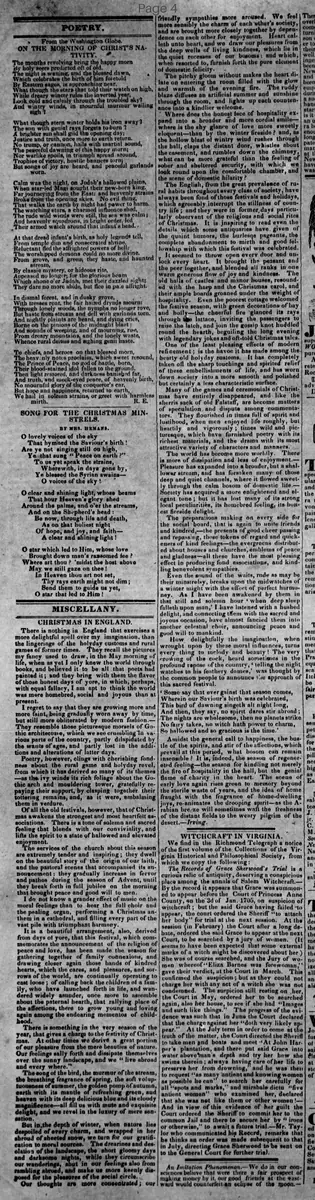
CHRISTMAS IN ENGLAND
There is nothing in England that exercises a more delightful spell over my imagination, than the lingerings of the holyday customs and rural games of former times. They recall the pictures my fancy used to draw, in the May morning of life, when as yet I only knew the world through books, and believed it to be all that poets had painted it; and they bring with them the flavor of those honest days of yore, in which, perhaps, with equal fallacy, I am apt to think the world was more homebred, social and joyous than at present.
I regret to say that they are growing more and more faint, being gradually worn away by time, but still more obliterated by modern fashion. They resemble those picturesque morsels of Gothic architecture, which we see crumbling in various parts of the country, partly dilapidated by the wants of ages, and partly lost in the additions and alterations of latter days.
Poetry, however, clings with cherishing tenderness about the rural game and holyday revel, from which it has derived so many of its themes—as the ivy winds its rich foliage about the Gothic arch and mouldering tower, gratefully repaying their support, by clasping together their tottering remains, and, as it were, embalming them in verdure.
Of all the old festivals, however, that of Christmas awakens the strongest and most heartfelt associations. There is a tone of solemn and sacred feeling that blends with our conviviality, and lifts the spirit to a state of hallowed and elevated enjoyment.
The services of the church about this season are extremely tender and inspiring; they dwell on the beautiful story of the origin of our faith, and the pastoral scenes that accompanied its announcement: they gradually increase in fervor and pathos during the season of Advent, until they break forth in full jubilee on the morning that brought peace and good will to men.
I do not know a grander effect of music on the moral feelings than to hear the full choir and the pealing organ, performing a Christmas anthem in a cathedral, and filling every part of the vast pile with triumphant harmony.
It is a beautiful arrangement, also, derived from days of yore, that this festival, which commemorates the announcement of the religion of peace and love, has been made the season for gathering together of family connexions, and drawing closer again those bands of kindred hearts, which the cares, and pleasures, and sorrows of the world, are continually operating to cast loose; of calling back the children of a family, who have launched forth in life, and wandered widely asunder, once more to assemble about the paternal hearth, that rallying place of the affections, there to grow young and loving again among the endearing mementos of childhood.
There is something in the very season of the year, that gives a charm to the festivity of Christmas. At other times we derive a great portion of our pleasure from the mere beauties of nature. Our feelings sally forth and dissipate themselves over the sunny landscape, and we "live abroad and every where."
The song of the bird, the murmur of the stream, the breathing fragrance of spring, the soft voluptuousness of summer, the golden pomp of autumn, earth with its mantle of refreshing green, and heaven with its deep delicious blue and its cloudy magnificence—all fill us with mute and exquisite delight, and we revel in the luxury of mere sensation.
But in the depth of winter, when nature lies despoiled of every charm, and wrapped in her shroud of sheeted snow, we turn for our gratification to moral sources. The dreariness and desolation of the landscape, the short gloomy days and darksome nights, while they circumscribe our wanderings, shut in our feelings also from rambling abroad, and make us more keenly disposed for the pleasures of the social circle.
Our thoughts are more concentrated; our friendly sympathies more aroused. We feel more sensibly the charm of each other's society, and are brought more closely together by dependence on each other for enjoyment. Heart calleth unto heart, and we draw our pleasures from the deep wells of living kindness, which lie in the quiet recesses of our bosoms: and which, when resorted to, furnish forth the pure element of domestic felicity.
The pitchy gloom without makes the heart dilate on entering the room filled with the glow and warmth of the evening fire. The ruddy blaze diffuses an artificial summer and sunshine through the room, and lights up each countenance into a kindlier welcome.
Where does the honest face of hospitality expand into a broader and more cordial smile—where is the shy glance of love more sweetly eloquent—than by the winter fireside? and, as the hollow blast of wintry wind rushes through the hall, claps the distant door, whistles about the casement, and rumbles down the chimney, what can be more grateful than the feeling of sober and sheltered security, with which we look round upon the comfortable chamber, and the scene of domestic hilarity?
The English, from the great prevalence of rural habits throughout every class of society, have always been fond of those festivals and holidays, which agreeably interrupt the stillness of country life; and they were in former days particularly observant of the religious and social rites of Christmas. It is inspiring to read even the details which some antiquaries have given of the quaint humors, the burlesque pageants, the complete abandonment to mirth and good fellowship with which this festival was celebrated. It seemed to throw open every door and unlock every heart. It brought the peasant and the peer together, and blended all ranks in one warm generous flow of joy and kindness. The old halls of castles and manor houses, resounded with the harp and the Christmas carol, and their ample boards groaned under the weight of hospitality. Even the poorest cottage welcomed the festive season, with green decorations of bay and holly—the cheerful fire glanced its rays through the lattice, inviting the passengers to raise the latch, and join the gossip knot huddled round the hearth, beguiling the long evening with legendary jokes and oft-told Christmas tales.
One of the least pleasing effects of modern refinement; is the havoc it has made among the hearty old holyday customs. It has completely taken off the sharp touchings and spirited relief of these embellishments of life, and has worn down society into a more smooth and polished but certainly a less characteristic surface.
Many of the games and ceremonials of Christmas have entirely disappeared, and like the sherris sack of old Falstaff, are become matters of speculation and dispute among commentators. They flourished in times full of spirit and lustihood, when men enjoyed life roughly, but heartily and vigorously; times wild and picturesque, which have furnished poetry with its richest materials, and the drama with its most attractive variety of characters and manners.
The world has become more worldly. There is more of dissipation and less of enjoyment. Pleasure has expanded into a broader, but a shallower stream, and has forsaken many of those deep and quiet channels, where it flowed sweetly through the calm bosom of domestic life. Society has acquired a more enlightened and elegant tone; but it has lost many of its strong local peculiarities, its homebred feeling, its honest fireside delight.
The preparations making on every side for the social board, that is again to unite friends and kindred,—the presents of good cheer passing and repassing, those tokens of regard and quickeners of kind feeling—the evergreens distributed about houses and churches, emblems of peace and gladness—all these have the most pleasing effect in producing fond associations, and kindling benevolent sympathies.
Even the sound of the waits, rude as may be their minstrelsy, breaks upon the midwatches of a winter night with the effect of perfect harmony. As I have been awakened by them in that 'still and solemn hour' when deep sleep falleth upon man,' I have listened with a hushed delight, and connecting them with the sacred and joyous occasion, have almost fancied them into another celestial choir, announcing peace and good will to mankind.
How delightfully the imagination, when wrought upon by these moral influences, turns every thing to melody and beauty! The very crowing of the cock, heard sometimes in the profound repose of the country, 'telling the night watches to his feathery dames,' was thought by the common people to announce the approach of this sacred festival.
Some say that ever 'gainst that season comes,
Wherein our Saviour's birth was celebrated,
This bird of dawning singeth all night long,
And then, they say, no spirit dares stir abroad;
The nights are wholesome, then no planets strike
No fairy takes, no witch hath power to charm,
So hallowed and so gracious is the time.
Amidst the general call to happiness, the bustle of the spirits, and stir of the affections, which prevail at this period, what bosom can remain insensible? It is, indeed, the season of regenerated feeling—the season for kindling not merely the fire of hospitality in the hall, but the genial flame of charity in the heart. The scene of early love again rises green to memory beyond the sterile waste of years, and the idea of home, fraught with the fragrance of home-dwelling joys, re-animates the drooping spirit—as the Arabian breeze will sometimes waft the freshness of the distant fields to the weary pilgrim of the desert.—Irving
CHRISTMAS IN ENGLAND
There is nothing in England that exercises a more delightful spell over my imagination, than the lingerings of the holyday customs and rural games of former times. They recall the pictures my fancy used to draw, in the May morning of life, when as yet I only knew the world through books, and believed it to be all that poets had painted it; and they bring with them the flavor of those honest days of yore, in which, perhaps, with equal fallacy, I am apt to think the world was more homebred, social and joyous than at present.
I regret to say that they are growing more and more faint, being gradually worn away by time, but still more obliterated by modern fashion. They resemble those picturesque morsels of Gothic architecture, which we see crumbling in various parts of the country, partly dilapidated by the wants of ages, and partly lost in the additions and alterations of latter days.
Poetry, however, clings with cherishing tenderness about the rural game and holyday revel, from which it has derived so many of its themes—as the ivy winds its rich foliage about the Gothic arch and mouldering tower, gratefully repaying their support, by clasping together their tottering remains, and, as it were, embalming them in verdure.
Of all the old festivals, however, that of Christmas awakens the strongest and most heartfelt associations. There is a tone of solemn and sacred feeling that blends with our conviviality, and lifts the spirit to a state of hallowed and elevated enjoyment.
The services of the church about this season are extremely tender and inspiring; they dwell on the beautiful story of the origin of our faith, and the pastoral scenes that accompanied its announcement: they gradually increase in fervor and pathos during the season of Advent, until they break forth in full jubilee on the morning that brought peace and good will to men.
I do not know a grander effect of music on the moral feelings than to hear the full choir and the pealing organ, performing a Christmas anthem in a cathedral, and filling every part of the vast pile with triumphant harmony.
It is a beautiful arrangement, also, derived from days of yore, that this festival, which commemorates the announcement of the religion of peace and love, has been made the season for gathering together of family connexions, and drawing closer again those bands of kindred hearts, which the cares, and pleasures, and sorrows of the world, are continually operating to cast loose; of calling back the children of a family, who have launched forth in life, and wandered widely asunder, once more to assemble about the paternal hearth, that rallying place of the affections, there to grow young and loving again among the endearing mementos of childhood.
There is something in the very season of the year, that gives a charm to the festivity of Christmas. At other times we derive a great portion of our pleasure from the mere beauties of nature. Our feelings sally forth and dissipate themselves over the sunny landscape, and we "live abroad and every where."
The song of the bird, the murmur of the stream, the breathing fragrance of spring, the soft voluptuousness of summer, the golden pomp of autumn, earth with its mantle of refreshing green, and heaven with its deep delicious blue and its cloudy magnificence—all fill us with mute and exquisite delight, and we revel in the luxury of mere sensation.
But in the depth of winter, when nature lies despoiled of every charm, and wrapped in her shroud of sheeted snow, we turn for our gratification to moral sources. The dreariness and desolation of the landscape, the short gloomy days and darksome nights, while they circumscribe our wanderings, shut in our feelings also from rambling abroad, and make us more keenly disposed for the pleasures of the social circle.
Our thoughts are more concentrated; our friendly sympathies more aroused. We feel more sensibly the charm of each other's society, and are brought more closely together by dependence on each other for enjoyment. Heart calleth unto heart, and we draw our pleasures from the deep wells of living kindness, which lie in the quiet recesses of our bosoms: and which, when resorted to, furnish forth the pure element of domestic felicity.
The pitchy gloom without makes the heart dilate on entering the room filled with the glow and warmth of the evening fire. The ruddy blaze diffuses an artificial summer and sunshine through the room, and lights up each countenance into a kindlier welcome.
Where does the honest face of hospitality expand into a broader and more cordial smile—where is the shy glance of love more sweetly eloquent—than by the winter fireside? and, as the hollow blast of wintry wind rushes through the hall, claps the distant door, whistles about the casement, and rumbles down the chimney, what can be more grateful than the feeling of sober and sheltered security, with which we look round upon the comfortable chamber, and the scene of domestic hilarity?
The English, from the great prevalence of rural habits throughout every class of society, have always been fond of those festivals and holidays, which agreeably interrupt the stillness of country life; and they were in former days particularly observant of the religious and social rites of Christmas. It is inspiring to read even the details which some antiquaries have given of the quaint humors, the burlesque pageants, the complete abandonment to mirth and good fellowship with which this festival was celebrated. It seemed to throw open every door and unlock every heart. It brought the peasant and the peer together, and blended all ranks in one warm generous flow of joy and kindness. The old halls of castles and manor houses, resounded with the harp and the Christmas carol, and their ample boards groaned under the weight of hospitality. Even the poorest cottage welcomed the festive season, with green decorations of bay and holly—the cheerful fire glanced its rays through the lattice, inviting the passengers to raise the latch, and join the gossip knot huddled round the hearth, beguiling the long evening with legendary jokes and oft-told Christmas tales.
One of the least pleasing effects of modern refinement; is the havoc it has made among the hearty old holyday customs. It has completely taken off the sharp touchings and spirited relief of these embellishments of life, and has worn down society into a more smooth and polished but certainly a less characteristic surface.
Many of the games and ceremonials of Christmas have entirely disappeared, and like the sherris sack of old Falstaff, are become matters of speculation and dispute among commentators. They flourished in times full of spirit and lustihood, when men enjoyed life roughly, but heartily and vigorously; times wild and picturesque, which have furnished poetry with its richest materials, and the drama with its most attractive variety of characters and manners.
The world has become more worldly. There is more of dissipation and less of enjoyment. Pleasure has expanded into a broader, but a shallower stream, and has forsaken many of those deep and quiet channels, where it flowed sweetly through the calm bosom of domestic life. Society has acquired a more enlightened and elegant tone; but it has lost many of its strong local peculiarities, its homebred feeling, its honest fireside delight.
The preparations making on every side for the social board, that is again to unite friends and kindred,—the presents of good cheer passing and repassing, those tokens of regard and quickeners of kind feeling—the evergreens distributed about houses and churches, emblems of peace and gladness—all these have the most pleasing effect in producing fond associations, and kindling benevolent sympathies.
Even the sound of the waits, rude as may be their minstrelsy, breaks upon the midwatches of a winter night with the effect of perfect harmony. As I have been awakened by them in that 'still and solemn hour' when deep sleep falleth upon man,' I have listened with a hushed delight, and connecting them with the sacred and joyous occasion, have almost fancied them into another celestial choir, announcing peace and good will to mankind.
How delightfully the imagination, when wrought upon by these moral influences, turns every thing to melody and beauty! The very crowing of the cock, heard sometimes in the profound repose of the country, 'telling the night watches to his feathery dames,' was thought by the common people to announce the approach of this sacred festival.
Some say that ever 'gainst that season comes,
Wherein our Saviour's birth was celebrated,
This bird of dawning singeth all night long,
And then, they say, no spirit dares stir abroad;
The nights are wholesome, then no planets strike
No fairy takes, no witch hath power to charm,
So hallowed and so gracious is the time.
Amidst the general call to happiness, the bustle of the spirits, and stir of the affections, which prevail at this period, what bosom can remain insensible? It is, indeed, the season of regenerated feeling—the season for kindling not merely the fire of hospitality in the hall, but the genial flame of charity in the heart. The scene of early love again rises green to memory beyond the sterile waste of years, and the idea of home, fraught with the fragrance of home-dwelling joys, re-animates the drooping spirit—as the Arabian breeze will sometimes waft the freshness of the distant fields to the weary pilgrim of the desert.—Irving
What sub-type of article is it?
Essay
What themes does it cover?
Religious
Social Manners
Seasonal Cycle
What keywords are associated?
Christmas
England
Traditions
Family
Winter
Hospitality
Customs
Nostalgia
What entities or persons were involved?
Irving
Literary Details
Title
Christmas In England
Author
Irving
Subject
Christmas Traditions In England
Key Lines
Of All The Old Festivals, However, That Of Christmas Awakens The Strongest And Most Heartfelt Associations. There Is A Tone Of Solemn And Sacred Feeling That Blends With Our Conviviality, And Lifts The Spirit To A State Of Hallowed And Elevated Enjoyment.
It Is A Beautiful Arrangement, Also, Derived From Days Of Yore, That This Festival, Which Commemorates The Announcement Of The Religion Of Peace And Love, Has Been Made The Season For Gathering Together Of Family Connexions, And Drawing Closer Again Those Bands Of Kindred Hearts.
But In The Depth Of Winter, When Nature Lies Despoiled Of Every Charm, And Wrapped In Her Shroud Of Sheeted Snow, We Turn For Our Gratification To Moral Sources.
It Seemed To Throw Open Every Door And Unlock Every Heart. It Brought The Peasant And The Peer Together, And Blended All Ranks In One Warm Generous Flow Of Joy And Kindness.
It Is, Indeed, The Season Of Regenerated Feeling—The Season For Kindling Not Merely The Fire Of Hospitality In The Hall, But The Genial Flame Of Charity In The Heart.