Thank you for visiting SNEWPapers!
Sign up free
Alexandria Gazette & Daily Advertiser
Alexandria, Virginia
What is this article about?
General San Martin, hero of Maipu and Chacabuco, entered Santiago, Chile, on October 29, 1818, evading planned honors but receiving receptions from officials and citizens. The Supreme Director hosted a splendid entertainment on November 1 with fireworks, illuminations, and a ball. A toast compared him to Epaminondas, highlighting their military virtues and battles.
Clipping
OCR Quality
Full Text
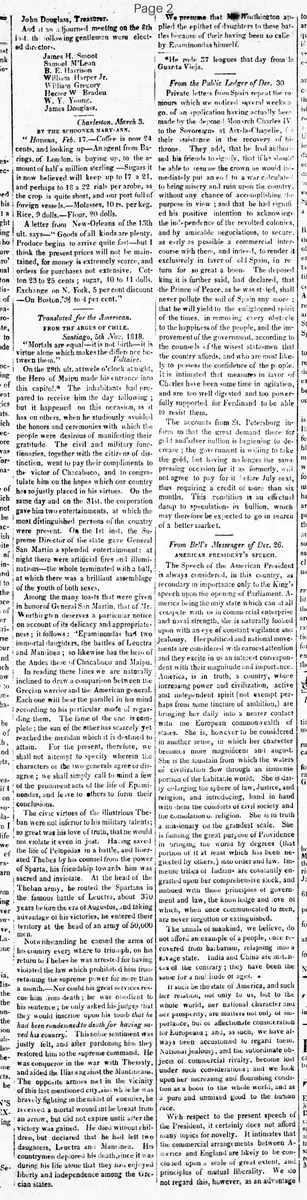
FROM THE ARGUS OF CHILE.
Santiago, 5th Nov. 1818.
"Mortals are equal--it is not birth--it is virtue alone which makes the difference between them."
Voltaire.
On the 29th ult. at twelve o'clock at night, the Hero of Maipu made his entrance into this capital.* The inhabitants had prepared to receive him the day following; but it happened on this occasion, as it has on others, when he studiously avoided the honors and ceremonies with which the people were desirous of manifesting their gratitude. The civil and military functionaries, together with the citizens of distinction, went to pay their compliments to the victor of Chacabuco, and to congratulate him on the hopes which our country has so justly placed in his virtues. On the same day and on the 31st, the corporation gave him two entertainments, at which the most distinguished persons of the country were present. On the 1st inst. the Supreme Director of the state gave General San Martin a splendid entertainment: at night there were artificial fires and illuminations--the whole terminated with a ball, at which there was a brilliant assemblage of the youth of both sexes.
Among the many toasts that were given in honor of General San Martin, that of Mr. Worthington deserves a particular notice on account of its delicacy and appropriateness; it follows: Epaminondas had two immortal daughters, the battles of Leuctra and Mantinea: so likewise has the hero of the Andes these of Chacabuco and Maipu.
In reading these lines we are naturally inclined to draw a comparison between the Grecian warrior and the American general. Each one will bear the parallel in his mind according to his particular mode of regarding them. The fame of the one is complete; the sun of the other has scarcely yet reached the meridian which it is destined to attain. For the present, therefore, we shall not attempt to specify wherein the characters of the two generals agree or disagree; we shall simply call to mind a few of the prominent acts of the life of Epaminondas, and leave to others to form their conclusions.
The civic virtues of the illustrious Theban were not inferior to his military talents: so great was his love of truth, that he would not violate it even in jest. Having saved the life of Pelopidas in a battle, and liberated Thebes by his counsel from the power of Sparta, his friendship towards him was sacred and inviolate. At the head of the Theban army, he routed the Spartans in the famous battle of Leuctra, about 370 years before the era of Augustus, and taking advantage of his victories, he entered their territory at the head of an army of 50,000 men.
Notwithstanding he caused the arms of his country every where to triumph, on his return to Thebes he was arrested for having violated the law which prohibited him from retaining the supreme power for more than a month.--Nor could his great services rescue him from death; he was obedient to his sentence: he only asked his judges that they would inscribe upon his tomb that he had been condemned to death for having saved his country: This noble sentiment was justly felt, and after pardoning him they restored him to the supreme command. He was conqueror in the war with Thessaly, and aided the Phliasians against the Mantineans.
The opposite armies met in the vicinity of this last mentioned city, and while he was bravely fighting in the midst of enemies, he received a mortal wound in the breast from an arrow, but did not expire until after the victory was gained. He died without children, but declared that he had left two daughters, Leuctra and Mantinea. His countrymen deplored his death, since it was during his life alone that they had enjoyed liberty and independence among the Grecian states.
We presume that Mr. Worthington applied the epithet of daughters to these battles because of their having been so called by Epaminondas himself.
*He rode 37 leagues that day from la Guarda Vieja.
What sub-type of article is it?
What keywords are associated?
What entities or persons were involved?
Where did it happen?
Foreign News Details
Primary Location
Santiago, Chile
Event Date
29th Ult. To 1st Inst. 1818
Key Persons
Outcome
splendid entertainments, artificial fires, illuminations, and a ball in honor of general san martin; comparison to epaminondas highlighting virtues and battles.
Event Details
On the 29th ult. at twelve o'clock at night, the Hero of Maipu made his entrance into this capital. The inhabitants had prepared to receive him the day following; but he studiously avoided the honors and ceremonies. The civil and military functionaries, together with the citizens of distinction, went to pay their compliments to the victor of Chacabuco. On the same day and on the 31st, the corporation gave him two entertainments. On the 1st inst. the Supreme Director gave General San Martin a splendid entertainment: at night there were artificial fires and illuminations--the whole terminated with a ball. Among the toasts, that of Mr. Worthington compared San Martin to Epaminondas, whose battles of Leuctra and Mantinea were called his immortal daughters, like Chacabuco and Maipu for San Martin. The article recounts Epaminondas's life and virtues.