Thank you for visiting SNEWPapers!
Sign up free
Story
June 21, 1833
Phenix Gazette
Alexandria, Virginia
What is this article about?
A comparison of American orators Henry Clay and Daniel Webster to British counterparts Henry Brougham and Edmund Burke, arguing that Clay's passion rivals Brougham's, while Webster's philosophical depth mirrors Burke's, leading to enduring reputation rather than immediate political effect.
Clipping
OCR Quality
98%
Excellent
Full Text
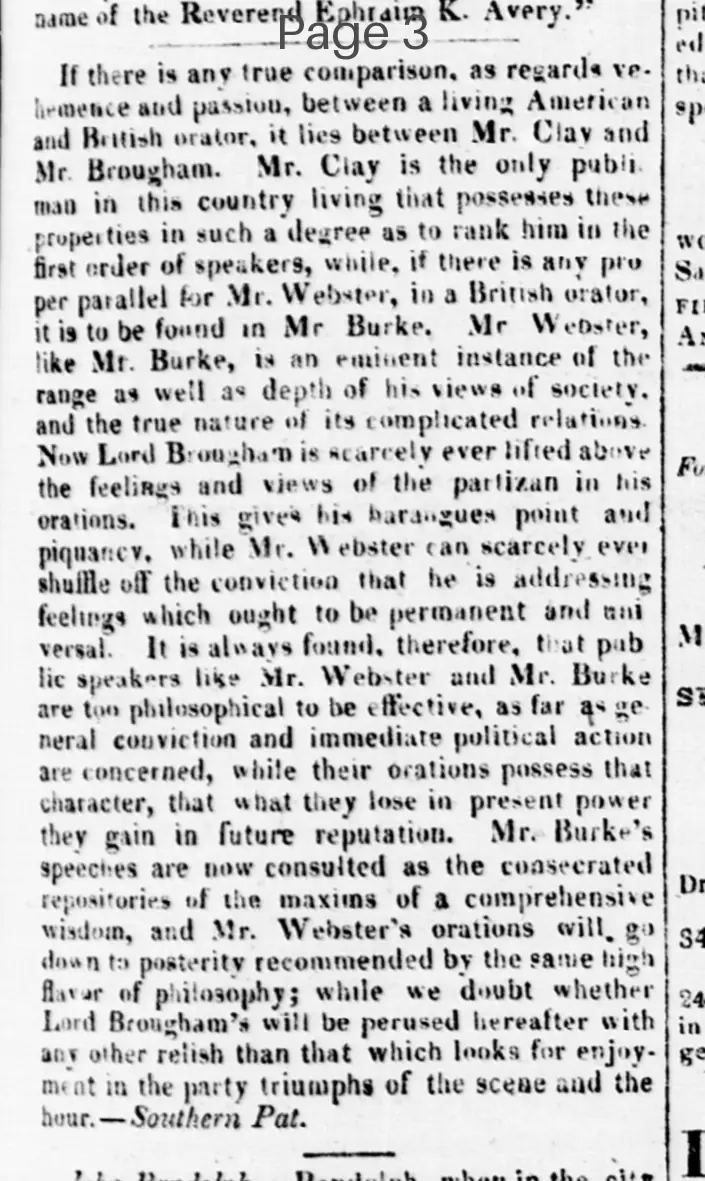
If there is any true comparison, as regards vehemence and passion, between a living American and British orator, it lies between Mr. Clay and Mr. Brougham. Mr. Clay is the only public man in this country living that possesses these properties in such a degree as to rank him in the first order of speakers, while, if there is any proper parallel for Mr. Webster, in a British orator, it is to be found in Mr. Burke. Mr. Webster, like Mr. Burke, is an eminent instance of the range as well as depth of his views of society, and the true nature of its complicated relations.
Now Lord Brougham is scarcely ever lifted above the feelings and views of the partizan in his orations. This gives his harangues point and piquancy, while Mr. Webster can scarcely ever shuffle off the conviction that he is addressing feelings which ought to be permanent and universal. It is always found, therefore, that public speakers like Mr. Webster and Mr. Burke are too philosophical to be effective, as far as general conviction and immediate political action are concerned, while their orations possess that character, that what they lose in present power they gain in future reputation. Mr. Burke's speeches are now consulted as the consecrated repositories of the maxims of a comprehensive wisdom, and Mr. Webster's orations will go down to posterity recommended by the same high flavor of philosophy; while we doubt whether Lord Brougham's will be perused hereafter with any other relish than that which looks for enjoyment in the party triumphs of the scene and the hour.
—Southern Pat.
Now Lord Brougham is scarcely ever lifted above the feelings and views of the partizan in his orations. This gives his harangues point and piquancy, while Mr. Webster can scarcely ever shuffle off the conviction that he is addressing feelings which ought to be permanent and universal. It is always found, therefore, that public speakers like Mr. Webster and Mr. Burke are too philosophical to be effective, as far as general conviction and immediate political action are concerned, while their orations possess that character, that what they lose in present power they gain in future reputation. Mr. Burke's speeches are now consulted as the consecrated repositories of the maxims of a comprehensive wisdom, and Mr. Webster's orations will go down to posterity recommended by the same high flavor of philosophy; while we doubt whether Lord Brougham's will be perused hereafter with any other relish than that which looks for enjoyment in the party triumphs of the scene and the hour.
—Southern Pat.
What sub-type of article is it?
Biography
Historical Event
What themes does it cover?
Moral Virtue
Triumph
What keywords are associated?
Orators Comparison
American British Speakers
Philosophical Oratory
Lasting Reputation
Partisan Speeches
What entities or persons were involved?
Mr. Clay
Mr. Brougham
Mr. Webster
Mr. Burke
Lord Brougham
Southern Pat.
Story Details
Key Persons
Mr. Clay
Mr. Brougham
Mr. Webster
Mr. Burke
Lord Brougham
Southern Pat.
Story Details
The piece compares the oratory styles of Henry Clay to Henry Brougham for passion, and Daniel Webster to Edmund Burke for philosophical depth, suggesting the latter pair's speeches endure as wisdom repositories while Brougham's are partisan and fleeting.