Thank you for visiting SNEWPapers!
Sign up free
Letter to Editor
May 31, 1820
Daily National Intelligencer
Washington, District Of Columbia
What is this article about?
A letter to the editors discusses scientific evidence from Dr. Mitchill and Mr. Hunter to argue that whales are mammals, not fish, differing in anatomy, blood, and respiration from true fish. It references historical zoological texts to support this classification.
Clipping
OCR Quality
97%
Excellent
Full Text
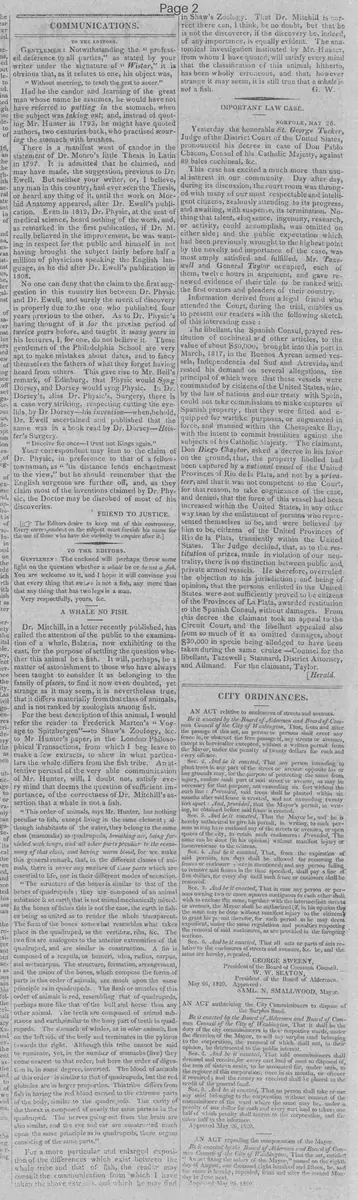
TO THE EDITORS.
Gentlemen: The enclosed will perhaps throw some light on the question whether a whale be or be not a fish. You are welcome to it, and I hope it will convince you that every thing that swims is not a fish, any more than that any thing that has two legs is a man.
Very respectfully, yours, &c.
A WHALE NO FISH.
Dr. Mitchill, in a letter recently published, has called the attention of the public to the examination of a whale, Balæna, now exhibiting to the east, for the purpose of settling the question whether this animal be a fish. It will, perhaps, be a matter of astonishment to those who have always been taught to consider it as belonging to the family of pisces, to find it now even doubted, yet strange as it may seem, it is nevertheless true, that it differs materially from that class of animals, and is not ranked by zoologists among fish.
For the best description of this animal, I would refer the reader to Frederick Marten's "Voyage to Spitzbergen"—to Shaw's Zoology, &c. to Mr. Hunter's paper, in the London Philosophical Transactions, from which I beg leave to make a few extracts, to shew in what particulars the whale differs from the fish tribe. An attentive perusal of the very able communication of Mr. Hunter, will, I doubt not, satisfy every mind that deems the question of sufficient importance, of the correctness of Dr. Mitchill's assertion that a whale is not a fish.
"This order of animals, says Mr. Hunter, has nothing peculiar to fish, except living in the same element; although inhabitants of the water, they belong to the same class (mammalia) as quadrupeds, breathing air, being furnished with lungs, and all other parts peculiar to the economy of that class, and having warm blood, for we make this general remark, that, in the different classes of animals, there is never any mixture of those parts which are essential to life, nor in their different modes of sensation."
"The structure of the bones is similar to that of the bones of quadrupeds; they are composed of an animal substance & an earth that is not animal mechanically mixed. In the bones of fishes this is not the case, the earth in fishes being so united as to render the whole transparent. The form of the bones somewhat resembles what takes place in the quadruped, as the vertebrae, ribs, &c. The two fins are analogous to the anterior extremities of the quadruped, and are similar in construction. A fin is composed of a scapula, os humeri, ulna, radius, carpus, and metacarpus. The structure, formation, arrangement, and the union of the bones, which compose the forms of parts in this order of animals, are much upon the same principle as in quadrupeds. The flesh or muscles of this order of animals is red, resembling that of quadrupeds, perhaps more like that of the bull and horse than any other animal. The teeth are composed of animal substance and earth, similar to the bony part of teeth in quadrupeds. The stomach of whales, as in other animals, lies on the left side of the body and terminates in the pylorus towards the right. Although this tribe cannot be said to ruminate, yet, in the number of stomachs (five) they come nearest to that order, but here the order of digestion is, in some degree, inverted. The blood of animals of this order is similar to that of quadrupeds, but the red globules are in larger proportion. This tribe differs from fish in having the red blood carried to the extreme parts of the body, similar to the quadrupeds. The cavity of the thorax is composed of nearly the same parts as in the quadruped. The nerves going out from the brain are also similar, and the eye and ear are constructed much upon the same principle as in quadrupeds, these organs consisting of the same parts."
For a more particular and enlarged exposition of the differences which exist between the whale tribe and that of fish, the reader may consult the communication from which I have taken the above extracts, and which he may find in Shaw's Zoology. That Dr. Mitchill is correct there can, I think, be no doubt, but that he is not the discoverer, if the discovery be, indeed, of any importance, is equally evident. The anatomical investigation instituted by Mr. Hunter, from whom I have quoted, will satisfy every mind that the classification of this animal, hitherto, has been wholly erroneous, and that, however strange it may seem, it is still true that a whale is not a fish.
G. W.
Gentlemen: The enclosed will perhaps throw some light on the question whether a whale be or be not a fish. You are welcome to it, and I hope it will convince you that every thing that swims is not a fish, any more than that any thing that has two legs is a man.
Very respectfully, yours, &c.
A WHALE NO FISH.
Dr. Mitchill, in a letter recently published, has called the attention of the public to the examination of a whale, Balæna, now exhibiting to the east, for the purpose of settling the question whether this animal be a fish. It will, perhaps, be a matter of astonishment to those who have always been taught to consider it as belonging to the family of pisces, to find it now even doubted, yet strange as it may seem, it is nevertheless true, that it differs materially from that class of animals, and is not ranked by zoologists among fish.
For the best description of this animal, I would refer the reader to Frederick Marten's "Voyage to Spitzbergen"—to Shaw's Zoology, &c. to Mr. Hunter's paper, in the London Philosophical Transactions, from which I beg leave to make a few extracts, to shew in what particulars the whale differs from the fish tribe. An attentive perusal of the very able communication of Mr. Hunter, will, I doubt not, satisfy every mind that deems the question of sufficient importance, of the correctness of Dr. Mitchill's assertion that a whale is not a fish.
"This order of animals, says Mr. Hunter, has nothing peculiar to fish, except living in the same element; although inhabitants of the water, they belong to the same class (mammalia) as quadrupeds, breathing air, being furnished with lungs, and all other parts peculiar to the economy of that class, and having warm blood, for we make this general remark, that, in the different classes of animals, there is never any mixture of those parts which are essential to life, nor in their different modes of sensation."
"The structure of the bones is similar to that of the bones of quadrupeds; they are composed of an animal substance & an earth that is not animal mechanically mixed. In the bones of fishes this is not the case, the earth in fishes being so united as to render the whole transparent. The form of the bones somewhat resembles what takes place in the quadruped, as the vertebrae, ribs, &c. The two fins are analogous to the anterior extremities of the quadruped, and are similar in construction. A fin is composed of a scapula, os humeri, ulna, radius, carpus, and metacarpus. The structure, formation, arrangement, and the union of the bones, which compose the forms of parts in this order of animals, are much upon the same principle as in quadrupeds. The flesh or muscles of this order of animals is red, resembling that of quadrupeds, perhaps more like that of the bull and horse than any other animal. The teeth are composed of animal substance and earth, similar to the bony part of teeth in quadrupeds. The stomach of whales, as in other animals, lies on the left side of the body and terminates in the pylorus towards the right. Although this tribe cannot be said to ruminate, yet, in the number of stomachs (five) they come nearest to that order, but here the order of digestion is, in some degree, inverted. The blood of animals of this order is similar to that of quadrupeds, but the red globules are in larger proportion. This tribe differs from fish in having the red blood carried to the extreme parts of the body, similar to the quadrupeds. The cavity of the thorax is composed of nearly the same parts as in the quadruped. The nerves going out from the brain are also similar, and the eye and ear are constructed much upon the same principle as in quadrupeds, these organs consisting of the same parts."
For a more particular and enlarged exposition of the differences which exist between the whale tribe and that of fish, the reader may consult the communication from which I have taken the above extracts, and which he may find in Shaw's Zoology. That Dr. Mitchill is correct there can, I think, be no doubt, but that he is not the discoverer, if the discovery be, indeed, of any importance, is equally evident. The anatomical investigation instituted by Mr. Hunter, from whom I have quoted, will satisfy every mind that the classification of this animal, hitherto, has been wholly erroneous, and that, however strange it may seem, it is still true that a whale is not a fish.
G. W.
What sub-type of article is it?
Informative
Philosophical
What themes does it cover?
Science Nature
What keywords are associated?
Whale Classification
Mammalia
Zoology
Anatomy
Dr Mitchill
Mr Hunter
Fish Differences
Scientific Debate
What entities or persons were involved?
G. W.
The Editors
Letter to Editor Details
Author
G. W.
Recipient
The Editors
Main Argument
whales are not fish but mammals, sharing anatomical and physiological traits with quadrupeds such as lungs, warm red blood, and bone structure, as evidenced by mr. hunter's anatomical studies.
Notable Details
References Dr. Mitchill's Letter On A Whale Exhibition
Quotes Extensively From Mr. Hunter's Paper In London Philosophical Transactions
Cites Frederick Marten's 'Voyage To Spitzbergen' And Shaw's Zoology
Highlights Differences In Bones, Muscles, Stomachs, Blood, And Organs From Fish