Thank you for visiting SNEWPapers!
Sign up free
Gold Hill Daily News
Gold Hill, Storey County, Nevada
What is this article about?
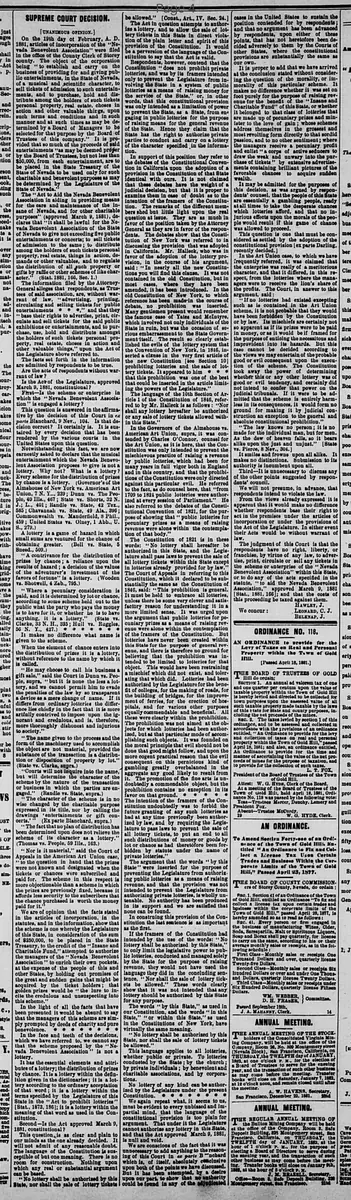
In 1881, the Nevada Supreme Court unanimously declares unconstitutional a state law aiding the Nevada Benevolent Association's lottery-like entertainments for charitable purposes, affirming they are prohibited lotteries under the constitution.
Merged-components note: Text continuation of Supreme Court decision on lottery constitutionality.
Clipping
OCR Quality
Full Text
[UNANIMOUS OPINION.]
On the 19th day of February, A. D. 1881, articles of incorporation of the "Nevada Benevolent Association" were filed in the office of the County Clerk of Storey county. The object of the corporation being "to establish and carry on the business of providing for and giving public entertainments, in the State of Nevada, of a musical and scientific character, to sell tickets of admission to such entertainments, and to purchase, hold and distribute among the holders of such tickets personal property, real estate, choses in action and other valuable things, upon such terms and conditions and in such manner and at such times as may be determined by a Board of Managers to be selected for that purpose by the Board of Trustees of this company." It is provided that so much of the proceeds of said entertainments "as may be deemed proper by the Board of Trustees, but not less than $50,000, from each entertainment, are to be placed in the State Treasury of the State of Nevada to be used only for such charitable and benevolent purposes as may be determined by the Legislature of the State of Nevada."
The "Act to Aid the Nevada Benevolent Association in aiding in providing means for the care and maintenance of the insane of Nevada, and for other charitable purposes" (approved March 9, 1881), declares that "it shall be lawful for the Nevada Benevolent Association of the State of Nevada to give not exceeding five public entertainments or concerts; to sell tickets of admission to the same; to distribute among the holders of such tickets personal property, real estate, things in action, demands or other valuables, and to regulate the distribution of all such property or gifts by raffle or other schemes of like character." (Stat. 1881, 166, Sec. 1.)
The information filed by the Attorney General alleges that respondents, as Trustees of said association, are, without warrant of law, "advertising, printing, circulating and selling tickets for public entertainments * * * ," and that they "base their rights to advertise, print, circulate and sell tickets for the said public exhibitions or entertainments, and to purchase, hold and distribute amongst the holders of such tickets personal property, real estate, choses in action and other valuable things," upon the Act of the Legislature above referred to.
The facts set forth in the information are admitted by respondents to be true.
Are the acts of respondents without warrant of law?
Is the Act of the Legislature, approved March 9, 1881, constitutional?
First--Is the scheme or enterprise in which the "Nevada Benevolent Association" is engaged a lottery?
This question is answered in the affirmative by the decision of this Court in ex parte Blanchard, 9 Nev., 101. Is that decision correct? It certainly is. It is sustained by every decision that has been rendered by the various courts in the United States upon this question.
Notwithstanding this fact, we are now earnestly asked to declare that the musical entertainment which the Nevada Benevolent Association proposes to give is not a lottery. Why not? What is a lottery?
Every scheme for the distribution of prizes by chance is a lottery. (Governors of the Almshouse of New York vs. American Art Union, 7 N. Y., 236; Dunn vs. The People, 40 Ills., 467; State vs. Shorts, 32 N. J. L., 401; Randle vs. State, 42 Tex., 585; Chavannah vs. State, 49 Ala., 396; Commonwealth vs. Manderfield, 8 Phil., 459; United States vs. Olney, 1 Abb., U. S., 279.)
A lottery is a game of hazard in which small sums are ventured for the chance of obtaining greater. (Bell vs. State, 5 Sneed., 509.)
"A contrivance for the distribution of prizes by chance; a reliance upon the results of hazard; a decision of the values of the adventurer's investment of the favors of fortune" is a lottery. (Woodruff vs. Shotwell, 6 Zab., 795.)
"Where a pecuniary consideration is paid, and it is determined by lot or chance, according to some scheme held out to the public what the party who pays the money is to have for it, or whether he is to have anything, it is a lottery." (State vs. Clarke, 33 N. H., 335; Hull vs. Ruggles, 56 N. Y., 427.) *
It makes no difference what name is given to the scheme.
When the element of chance enters into the distribution of prizes it is a lottery, without reference to the name by which it is called.
"He may choose to call his business a gift sale," said the Court in Dunn vs. People, supra, "but it is none the less a lottery, and we cannot permit him to evade the penalties of the law by so transparent a device as a mere change of name. If it differs from ordinary lotteries the difference lies chiefly in the fact that it is more artfully contrived to impose upon the ignorant and credulous, and is, therefore, more thoroughly dishonest and injurious to society."
"The name given to the process and the form of the machinery used to accomplish the object are not material, provided the substance of the transaction is distribution or disposition of property by lot." (State vs. Clarke, supra.)
"Courts will not inquire into the name, but will determine the character of the scheme by the nature of the transaction or business in which the parties are engaged." (Randle vs. State, supra.)
"The character of the scheme is in no wise changed by the charitable purpose expressed in its title, nor by calling the drawings entertainments or gift concerts." (Ex parte Blanchard, supra.)
"The fact that no plan of distribution has been determined upon does not relieve the scheme of its character as a lottery." (Thomas vs. People, 59 Ills., 163.)
"Nor is it material," said the Court of Appeals in the American Art Union case, "to the question in hand that the prizes were not known and designated when the tickets or chances were subscribed and paid for. The scheme in this respect is more objectionable than a scheme in which the prizes are previously fixed, because it affords less security to the subscribers that the chance purchased is worth the money paid for it."
We are of opinion that the facts stated in the articles of incorporation, in the statutes, and in the information, show that the scheme is one whereby the Legislature of this State, in consideration of the sum of $250,000, to be placed in the State Treasury, to the credit of the "Insane and Charitable Fund," attempted to authorize the managers of the "Nevada Benevolent Association" to enrich their own pockets, at the expense of the people of this and other States, by holding out promises of the great and sudden gains that might be acquired by the ticket holders; that golden prizes would be "the lure to incite the credulous and unsuspecting into this scheme."
In the light of all the facts that have been presented it would be absurd to say that the managers of this scheme are simply prompted by deeds of charity and pure benevolence.
In the face and teeth of the decisions which we have referred to, we cannot say that the scheme proposed by the "Nevada Benevolent Association" is not a lottery.
It has the essential elements and attributes of a lottery; the distribution of prizes by chance. It is a lottery within the definition given in the dictionaries; it is a lottery according to the ordinary acceptation of that word; it is a lottery within the terms specified by the Legislature of this State in the "Act to prohibit lotteries" [Stat., 1873, 186]; it is a lottery within the meaning of that word as used in the Constitution.
Second--Is the Act approved March 9, 1881, constitutional?
This question is as clear and plain to our minds as the one already decided. It will not admit of any reasonable doubt.
The language of the Constitution is susceptible of but one meaning. There is no room for construction. Nothing upon which any real or substantial argument can be based.
"No lottery shall be authorized by this State, nor shall the sale of lottery tickets be allowed." [Const., Art. IV, Sec. 24.]
The Act in question attempts to authorize a lottery, and to allow the sale of lottery tickets in this State in direct violation of the plain letter and spirit of this provision of the Constitution. It would be a perversion of the language of the Constitution to say that the Act is valid.
Respondents, however, contend that the Constitution "does not prohibit private lotteries, and was by its framers intended only to prevent the Legislature from involving the State in a system of public lotteries as a means of raising money for the service of the State," or, in other words, that this constitutional provision was only intended as a limitation of power to prevent the State, as a State, from engaging in public lotteries for the purpose of raising means for the general revenue of the State. Hence they claim that the State has the right to authorize private parties to conduct and carry on a lottery of the character specified in the information.
In support of this position they refer to the debates of the Constitutional Convention in California upon the adoption of a provision in the Constitution of that State identical with ours. It is not claimed that these debates have the weight of a judicial decision, but that it is proper to examine them in case of doubt as to the intention of the framers of the Constitution. The remarks of the different members shed but little light upon the real question at issue. They are as much in favor of the position taken by the Attorney General as they are in favor of the respondents. The debates show that the Constitution of New York was referred to in discussing the provision that was adopted in California. Mr. Halleck, who was in favor of the adoption of the lottery provision, in the course of his argument, said: "In nearly all the new Constitutions you will find this clause. It was not contained in the old Constitution, but in most cases, where they have been amended, it has been introduced. In the old Constitution of New York, to which reference has been made in the course of debate, no prohibition was inserted. Many gentlemen present would remember the famous case of Yates and McIntyre, which involved not only individuals of the State in ruin, but was the occasion of serious embarrassment to the State Government itself. The result so clearly established the evils of the lottery system that the Convention of New York, in 1821, inserted a clause in the very first article of the new Constitution [see Section 10] prohibiting lotteries and the sale of lottery tickets. It appeared to him * * * that this prohibition was one of the best that could be inserted in the article limiting the powers of the Legislature."
The language of the 10th Section of Article 1 of the Constitution of 1821, referred to by Mr. Halleck is as follows: "Nor shall any lottery hereafter be authorized or any sale of lottery tickets allowed within this State."
In the Governors of the Almshouse vs. American Art Union, supra, it was contended by Charles O'Connor, counsel for the Art Union, as it is here, that the Constitution was only intended to prevent the mischievous practice of raising a revenue by public lotteries, which had been for many years in full vigor both in England and in this country, and that the prohibitions of the Constitution were only directed against this particular evil. He referred to the fact, as do counsel here, that "from 1709 to 1823 public lotteries were authorized at every session of Parliament." He also referred to the debates of the Constitutional Convention of 1821, for the purpose of showing that "public lotteries for pecuniary prizes as a means of raising revenue were alone within the contemplation of that body."
The Constitution of 1821 is in these words: "No lottery shall hereafter be authorized in this State, and the Legislature shall pass laws to prevent the sale of all lottery tickets within this State except in lotteries already provided for by law."
The Court of Appeals in referring to this Constitution, which it declared to be substantially the same as the Constitution of 1846, said: "This prohibition is general. It must be held to embrace all lotteries unless there be some very clever and satisfactory reason for understanding it in a more limited sense. It was urged upon the argument that public lotteries for pecuniary prizes as a means of raising revenue were alone within the contemplation of the framers of the Constitution. But lotteries have never been created within this State for the purpose of general revenue, and there is therefore no ground for believing that the prohibition was intended to be limited to lotteries for that object. This would have been restraining a mischief which did not exist, and tolerating that which did. Lotteries had been authorized by the Legislature for the benefit of colleges, for the making of roads, for the building of bridges, for the improvement of ferries, for the erection of hospitals, and for various other purposes equally commendable and beneficial. All these were clearly within the prohibition. The prohibition was not aimed at the objects for which lotteries had been authorized, but at that particular mode of accomplishing such objects. It was founded on the moral principle that evil should not be done that good might follow, and upon the more cogent practical reason that the evil consequent on this pernicious kind of gambling greatly overbalanced in the aggregate any good likely to result from it. The promotion of the fine arts is undoubtedly a commendable object, but the prohibition contains no exception in its favor.
The intention of the framers of the Constitution undoubtedly was to forbid the future granting of any such lotteries as had at any time previously been authorized by law, and by requiring the Legislature to pass laws to prevent the sale of all lottery tickets, to put an end to all such distributions of money or goods by lot or chance as had theretofore been forbidden by statute under the name of private lotteries."
The argument that the words "by this State" were inserted for the purpose of preventing the Legislature from authorizing public lotteries as a means of raising revenue, and that the provision was not intended to prevent the Legislature from authorizing private lotteries, is wholly untenable. No authority has been produced in its support and we are satisfied that none can be found.
In construing this provision of the Constitution the last sentence is as important as the first.
If the framers of the Constitution had intended by the use of the words: "No lottery shall be authorized by this State," to only limit the legislative power to public lotteries, conducted and managed solely by the State for the purpose of raising revenue, they would not have used the language they did in the concluding sentence, "Nor shall the sale of lottery tickets be allowed." These words clearly show that it was not intended that any lottery should be authorized by this State for any purpose.
The words "by this State," as used in our Constitution, and the words "in this State," "or within this State," as used in the Constitutions of New York, have virtually the same meaning.
"No lottery shall be authorized by this State, nor shall the sale of lottery tickets be allowed."
This language applies to all lotteries whether public or private. To lotteries conducted by the State; by the church; by private individuals; by benevolent and charitable associations, and by corporations.
No lottery of any kind can be authorized by the Legislature under the present Constitution.
We again repeat what, it seems to us, must be evident to every unbiased and impartial mind, that the language of the constitutional provision is too plain for argument. That under it the Legislature cannot authorize any lottery in this State, and that the Act approved March 9, 1881, is null and void.
We are conscious of the fact that it was unnecessary to add anything to the reasoning of this Court in ex parte Blanchard which is, of itself, absolutely conclusive upon both of the points we have discussed. But it has been attempted, by a desire upon our part, to show that no authority could be found in any of the adjudicated cases in the United States to sustain the position contended for by respondents; and that no argument has been advanced by respondents, upon either of these points, that has not heretofore been decided adversely to them by the Courts of other States, where the constitutional provisions are substantially the same as our own.
It is proper to add that we have arrived at the conclusion stated without considering the question of the morality, or immorality of this particular scheme. It makes no difference whether it was set on foot purely for the purpose of raising revenue for the benefit of the "Insane and Charitable Fund" of this State, or whether it belonged to that class of lotteries that are made up of pecuniary prizes and minister to the love of gain; whose schemes address themselves in the grossest and most revolting form directly to that sordid passion, and to no other sentiment; where the managers receive a pecuniary profit and enlist "a corps of active seducers to draw the weak and unwary into the purchase of tickets" by extensive advertisements containing brilliant pictures of the favorable chances to acquire sudden wealth.
It may be admitted for the purposes of this decision, as was argued by respondents' counsel, that the people of this State are essentially a gambling people, ready at all times to take the desperate chances which lotteries afford, and that no injurious effects upon the morals of the people would result if this game of chance was allowed to proceed.
This question is one that must be considered as settled by the adoption of the constitutional provision (ex parte Darling, recently decided.)
In the Art Union case, to which we have frequently referred, it was claimed that the enterprise was really of a meritorious character, and that it differed, in this respect, from the lotteries where the managers were to receive the lion's share of the profits. The Court, in answer to this argument, said:
"If no lotteries had existed excepting such as is contained in the Art Union scheme, it is not probable that they would have been forbidden by the Constitution or by law. Its mischiefs are certainly not so apparent as if its prizes were to be paid in money, or as it would be if framed for the purpose of enticing the necessitous and improvident into its hazards. But this case cannot be decided according to the views we may entertain of the probable good or evil consequent upon the execution of the scheme. The Constitution took away the power of determining whether this or any other lottery was of good or evil tendency, and certainly did not intend to confer that power on the judicial tribunals. If it were to be admitted that the scheme is entirely harmless in its consequences, it would form no ground for making it by judicial construction an exception to the general and absolute constitutional prohibition."
"The law knows no person; it is no respecter of persons. It is made for the individual man, but for men. As the dew of heaven falls, so it bears alike upon the just and unjust."
[State vs. Pierce, 8 Nev., 301.]
It smiles and frowns upon all alike. It makes no distinctions. Submission to its authority is incumbent upon all.
Third--It is unnecessary to discuss any of the other points suggested by respondents' counsel.
We will not presume, in advance, that respondents intend to violate the law.
From the views already expressed it is apparent that it would make no difference whether respondents base their right to act in the premises under the articles of incorporation or under the provisions of the Act of the Legislature. In either event their acts would be without warrant of law.
The judgment of this Court is that the respondents have no right, liberty, or franchise, by virtue of any law, to advertise, print, circulate or sell any tickets in the scheme or enterprise of the "Nevada Benevolent Association" within this State, or to do any of the acts specified in the statute, "to aid the Nevada Benevolent Association," approved March 9, 1881 [Stat., 1881, 166]; and that the costs of this proceeding be taxed against them.
HAWLEY, J.
We concur:
LEONARD, C. J.
BELKNAP, J.
What sub-type of article is it?
What themes does it cover?
What keywords are associated?
What entities or persons were involved?
Where did it happen?
Story Details
Key Persons
Location
State Of Nevada
Event Date
1881
Story Details
The Nevada Supreme Court rules that the Nevada Benevolent Association's scheme of public entertainments with prize distributions by chance constitutes a lottery, and the legislative act authorizing it violates the state constitution's prohibition on lotteries.