Thank you for visiting SNEWPapers!
Sign up free
Editorial
November 8, 1856
Republican Vindicator
Staunton, Virginia
What is this article about?
This editorial defends the three-fifths clause of the U.S. Constitution against Republican criticism, arguing it disadvantages Southern slave states by undercounting slaves for congressional representation compared to free Northern states, where Black populations count fully.
Clipping
OCR Quality
98%
Excellent
Full Text
The Three-Fifths Principle in the Constitution.
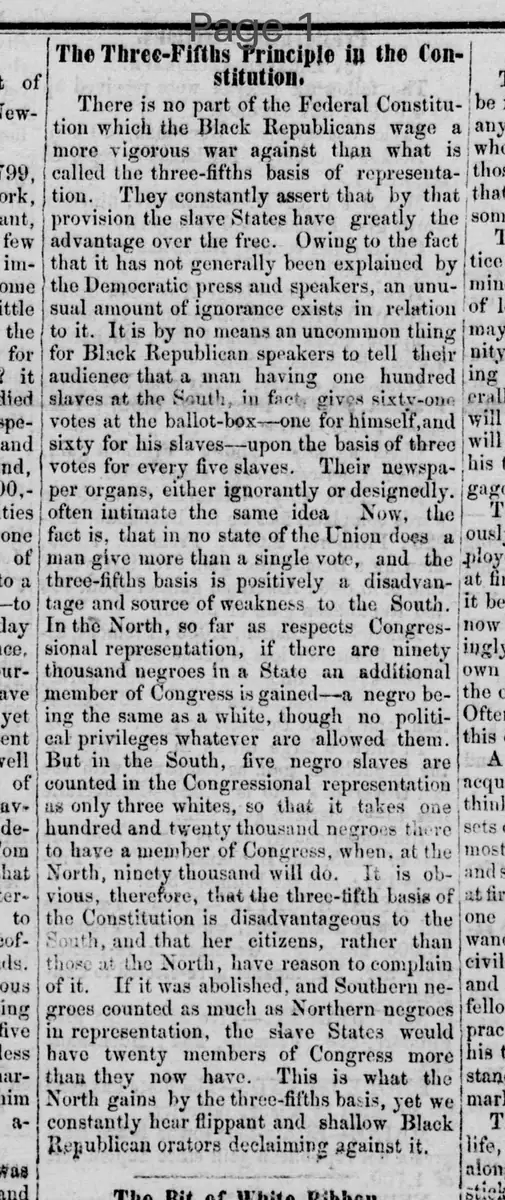
There is no part of the Federal Constitution which the Black Republicans wage a more vigorous war against than what is called the three-fifths basis of representation. They constantly assert that by that provision the slave States have greatly the advantage over the free. Owing to the fact that it has not generally been explained by the Democratic press and speakers, an unusual amount of ignorance exists in relation to it. It is by no means an uncommon thing for Black Republican speakers to tell their audience that a man having one hundred slaves at the South, in fact, gives sixty-one votes at the ballot-box--one for himself, and sixty for his slaves--upon the basis of three votes for every five slaves. Their newspaper organs, either ignorantly or designedly, often intimate the same idea. Now, the fact is, that in no state of the Union does a man give more than a single vote, and the three-fifths basis is positively a disadvantage and source of weakness to the South. In the North, so far as respects Congressional representation, if there are ninety thousand negroes in a State an additional member of Congress is gained--a negro being the same as a white, though no political privileges whatever are allowed them. But in the South, five negro slaves are counted in the Congressional representation as only three whites, so that it takes one hundred and twenty thousand negroes there to have a member of Congress, when, at the North, ninety thousand will do. It is obvious, therefore, that the three-fifth basis of the Constitution is disadvantageous to the South, and that her citizens, rather than those at the North, have reason to complain of it. If it was abolished, and Southern negroes counted as much as Northern negroes in representation, the slave States would have twenty members of Congress more than they now have. This is what the North gains by the three-fifths basis, yet we constantly hear flippant and shallow Black Republican orators declaiming against it.
There is no part of the Federal Constitution which the Black Republicans wage a more vigorous war against than what is called the three-fifths basis of representation. They constantly assert that by that provision the slave States have greatly the advantage over the free. Owing to the fact that it has not generally been explained by the Democratic press and speakers, an unusual amount of ignorance exists in relation to it. It is by no means an uncommon thing for Black Republican speakers to tell their audience that a man having one hundred slaves at the South, in fact, gives sixty-one votes at the ballot-box--one for himself, and sixty for his slaves--upon the basis of three votes for every five slaves. Their newspaper organs, either ignorantly or designedly, often intimate the same idea. Now, the fact is, that in no state of the Union does a man give more than a single vote, and the three-fifths basis is positively a disadvantage and source of weakness to the South. In the North, so far as respects Congressional representation, if there are ninety thousand negroes in a State an additional member of Congress is gained--a negro being the same as a white, though no political privileges whatever are allowed them. But in the South, five negro slaves are counted in the Congressional representation as only three whites, so that it takes one hundred and twenty thousand negroes there to have a member of Congress, when, at the North, ninety thousand will do. It is obvious, therefore, that the three-fifth basis of the Constitution is disadvantageous to the South, and that her citizens, rather than those at the North, have reason to complain of it. If it was abolished, and Southern negroes counted as much as Northern negroes in representation, the slave States would have twenty members of Congress more than they now have. This is what the North gains by the three-fifths basis, yet we constantly hear flippant and shallow Black Republican orators declaiming against it.
What sub-type of article is it?
Constitutional
Slavery Abolition
Partisan Politics
What keywords are associated?
Three Fifths Clause
Constitutional Representation
Slavery
Black Republicans
Southern Disadvantage
Congressional Seats
What entities or persons were involved?
Black Republicans
Slave States
Free States
South
North
Federal Constitution
Editorial Details
Primary Topic
Defense Of The Three Fifths Clause Against Republican Attacks
Stance / Tone
Pro Southern Defense, Critical Of Black Republicans
Key Figures
Black Republicans
Slave States
Free States
South
North
Federal Constitution
Key Arguments
Three Fifths Basis Disadvantages The South In Congressional Representation
No Individual Votes More Than Once, Contrary To Republican Claims
Northern Negroes Count Fully For Representation Despite No Voting Rights
Southern Slaves Count As Three Fifths, Requiring More To Gain A Congressional Seat
Abolishing The Clause Would Give Slave States 20 More Congressional Members
Republicans Ignorantly Or Designedly Misrepresent The Provision