Thank you for visiting SNEWPapers!
Sign up free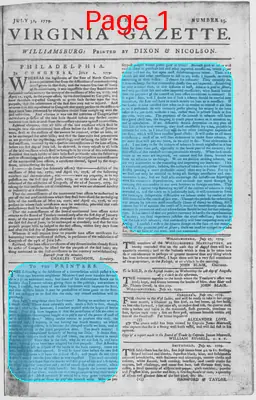
Letter to Editor
July 31, 1779
The Virginia Gazette
Richmond, Williamsburg, Richmond County, Virginia
What is this article about?
A letter recounts a conversation between neighbors on economic hardships from excess paper money causing inflation. It proposes paying loan office interest in tobacco to stabilize currency, reduce circulation of depreciating money, encourage tobacco cultivation, and aid state debt repayment.
Clipping
OCR Quality
98%
Excellent
Full Text
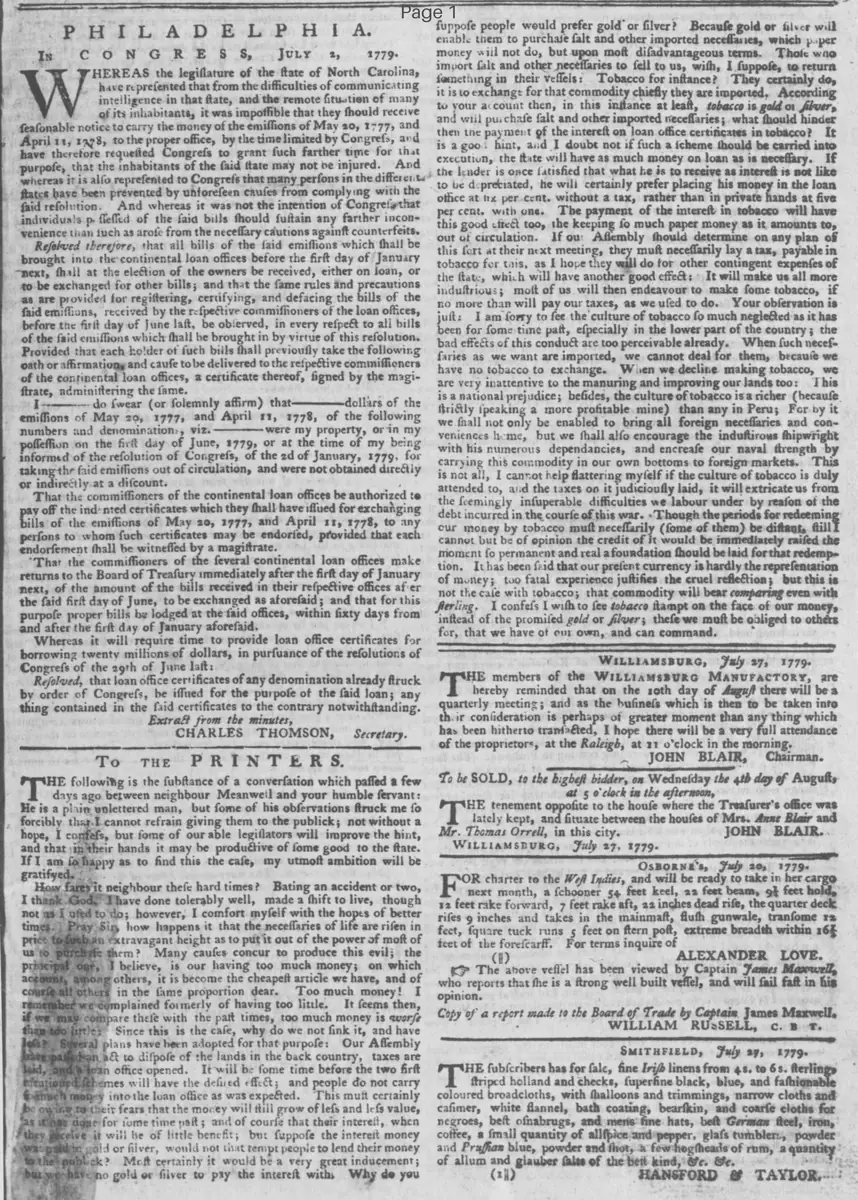
To THE PRINTERS.
The following is the substance of a conversation which passed a few days ago between neighbour Meanwell and your humble servant:
He is a plain unlettered man, but some of his observations struck me so forcibly that I cannot refrain giving them to the publick; not without a hope, I confess, but some of our able legislators will improve the hint, and that in their hands it may be productive of some good to the state.
If I am so happy as to find this the case, my utmost ambition will be gratified.
How fares it neighbour? These hard times? Bating an accident or two, I thank God, I have done tolerably well, made a shift to live, though not as I used to do; however, I comfort myself with the hopes of better times. Pray Sir, how happens it that the necessaries of life are risen in price to such an extravagant height as to put it out of the power of most of us to purchase them?
Many causes concur to produce this evil; the principal one, I believe, is our having too much money; on which account, among others, it is become the cheapest article we have, and of course all others in the same proportion dear.
Too much money! I remember we complained formerly of having too little. It seems then, if we may compare these with the past times, too much money is worse than too little: Since this is the case, why do we not sink it, and have less?
Several plans have been adopted for that purpose: Our Assembly have passed an act to dispose of the lands in the back country, taxes are laid, and loan office opened. It will be some time before the two first mentioned schemes will have the desired effect; and people do not carry much money into the loan office as was expected. This must certainly be owing to their fears that the money will still grow of less and less value, as it has done for some time past; and of course that their interest, when they receive it will be of little benefit; but suppose the interest money was paid in gold or silver, would not that tempt people to lend their money to the publick?
Most certainly it would be a very great inducement; but we have no gold or silver to pay the interest with. Why do you suppose people would prefer gold or silver? Because gold or silver will enable them to purchase salt and other imported necessaries, which paper money will not do, but upon most disadvantageous terms. Those who import salt and other necessaries to sell to us, wish, I suppose, to return something in their vessels: Tobacco for instance? They certainly do, it is to exchange for that commodity chiefly they are imported. According to your account then, in this instance at least, tobacco is gold or silver, and will purchase salt and other imported necessaries; what should hinder then the payment of the interest on loan office certificates in tobacco?
It is a good hint, and I doubt not if such a scheme should be carried into execution, the state will have as much money on loan as is necessary. If the lender is once satisfied that what he is to receive as interest is not like to be depreciated, he will certainly prefer placing his money in the loan office at six per cent. without a tax, rather than in private hands at five per cent. with one. The payment of the interest in tobacco will have this good effect too, the keeping so much paper money as it amounts to, out of circulation. If our Assembly should determine on any plan of this sort at their next meeting, they must necessarily lay a tax, payable in tobacco for taxes, as I hope they will do for other contingent expenses of the state, which will have another good effect: It will make us all more industrious; most of us will then endeavour to make some tobacco, if no more than will pay our taxes, as we used to do. Your observation is just: I am sorry to see the culture of tobacco so much neglected as it has been for some time past, especially in the lower part of the country; the bad effects of this conduct are too perceivable already. When such necessaries as we want are imported, we cannot deal for them, because we have no tobacco to exchange. When we decline making tobacco, we are very inattentive to the manuring and improving our lands too: This is a national prejudice; besides, the culture of tobacco is a richer (because strictly speaking a more profitable mine) than any in Peru; For by it we shall not only be enabled to bring all foreign necessaries and conveniences home, but we shall also encourage the industrious shipwright with his numerous dependancies, and encrease our naval strength by carrying this commodity in our own bottoms to foreign markets. This is not all, I cannot help flattering myself if the culture of tobacco is duly attended to, and the taxes on it judiciously laid, it will extricate us from the seemingly insuperable difficulties we labour under by reason of the debt incurred in the course of this war. Though the periods for redeeming our money by tobacco must necessarily (some of them) be distant, still I cannot but be of opinion the credit of it would be immediately raised the moment so permanent and real a foundation should be laid for that redemption. It has been said that our present currency is hardly the representation of money; too fatal experience justifies the cruel reflection; but this is not the case with tobacco; that commodity will bear comparing even with sterling. I confess I wish to see tobacco stamped on the face of our money, instead of the promised gold or silver; these we must be obliged to others for, that we have of our own, and can command.
The following is the substance of a conversation which passed a few days ago between neighbour Meanwell and your humble servant:
He is a plain unlettered man, but some of his observations struck me so forcibly that I cannot refrain giving them to the publick; not without a hope, I confess, but some of our able legislators will improve the hint, and that in their hands it may be productive of some good to the state.
If I am so happy as to find this the case, my utmost ambition will be gratified.
How fares it neighbour? These hard times? Bating an accident or two, I thank God, I have done tolerably well, made a shift to live, though not as I used to do; however, I comfort myself with the hopes of better times. Pray Sir, how happens it that the necessaries of life are risen in price to such an extravagant height as to put it out of the power of most of us to purchase them?
Many causes concur to produce this evil; the principal one, I believe, is our having too much money; on which account, among others, it is become the cheapest article we have, and of course all others in the same proportion dear.
Too much money! I remember we complained formerly of having too little. It seems then, if we may compare these with the past times, too much money is worse than too little: Since this is the case, why do we not sink it, and have less?
Several plans have been adopted for that purpose: Our Assembly have passed an act to dispose of the lands in the back country, taxes are laid, and loan office opened. It will be some time before the two first mentioned schemes will have the desired effect; and people do not carry much money into the loan office as was expected. This must certainly be owing to their fears that the money will still grow of less and less value, as it has done for some time past; and of course that their interest, when they receive it will be of little benefit; but suppose the interest money was paid in gold or silver, would not that tempt people to lend their money to the publick?
Most certainly it would be a very great inducement; but we have no gold or silver to pay the interest with. Why do you suppose people would prefer gold or silver? Because gold or silver will enable them to purchase salt and other imported necessaries, which paper money will not do, but upon most disadvantageous terms. Those who import salt and other necessaries to sell to us, wish, I suppose, to return something in their vessels: Tobacco for instance? They certainly do, it is to exchange for that commodity chiefly they are imported. According to your account then, in this instance at least, tobacco is gold or silver, and will purchase salt and other imported necessaries; what should hinder then the payment of the interest on loan office certificates in tobacco?
It is a good hint, and I doubt not if such a scheme should be carried into execution, the state will have as much money on loan as is necessary. If the lender is once satisfied that what he is to receive as interest is not like to be depreciated, he will certainly prefer placing his money in the loan office at six per cent. without a tax, rather than in private hands at five per cent. with one. The payment of the interest in tobacco will have this good effect too, the keeping so much paper money as it amounts to, out of circulation. If our Assembly should determine on any plan of this sort at their next meeting, they must necessarily lay a tax, payable in tobacco for taxes, as I hope they will do for other contingent expenses of the state, which will have another good effect: It will make us all more industrious; most of us will then endeavour to make some tobacco, if no more than will pay our taxes, as we used to do. Your observation is just: I am sorry to see the culture of tobacco so much neglected as it has been for some time past, especially in the lower part of the country; the bad effects of this conduct are too perceivable already. When such necessaries as we want are imported, we cannot deal for them, because we have no tobacco to exchange. When we decline making tobacco, we are very inattentive to the manuring and improving our lands too: This is a national prejudice; besides, the culture of tobacco is a richer (because strictly speaking a more profitable mine) than any in Peru; For by it we shall not only be enabled to bring all foreign necessaries and conveniences home, but we shall also encourage the industrious shipwright with his numerous dependancies, and encrease our naval strength by carrying this commodity in our own bottoms to foreign markets. This is not all, I cannot help flattering myself if the culture of tobacco is duly attended to, and the taxes on it judiciously laid, it will extricate us from the seemingly insuperable difficulties we labour under by reason of the debt incurred in the course of this war. Though the periods for redeeming our money by tobacco must necessarily (some of them) be distant, still I cannot but be of opinion the credit of it would be immediately raised the moment so permanent and real a foundation should be laid for that redemption. It has been said that our present currency is hardly the representation of money; too fatal experience justifies the cruel reflection; but this is not the case with tobacco; that commodity will bear comparing even with sterling. I confess I wish to see tobacco stamped on the face of our money, instead of the promised gold or silver; these we must be obliged to others for, that we have of our own, and can command.
What sub-type of article is it?
Persuasive
Informative
What themes does it cover?
Economic Policy
Agriculture
Commerce Trade
What keywords are associated?
Paper Money
Currency Depreciation
Tobacco Payment
Loan Office
Economic Hardship
War Debt
Colonial Assembly
What entities or persons were involved?
The Printers
Letter to Editor Details
Recipient
The Printers
Main Argument
excess paper money causes inflation and economic hardship; paying loan office interest in tobacco would stabilize currency by reducing paper circulation, encourage tobacco production, and help repay war debts.
Notable Details
Conversation With Neighbour Meanwell
Proposes Tobacco As Payment For Interest
Compares Tobacco To Gold/Silver For Imports
References Assembly Acts, Loan Office, War Debt
Tobacco Culture More Profitable Than Peruvian Mines