Thank you for visiting SNEWPapers!
Sign up free
The New Hampshire Gazette
Portsmouth, Rockingham County, New Hampshire
What is this article about?
Reports on U.S. House of Representatives proceedings on Dec. 13-14: bill on law promulgation read third time; Treasury's direct taxation plan printed; Massachusetts resolve on Gay Head lighthouse committed; codfish bounty petitions received. Debates on amending and postponing response to President's speech, involving members like Giles, Smith, and Ames, ultimately deferred.
Clipping
OCR Quality
Full Text
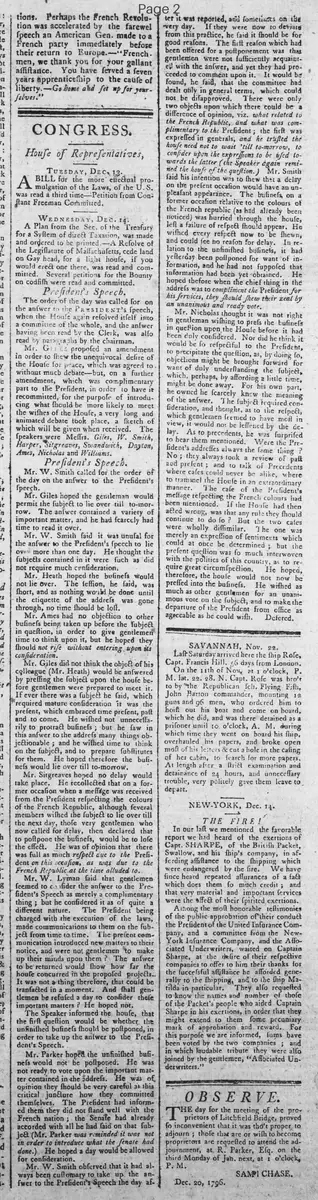
House of Representatives,
Tuesday, Dec 13.
BILL for the more effectual promulgation of the Laws, of the U.S. was read a third time. Petition from Constant Freeman Committed.
Wednesday, Dec.14.
A Plan from the Sec. of the Treasury for a System of direct Taxation, was made and ordered to be printed.-A Resolve of the Legislature of Massachusetts, cede land on Gay head, for a light house, if you would erect one there, was read and committed. Several petitions for the Bounty on codfish were read and committed.
President's Speech.
The order of the day was called for on the answer to the President's speech, when the House again resolved itself into a committee of the whole, and the answer having been read by the Clerk, was also read by paragraphs by the chairman. Mr. Giles proposed an amendment in order to shew the unequivocal desire of the House for peace, which was agreed to. without much debate--but, on a further amendment, which was complimentary part to the President, in order to have it recommitted, for the purpose of introducing what should be more likely to meet the wishes of the House, a very long and animated debate took place, a sketch of which will be given when received. The speakers were Messrs. Giles, W. Smith, Harper, Sitgreaves, Swandwich, Dayton, Ames, Nicholas and Williams.
President's Speech.
Mr. W. Smith called for the order of the day on the answer to the President's speech. Mr. Giles hoped the gentleman would permit the subject to lie over till to-morrow. The answer contained a variety of important matter, and he had scarcely had time to read it over. Mr. W. Smith said it was unusual for the answer to the President's speech to lie over more than one day: He thought the subjects contained in it were such as did not require much consideration. Mr. Heath hoped the business would not lie over. The session, he said, was short, and as nothing would be done until the etiquette of the address was gone through, no time should be lost. Mr. Ames had no objection to other business being taken up before the subject in question, in order to give gentlemen time to think upon it, but he hoped they should not rise without entering upon its consideration. Mr. Giles did not think the object of his colleague (Mr. Heath) would be answered by pressing the subject upon the house before gentlemen were prepared to meet it. If ever there was a subject he said, which required mature consideration it was the present, which embraced time present, past and to come. He wished not unnecessarily to protract business ; -but he saw in this answer to the address many things objectionable ; and he wished time to think on the subject, and to prepare substitutes for them. He hoped therefore the business would lie over till to-morrow. Mr. Sitgreaves hoped no delay would take place, He recollected that on a former occasion when a message was received from the President respecting the colours of the French Republic, although several members wished the subject to lie over till the next day, those very gentlemen who now called for delay, then declared that to postpone the business, would be to lose the effect. He was of opinion that there was full as much respect due to the President on this occasion, as was due to the French Republic at the time alluded to. Mr. W. Lyman said that gentlemen seemed to consider the answer to the President's Speech as merely a complimentary thing ; but he considered it as of quite a different nature. The President being charged with the execution of the laws, made communications to them on the subject from time to time. The present communication introduced new matters to their notice, and were not gentlemen to make up their minds upon them ? The answer to be returned would show how far the house concurred in the proposed projects. It was not a thing therefore, that could be transacted in a moment. And shall gentlemen be refused a day to consider these important matters ? He hoped not. The Speaker informed the house, that the first question would be whether the unfinished business should be postponed, in order to take up the answer to the President's Speech. Mr. Parker hoped the unfinished business would not be postponed. He was not ready to vote upon the important matter contained in the address. He was of opinion they should be very careful at this critical juncture how they committed themselves. The President had informed them they did not stand well with the French nation ; the Senate had already accorded with all he had said on that subject (Mr. Parker was reminded it was not in order to introduce what the senate had done.) He hoped a day would be allowed for consideration. Mr. W. Smith observed that it had always been customary to take up the answer to the President's Speech the day after it was reported. and sometimes on this very day. If they were now to deviate from this practice. he said it should be for good reasons. The first reason which had been offered for a postponement was that gentlemen were not sufficiently acquainted with the answer, and yet they had proceeded to comment upon it. It would be found, he said, that the committee had dealt only in general terms, which could not be disapproved. There were only two objects upon which there could be a difference of opinion, viz. what related to the French Republic, and what was complimentary to the President; the first was expressed in generals; and he trusted the house need not to wait 'till to-morrow, to consider upon the expressions to be used towards the latter (the Speaker again reminded the house of the question.) Mr. Smith said his intention was to shew that a delay on this present occasion would have an unpleasant appearance. The business on a former occasion relative to the colours of the French republic (as had already been noticed) was hurried through the house, lest a failure of respect should appear. He wished every respect now to be shewn, and could see no reason for delay. In relation to the unfinished business, it had yesterday been postponed for want of information, and he had not supposed that information had yet-obtained. He hoped therefore when the chief thing in the address was to compliment the President for his services, they should shew their zeal by an unanimous and ready vote. Mr. Nicholas thought it was not right in gentleman wishing to press the business in question upon the House before it had been duly considered. Nor did he think it would be so respectful to the President, to precipitate the question, as, by doing so, objections might be brought forward for want of duly understanding the subject, which, perhaps, by affording a little time, might be done away. For his own part, he owned he scarcely knew the meaning of the answer. The subject required consideration, and thought, as to the respect, which gentlemen seemed to have most in view, it would not be lessened by the delay. As to precedents, he was surprised to hear them mentioned. Were the President's addresses always the same thing ? No; they always took a review of past and present; and to talk of Precedents where cases could never be alike, where to trammel the House in an extraordinary manner. The case of the President's message respecting the French colours had been mentioned. If the House had then acted wrong, was that any rule they should continue to do so ? But the two cases were wholly dissimilar. The one was merely an expression of sentiments which could at once be determined ; but the present question was so much interwoven with the politics of this country, as to require great circumspection. He hoped, therefore, the house would not now be pressed into the business. He wished as much as other gentlemen for an unanimous vote on the subject, and to make the departure of the President from office as agreeable as he could wish. Deferred.
What sub-type of article is it?
What keywords are associated?
What entities or persons were involved?
Domestic News Details
Event Date
Tuesday, Dec 13; Wednesday, Dec.14
Key Persons
Outcome
bill read third time; petition committed; taxation plan printed; massachusetts resolve and codfish petitions committed; amendment on peace agreed; debate on complimentary amendment; consideration of answer to president's speech deferred.
Event Details
House proceedings: Bill for law promulgation read third time and petition from Constant Freeman committed on Dec 13. On Dec 14, Treasury's direct taxation plan ordered printed; Massachusetts resolve ceding land for lighthouse on Gay Head committed; petitions for codfish bounty committed. Committee debated answer to President's speech; Giles' peace amendment agreed; long debate on recommitting complimentary part with speakers Giles, Smith, Harper, etc. Further debate on postponing consideration, with arguments for and against delay; ultimately deferred.