Thank you for visiting SNEWPapers!
Sign up free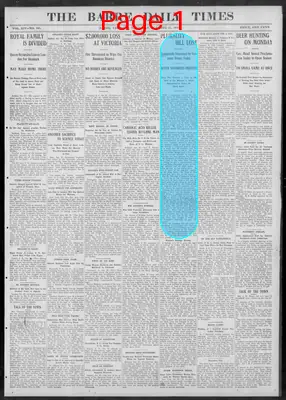
Domestic News
October 27, 1910
The Barre Daily Times
Barre, Washington County, Vermont
What is this article about?
The Vermont House of Representatives decisively rejected the Plurality Bill, which would allow town representatives to be elected by plurality on the third ballot, following intense debate with few defenders, despite prior committee approval.
Clipping
OCR Quality
98%
Excellent
Full Text
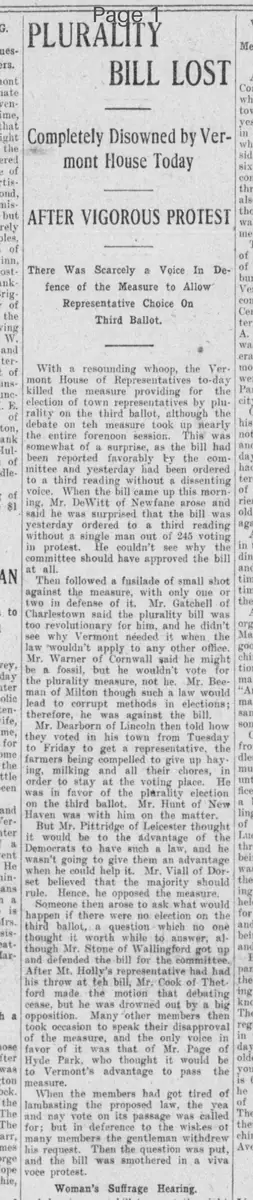
PLURALITY BILL LOST
Completely Disowned by Vermont House Today
AFTER VIGOROUS PROTEST
There Was Scarcely a Voice In Defence of the Measure to Allow Representative Choice On Third Ballot.
With a resounding whoop, the Vermont House of Representatives to-day killed the measure providing for the election of town representatives by plurality on the third ballot, although the debate on the measure took up nearly the entire forenoon session. This was somewhat of a surprise, as the bill had been reported favorably by the committee and yesterday had been ordered to a third reading without a dissenting voice. When the bill came up this morning, Mr. DeWitt of Newfane arose and said he was surprised that the bill was yesterday ordered to a third reading without a single man out of 245 voting in protest. He couldn't see why the committee should have approved the bill at all.
Then followed a fusilade of small shot against the measure, with only one or two in defense of it. Mr. Gatchell of Charlestown said the plurality bill was too revolutionary for him, and he didn't see why Vermont needed it when the law wouldn't apply to any other office. Mr. Warner of Cornwall said he might be a fossil, but he wouldn't vote for the plurality measure, not he. Mr. Beeman of Milton thought such a law would lead to corrupt methods in elections; therefore, he was against the bill.
Mr. Dearborn of Lincoln then told how they voted in his town from Tuesday to Friday to get a representative, the farmers being compelled to give up haying, milking and all their chores, in order to stay at the voting place. He was in favor of the plurality election on the third ballot. Mr. Hunt of New Haven was with him on the matter.
But Mr. Pittridge of Leicester thought it would be to the advantage of the Democrats to have such a law, and he wasn't going to give them an advantage when he could help it. Mr. Viall of Dorset believed that the majority should rule. Hence, he opposed the measure.
Someone then arose to ask what would happen if there were no election on the third ballot, a question which no one thought it worth while to answer, although Mr. Stone of Wallingford got up and defended the bill for the committee.
After Mt. Holly's representative had had his throw at the bill, Mr. Cook of Thetford made the motion that debating cease, but he was drowned out by a big opposition. Many other members then took occasion to speak their disapproval of the measure, and the only voice in favor of it was that of Mr. Page of Hyde Park, who thought it would be to Vermont's advantage to pass the measure.
When the members had got tired of lambasting the proposed law, the yea and nay vote on its passage was called for; but in deference to the wishes of many members the gentleman withdrew his request. Then the question was put, and the bill was smothered in a viva voce protest.
Completely Disowned by Vermont House Today
AFTER VIGOROUS PROTEST
There Was Scarcely a Voice In Defence of the Measure to Allow Representative Choice On Third Ballot.
With a resounding whoop, the Vermont House of Representatives to-day killed the measure providing for the election of town representatives by plurality on the third ballot, although the debate on the measure took up nearly the entire forenoon session. This was somewhat of a surprise, as the bill had been reported favorably by the committee and yesterday had been ordered to a third reading without a dissenting voice. When the bill came up this morning, Mr. DeWitt of Newfane arose and said he was surprised that the bill was yesterday ordered to a third reading without a single man out of 245 voting in protest. He couldn't see why the committee should have approved the bill at all.
Then followed a fusilade of small shot against the measure, with only one or two in defense of it. Mr. Gatchell of Charlestown said the plurality bill was too revolutionary for him, and he didn't see why Vermont needed it when the law wouldn't apply to any other office. Mr. Warner of Cornwall said he might be a fossil, but he wouldn't vote for the plurality measure, not he. Mr. Beeman of Milton thought such a law would lead to corrupt methods in elections; therefore, he was against the bill.
Mr. Dearborn of Lincoln then told how they voted in his town from Tuesday to Friday to get a representative, the farmers being compelled to give up haying, milking and all their chores, in order to stay at the voting place. He was in favor of the plurality election on the third ballot. Mr. Hunt of New Haven was with him on the matter.
But Mr. Pittridge of Leicester thought it would be to the advantage of the Democrats to have such a law, and he wasn't going to give them an advantage when he could help it. Mr. Viall of Dorset believed that the majority should rule. Hence, he opposed the measure.
Someone then arose to ask what would happen if there were no election on the third ballot, a question which no one thought it worth while to answer, although Mr. Stone of Wallingford got up and defended the bill for the committee.
After Mt. Holly's representative had had his throw at the bill, Mr. Cook of Thetford made the motion that debating cease, but he was drowned out by a big opposition. Many other members then took occasion to speak their disapproval of the measure, and the only voice in favor of it was that of Mr. Page of Hyde Park, who thought it would be to Vermont's advantage to pass the measure.
When the members had got tired of lambasting the proposed law, the yea and nay vote on its passage was called for; but in deference to the wishes of many members the gentleman withdrew his request. Then the question was put, and the bill was smothered in a viva voce protest.
What sub-type of article is it?
Politics
What keywords are associated?
Plurality Bill
Vermont House
Election Measure
Legislative Debate
Bill Defeat
What entities or persons were involved?
Mr. Dewitt Of Newfane
Mr. Gatchell Of Charlestown
Mr. Warner Of Cornwall
Mr. Beeman Of Milton
Mr. Dearborn Of Lincoln
Mr. Hunt Of New Haven
Mr. Pittridge Of Leicester
Mr. Viall Of Dorset
Mr. Stone Of Wallingford
Mr. Cook Of Thetford
Mr. Page Of Hyde Park
Where did it happen?
Vermont House Of Representatives
Domestic News Details
Primary Location
Vermont House Of Representatives
Event Date
Today
Key Persons
Mr. Dewitt Of Newfane
Mr. Gatchell Of Charlestown
Mr. Warner Of Cornwall
Mr. Beeman Of Milton
Mr. Dearborn Of Lincoln
Mr. Hunt Of New Haven
Mr. Pittridge Of Leicester
Mr. Viall Of Dorset
Mr. Stone Of Wallingford
Mr. Cook Of Thetford
Mr. Page Of Hyde Park
Outcome
the bill was killed by the house in a viva voce vote after debate.
Event Details
The Vermont House debated and rejected a bill for electing town representatives by plurality on the third ballot, with most members opposing it despite committee approval and few in defense.