Thank you for visiting SNEWPapers!
Sign up free
Story
July 21, 1916
The Jasper Weekly Courier
Jasper, Dubois County, Indiana
What is this article about?
Historical reflection on famous war horses honored by generals like Wellington, Napoleon, and Lee, noting that automobiles will end this tradition.
Clipping
OCR Quality
100%
Excellent
Full Text
Famous War Horses of Old
Replaced by Automobiles
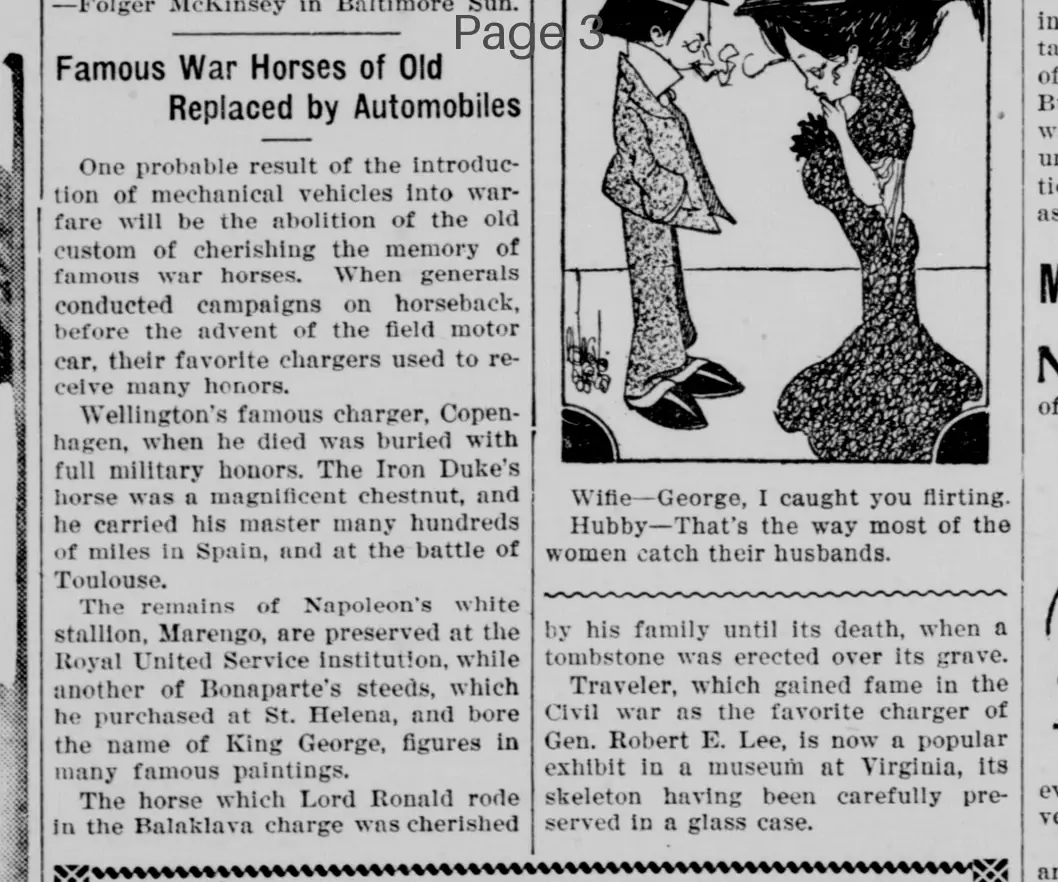
One probable result of the introduction of mechanical vehicles into warfare will be the abolition of the old custom of cherishing the memory of famous war horses.
When generals conducted campaigns on horseback, before the advent of the field motor car, their favorite chargers used to receive many honors. Wellington's famous charger, Copenhagen, when he died was buried with full military honors. The Iron Duke's horse was a magnificent chestnut, and he carried his master many hundreds of miles in Spain, and at the battle of Toulouse.
The remains of Napoleon's white stallion, Marengo, are preserved at the Royal United Service institution, while another of Bonaparte's steeds, which he purchased at St. Helena, and bore the name of King George, figures in many famous paintings.
The horse which Lord Ronald rode in the Balaklava charge was cherished by his family until its death, when a tombstone was erected over its grave. Traveler, which gained fame in the Civil war as the favorite charger of Gen. Robert E. Lee, is now a popular exhibit in a museum at Virginia, its skeleton having been carefully preserved in a glass case.
Replaced by Automobiles
One probable result of the introduction of mechanical vehicles into warfare will be the abolition of the old custom of cherishing the memory of famous war horses.
When generals conducted campaigns on horseback, before the advent of the field motor car, their favorite chargers used to receive many honors. Wellington's famous charger, Copenhagen, when he died was buried with full military honors. The Iron Duke's horse was a magnificent chestnut, and he carried his master many hundreds of miles in Spain, and at the battle of Toulouse.
The remains of Napoleon's white stallion, Marengo, are preserved at the Royal United Service institution, while another of Bonaparte's steeds, which he purchased at St. Helena, and bore the name of King George, figures in many famous paintings.
The horse which Lord Ronald rode in the Balaklava charge was cherished by his family until its death, when a tombstone was erected over its grave. Traveler, which gained fame in the Civil war as the favorite charger of Gen. Robert E. Lee, is now a popular exhibit in a museum at Virginia, its skeleton having been carefully preserved in a glass case.
What sub-type of article is it?
Historical Event
Curiosity
What themes does it cover?
Triumph
Misfortune
What keywords are associated?
War Horses
Famous Chargers
Military History
Automobiles Warfare
Wellington
Napoleon
Robert E. Lee
What entities or persons were involved?
Wellington
Copenhagen
Napoleon
Marengo
King George
Lord Ronald
Gen. Robert E. Lee
Traveler
Where did it happen?
Spain, Battle Of Toulouse, St. Helena, Balaklava, Virginia
Story Details
Key Persons
Wellington
Copenhagen
Napoleon
Marengo
King George
Lord Ronald
Gen. Robert E. Lee
Traveler
Location
Spain, Battle Of Toulouse, St. Helena, Balaklava, Virginia
Event Date
19th Century
Story Details
The introduction of mechanical vehicles in warfare will abolish the custom of cherishing famous war horses, as generals' chargers like Wellington's Copenhagen, Napoleon's Marengo and King George, Lord Ronald's horse from Balaklava, and Lee's Traveler received honors, burials, preservation, and exhibits.