Thank you for visiting SNEWPapers!
Sign up free
The Massachusetts Spy
Boston, Suffolk County, Massachusetts
What is this article about?
In June 1771, Virginia clergy professors Samuel Henley and Thomas Gwatkin publicly dissent from a convention resolution to petition King George III for an American Episcopate, citing inadequate representation, procedural irregularities, threats to colonial autonomy, and loyalty to the Bishop of London. (214 characters)
Merged-components note: Continuation of the dissenting clergy's protest against the resolution for an American Episcopate.
Clipping
OCR Quality
Full Text
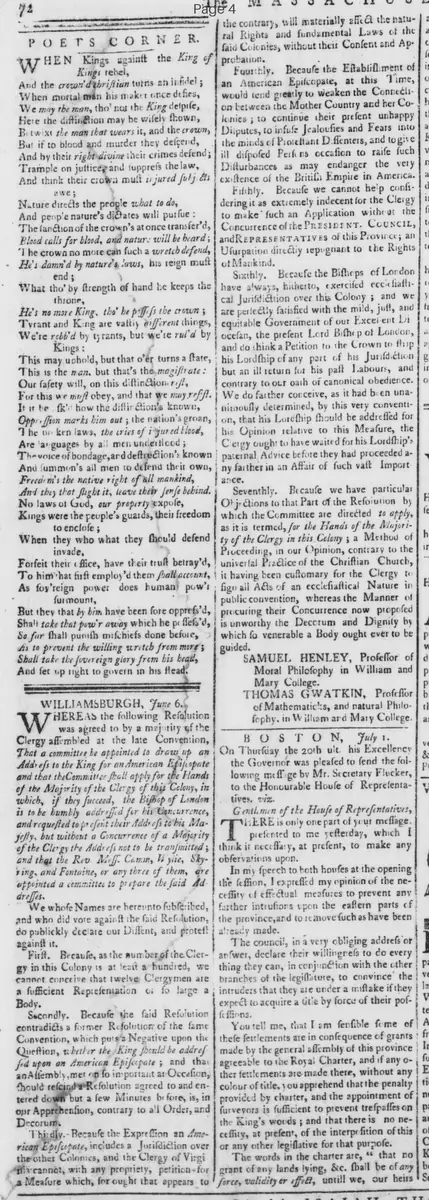
WHEREAS the following Resolution was agreed to by a majority of the Clergy assembled at the late Convention,
That a committee be appointed to draw up an Address to the King for an American Episcopate and that the Committee shall apply for the Hands of the Majority of the Clergy of this Colony, in which, if they succeed, the Bishop of London is to be humbly addressed for his Concurrence, and requested to present their Address to his Majesty, but without a Concurrence of a Majority of the Clergy the Address not to be transmitted ; and that the Rev Mess. Cann, Wylie, Skyrin and Fontaine, or any three of them, are appointed a committee to prepare the said Addresses.
We whose Names are hereunto subscribed, and who did vote against the said Resolution, do publickly declare our Dissent, and protest against it.
First. Because, as the number of the Clergy in this Colony is at least a hundred, we cannot conceive that twelve Clergymen are a sufficient Representation of so large a Body.
Secondly. Because the said Resolution contradicts a former Resolution of the same Convention, which puts a Negative upon the Question, whether the King should be addressed upon an American Episcopate ; and that an Assembly, met on so important an Occasion, Should rescind a Resolution agreed to and entered down but a few Minutes before, is, in our Apprehension, contrary to all Order, and Decorum
Thirdly. Because the Expression an American Episcopate, includes a Jurisdiction over the other Colonies, and the Clergy of Virginia cannot, with any propriety, petition-for a Measure which, for ought that appears to the contrary, will materially affect the natural Rights and fundamental Laws of the said Colonies, without their Consent and Approbation.
Fourthly. Because the Establishment of an American Episcopate, at this Time, would tend greatly to weaken the Connection between the Mother Country and her Colonies ; to continue their present unhappy Disputes, to infuse Jealousies and Fears into the minds of Protestant Dissenters, and to give ill disposed Persons occasion to raise such Disturbances as may endanger the very existence of the British Empire in America.
Fifthly. Because we cannot help considering it as extremely indecent for the Clergy to make such an Application without the Concurrence of the President, Council, and Representatives of this Province; an Usurpation directly repugnant to the Rights of Mankind.
Sixthly. Because the Bishops of London have always, hitherto, exercised ecclesiastical Jurisdiction over this Colony ; and we are perfectly satisfied with the mild, just, and equitable Government of our Excellent Lordship, the present Lord Bishop of London. and do think a Petition to the Crown to strip his Lordship of any part of his Jurisdiction but an ill return for his past Labours, and contrary to our oath of canonical obedience.
We do farther conceive, as it had been unanimously determined, by this very convention, that his Lordship should be addressed for his Opinion relative to this Measure, the Clergy ought to have waited for his Lordship's paternal Advice before they had proceeded any farther in an Affair of such vast Importance.
Seventhly. Because we have particular Objections to that Part of the Resolution by which the Committee are directed to apply, as it is termed, for the Hands of the Majority of the Clergy in this Colony ; a Method of Proceeding, in our Opinion, contrary to the universal Practice of the Christian Church, it having been customary for the Clergy to sign all Acts of an ecclesiastical Nature in public convention, whereas the Manner of procuring their Concurrence now proposed is unworthy the Decorum and Dignity by which so venerable a Body ought ever to be guided.
SAMUEL HENLEY, Professor of Moral Philosophy in William and Mary College.
THOMAS GWATKIN, Professor of Mathematicks, and natural Philosophy. in William and Mary College.
What sub-type of article is it?
What themes does it cover?
What keywords are associated?
What entities or persons were involved?
Letter to Editor Details
Author
Samuel Henley, Professor Of Moral Philosophy In William And Mary College; Thomas Gwatkin, Professor Of Mathematicks, And Natural Philosophy In William And Mary College
Main Argument
the signatories dissent from a resolution passed by a majority of the virginia clergy to petition the king for an american episcopate, arguing it lacks proper representation, contradicts prior decisions, infringes on colonial rights, weakens ties with britain, bypasses civil authorities, disrespects the bishop of london, and uses improper procedures.
Notable Details