Thank you for visiting SNEWPapers!
Sign up free
Casper Daily Tribune
Casper, Natrona County, Wyoming
What is this article about?
In New York on Nov. 18, 1922, the stock market experienced severe setbacks early in the week due to taxation selling and bond liquidation, interrupting the bull trend since 1921. Partial recovery followed, influenced by positive corporate dividends and easing money rates, despite bearish pressures.
Clipping
OCR Quality
Full Text
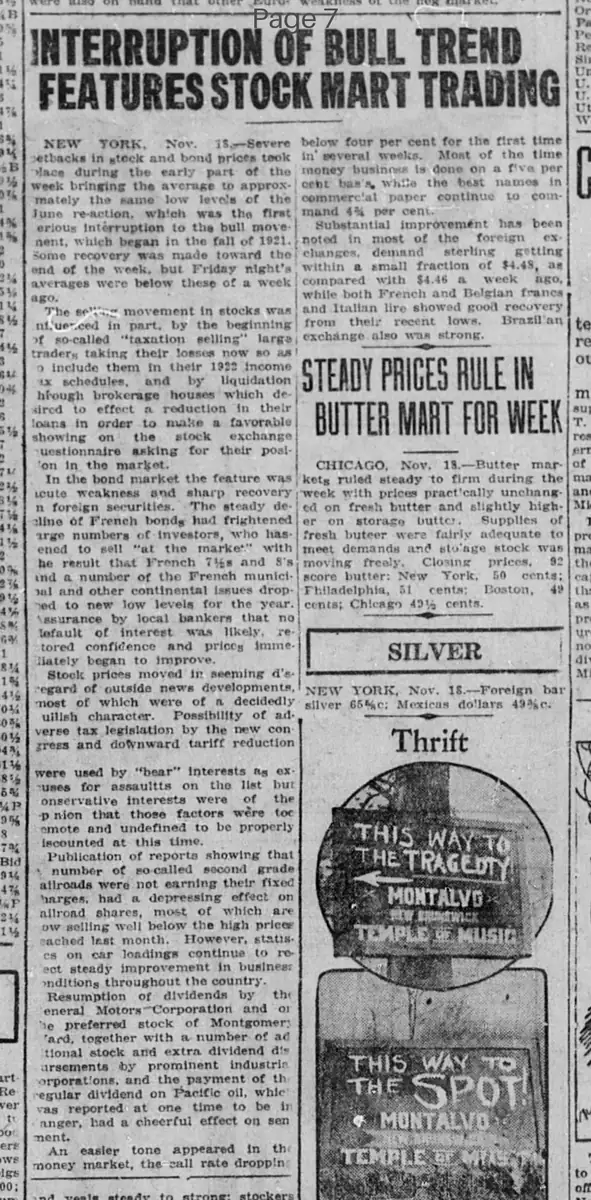
FEATURES STOCK MART TRADING
NEW YORK. Nov. 18.—Severe setbacks in stock and bond prices took place during the early part of the week bringing the average to approximately the same low levels of the June reaction, which was the first serious interruption to the bull movement, which began in the fall of 1921.
Some recovery was made toward the end of the week, but Friday night's averages were below those of a week ago.
The sell movement in stocks was influenced in part by the beginning of so-called "taxation selling" large traders taking their losses now so as to include them in their 1922 income tax schedules, and by liquidation through brokerage houses which desired to effect a reduction in their loans in order to make a favorable showing on the stock exchange questionnaire asking for their position in the market.
In the bond market the feature was acute weakness and sharp recovery in foreign securities. The steady decline of French bonds had frightened large numbers of investors, who hastened to sell "at the market" with the result that French 7½s and 8s and a number of the French municipal and other continental issues dropped to new low levels for the year.
Assurance by local bankers that no default of interest was likely, restored confidence and prices immediately began to improve.
Stock prices moved in seeming disregard of outside news developments, most of which were of a decidedly bullish character. Possibility of adverse tax legislation by the new congress and downward tariff reduction were used by "bear" interests as excuses for assaults on the list but conservative interests were of the opinion that those factors were too remote and undefined to be properly discounted at this time.
Publication of reports showing that number of so called second grade railroads were not earning their fixed charges, had a depressing effect on railroad shares, most of which are now selling well below the high prices reached last month. However, statistics on car loadings continue to reflect steady improvement in business conditions throughout the country.
Resumption of dividends by the General Motors Corporation and on the preferred stock of Montgomery Ward, together with a number of additional stock and extra dividend disbursements by prominent industrial corporations, and the payment of the regular dividend on Pacific oil, which was reported at one time to be in danger, had a cheerful effect on sentiment.
An easier tone appeared in the money market, the call rate dropping below four per cent for the first time in several weeks. Most of the time money business is done on a five per cent basis, while the best names in commercial paper continue to command 4½ per cent.
Substantial improvement has been noted in most of the foreign exchanges,
demand sterling getting within a small fraction of $4.86, as compared with $4.86 a week ago,
while both French and Belgian francs and Italian lire showed good recovery from their recent lows.
Brazilian exchange also was strong.
What sub-type of article is it?
What themes does it cover?
What keywords are associated?
Where did it happen?
Story Details
Location
New York
Event Date
Nov. 18, 1922
Story Details
Severe stock and bond price setbacks early in the week interrupted the bull market trend since fall 1921, driven by taxation selling and brokerage liquidations; partial recovery followed amid positive dividends, easing rates, and foreign exchange improvements, despite bearish pressures from tax fears and railroad reports.