Thank you for visiting SNEWPapers!
Sign up free
Letter to Editor
July 5, 1798
Gazette Of The United States, & Philadelphia Daily Advertiser
Philadelphia, Philadelphia County, Pennsylvania
What is this article about?
Claudius submits to Mr. Fenno an extract from a Paris resident exposing the disloyal American expatriates in France who undermine U.S. diplomacy, insult leaders like Washington, and support French demands; it also critiques the Directory's despotic military rule, controlled press, and rigged elections in 1798.
Clipping
OCR Quality
98%
Excellent
Full Text
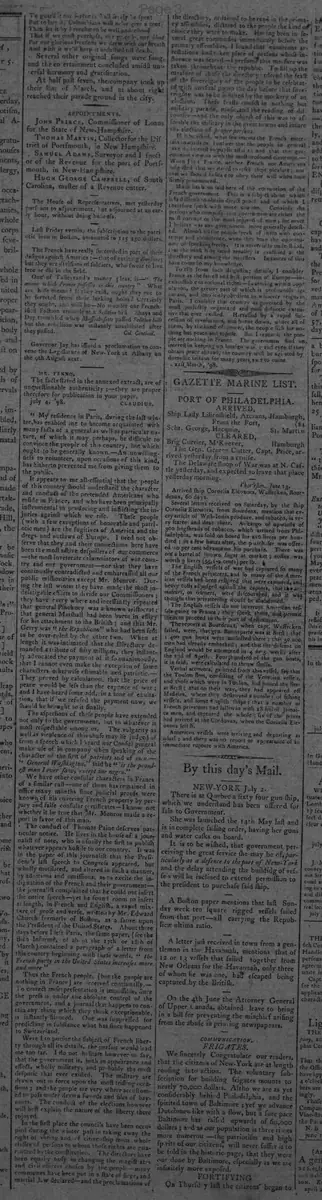
MR. FENNO,
The facts stated in the annexed extract, are of unquestionable authenticity;—they are proper therefore for publication in your paper.
July 4, '98.
CLAUDIUS.
"My residence in Paris, during the last winter, has enabled me to become acquainted with many facts of a general as well as particular nature, of which it may perhaps, be difficult to convince the people of this country, but which ought to be generally known.—An unwillingness to volunteer, upon occasions of this kind, has hitherto prevented me from giving them to the public.
It appears to me all-essential that the people of this country should understand the character and conduct of the pretended Americans who reside in France, and who have been principally instrumental in producing and inflicting the injuries against which we rise. These people (with a few exceptions of honorable and patriotic men) are the fugitives of America and the dregs and outlaws of Europe. I need not observe that they and their connections here have been the most active depredators of our commerce—the most inveterate calumniators of our country and our government—nor that they have continually contradicted and embarrassed all our public missionaries except Mr. Monroe. During the last winter they have made the most indefatigable efforts to divide our Commissioners; they have every where and incessantly repeated that general Pinckney was a known aristocrat; that general Marshall had been burnt in effigy for his attachment to the British; and that Mr. Gerry was "the Republican" who had been sent to be over-ruled by the other two. When at length it was intimated that the Directory demanded a tribute of fifty millions, they instantly advocated the payment of it so unanimously, that I cannot even make the exception of some characters otherwise estimable and patriotic.—They proved by calculation, that the price of peace would be less than the expense of war; and I have heard some add, in a tone of exultation, that if we refused the payment now, we should be brought to it finally.
The asperations of these people have extended not only to the government, but to whatever is most respectable among us. The vulgarity as well as virulence of this abuse may be judged of from a speech which I heard our Consul general make use of in company when speaking of the character of the first of patriots and of men. "General Washington," said he "is the proudest man I ever saw, except one negro."
We have other consular characters in France of a similar cast—one of them has remained in office many months since judicial proofs were known of his covering French property by perjury and false consular certificates—I know not whether it be true that Mr. Monroe made a report in favor of this man.
The conduct of Thomas Paine deserves particular notice. He lives in the house of a journalist of note, who is usually the first to publish whatever appears hostile to our country. It was in the paper of this journalist that the President's last speech to Congress appeared. but wholly mutilated, and altered in such a manner, by additions and omissions, as to excite the indignation of the French and their government—the journalist complained that he could not insert the entire speech—yet he found room to insert at length, in French and English, a vapid mixture of prose and verse, written by Mr. Edward Church formerly of Boston, as a satire upon the President of the United States. About three days before I left Paris, the same paper, (see the Bien Informé, of about the 17th or 18th of March) contained a paragraph of a letter from this country beginning with these words, "the French party in the United States increases more and more"
Thus the French people, (but the people are nothing in France) are deceived continually.—To correct misrepresentation is impossible, since the press is under the absolute control of the government, and a journal that happens to contain any thing which they think exceptionable, is instantly silenced. One was suppressed for predicting in substance what has since happened to Switzerland.
Were I to pursue the subject of French liberty through all its details, the pursuit would lead me too far. I do not hesitate however to say, that the government is, both in appearance and effect, wholly military, and probably the most despotic that ever existed. The military are drawn out in force upon the most trifling occasions; and the people are every where accustomed to pass under drawn swords and files of bayonets. The conduct of the elections however will best explain the nature of the liberty there enjoyed.
In the first place the councils have been occupied during the winter past in taking away the right of voting and of citizenship from whole classes of persons to whom those rights are guaranteed by the constitution. The directory have been equally busy in changing the magistrates and civil officers chosen by the people—many communes have been put in a state of siege, and martial law declared—and the proclamations of the directory, ordained to be read in the primary assemblies, dictated to the people the kind of choice they were to make. Having been in several great communes immediately before the primary assemblies, I found that numerous arrests had taken place of persons whose influence was feared—I presume this measure was taken throughout the republic. To fill up the measure of abuse the directory ordered the feast of the sovereignty of the people to be celebrated with unusual pomp the day before that sovereignty was to be insulted by the mockery of an election. These feasts consist in nothing but military parade, music, and the reading of discourses—and the only object of this was to assemble the military in the great towns and insure the election of proper persons.
If it be asked, what sentiments the French entertain towards us, I answer that the people in general take little interest in public affairs; and that the government view us with the most profound contempt.—When I left France, neither French nor Americans suspected that we dared to resist their pleasure; nor that we should hesitate to obey their will when once firmly pronounced.
Much has been said here of the corruption of the French government This is a subject about which it is difficult to obtain direct proof and of which I therefore speak with more caution. Certainly the persons who compose that government are either the most corrupt or the most injured of men; or never I believe was any government more generally detested. Almost all the people speak of them with contempt and abhorrence, when they have the opportunity of speaking freely. It is universally understood, that the most hateful venality is practiced at the directory and among the ministers Instances of this have come to my knowledge.
To rise from such disgusting details, I consider France as the fairest and best portion of Europe—inexhaustible in national riches—swarming with a population, the greater part of which is profoundly ignorant, and implicitly obedient to whoever reigns in Paris. I consider that country as governed by the most perfectly organized and most despotic executive that ever existed. Harassed by a rapid succession of revolutions, and borne down, under all of them, by the hand of power, the people wish for nothing but peace and repose. But I repeat it the people are nothing in France. The government find an interest in keeping up foreign war: and even if they obtain peace abroad, the country will be agitated by domestic faction for many years yet to come.
21st March, '98.
The facts stated in the annexed extract, are of unquestionable authenticity;—they are proper therefore for publication in your paper.
July 4, '98.
CLAUDIUS.
"My residence in Paris, during the last winter, has enabled me to become acquainted with many facts of a general as well as particular nature, of which it may perhaps, be difficult to convince the people of this country, but which ought to be generally known.—An unwillingness to volunteer, upon occasions of this kind, has hitherto prevented me from giving them to the public.
It appears to me all-essential that the people of this country should understand the character and conduct of the pretended Americans who reside in France, and who have been principally instrumental in producing and inflicting the injuries against which we rise. These people (with a few exceptions of honorable and patriotic men) are the fugitives of America and the dregs and outlaws of Europe. I need not observe that they and their connections here have been the most active depredators of our commerce—the most inveterate calumniators of our country and our government—nor that they have continually contradicted and embarrassed all our public missionaries except Mr. Monroe. During the last winter they have made the most indefatigable efforts to divide our Commissioners; they have every where and incessantly repeated that general Pinckney was a known aristocrat; that general Marshall had been burnt in effigy for his attachment to the British; and that Mr. Gerry was "the Republican" who had been sent to be over-ruled by the other two. When at length it was intimated that the Directory demanded a tribute of fifty millions, they instantly advocated the payment of it so unanimously, that I cannot even make the exception of some characters otherwise estimable and patriotic.—They proved by calculation, that the price of peace would be less than the expense of war; and I have heard some add, in a tone of exultation, that if we refused the payment now, we should be brought to it finally.
The asperations of these people have extended not only to the government, but to whatever is most respectable among us. The vulgarity as well as virulence of this abuse may be judged of from a speech which I heard our Consul general make use of in company when speaking of the character of the first of patriots and of men. "General Washington," said he "is the proudest man I ever saw, except one negro."
We have other consular characters in France of a similar cast—one of them has remained in office many months since judicial proofs were known of his covering French property by perjury and false consular certificates—I know not whether it be true that Mr. Monroe made a report in favor of this man.
The conduct of Thomas Paine deserves particular notice. He lives in the house of a journalist of note, who is usually the first to publish whatever appears hostile to our country. It was in the paper of this journalist that the President's last speech to Congress appeared. but wholly mutilated, and altered in such a manner, by additions and omissions, as to excite the indignation of the French and their government—the journalist complained that he could not insert the entire speech—yet he found room to insert at length, in French and English, a vapid mixture of prose and verse, written by Mr. Edward Church formerly of Boston, as a satire upon the President of the United States. About three days before I left Paris, the same paper, (see the Bien Informé, of about the 17th or 18th of March) contained a paragraph of a letter from this country beginning with these words, "the French party in the United States increases more and more"
Thus the French people, (but the people are nothing in France) are deceived continually.—To correct misrepresentation is impossible, since the press is under the absolute control of the government, and a journal that happens to contain any thing which they think exceptionable, is instantly silenced. One was suppressed for predicting in substance what has since happened to Switzerland.
Were I to pursue the subject of French liberty through all its details, the pursuit would lead me too far. I do not hesitate however to say, that the government is, both in appearance and effect, wholly military, and probably the most despotic that ever existed. The military are drawn out in force upon the most trifling occasions; and the people are every where accustomed to pass under drawn swords and files of bayonets. The conduct of the elections however will best explain the nature of the liberty there enjoyed.
In the first place the councils have been occupied during the winter past in taking away the right of voting and of citizenship from whole classes of persons to whom those rights are guaranteed by the constitution. The directory have been equally busy in changing the magistrates and civil officers chosen by the people—many communes have been put in a state of siege, and martial law declared—and the proclamations of the directory, ordained to be read in the primary assemblies, dictated to the people the kind of choice they were to make. Having been in several great communes immediately before the primary assemblies, I found that numerous arrests had taken place of persons whose influence was feared—I presume this measure was taken throughout the republic. To fill up the measure of abuse the directory ordered the feast of the sovereignty of the people to be celebrated with unusual pomp the day before that sovereignty was to be insulted by the mockery of an election. These feasts consist in nothing but military parade, music, and the reading of discourses—and the only object of this was to assemble the military in the great towns and insure the election of proper persons.
If it be asked, what sentiments the French entertain towards us, I answer that the people in general take little interest in public affairs; and that the government view us with the most profound contempt.—When I left France, neither French nor Americans suspected that we dared to resist their pleasure; nor that we should hesitate to obey their will when once firmly pronounced.
Much has been said here of the corruption of the French government This is a subject about which it is difficult to obtain direct proof and of which I therefore speak with more caution. Certainly the persons who compose that government are either the most corrupt or the most injured of men; or never I believe was any government more generally detested. Almost all the people speak of them with contempt and abhorrence, when they have the opportunity of speaking freely. It is universally understood, that the most hateful venality is practiced at the directory and among the ministers Instances of this have come to my knowledge.
To rise from such disgusting details, I consider France as the fairest and best portion of Europe—inexhaustible in national riches—swarming with a population, the greater part of which is profoundly ignorant, and implicitly obedient to whoever reigns in Paris. I consider that country as governed by the most perfectly organized and most despotic executive that ever existed. Harassed by a rapid succession of revolutions, and borne down, under all of them, by the hand of power, the people wish for nothing but peace and repose. But I repeat it the people are nothing in France. The government find an interest in keeping up foreign war: and even if they obtain peace abroad, the country will be agitated by domestic faction for many years yet to come.
21st March, '98.
What sub-type of article is it?
Informative
Investigative
Political
What themes does it cover?
Politics
Press Freedom
Constitutional Rights
What keywords are associated?
American Expatriates
French Directory
Thomas Paine
Us Commissioners
French Elections
Press Control
Despotic Government
Paris 1798
What entities or persons were involved?
Claudius
Mr. Fenno
Letter to Editor Details
Author
Claudius
Recipient
Mr. Fenno
Main Argument
americans must understand the disloyal character of expatriates in france who sabotage u.s. interests and support french demands, while the french directory operates a despotic military government with controlled press and rigged elections.
Notable Details
Insult To General Washington By Consul General
Thomas Paine's Association With Anti American Journalist
Edward Church's Satire On U.S. President
French Directory's Demand For 50 Million Tribute
Suppression Of Journals For Exceptionable Content