Thank you for visiting SNEWPapers!
Sign up free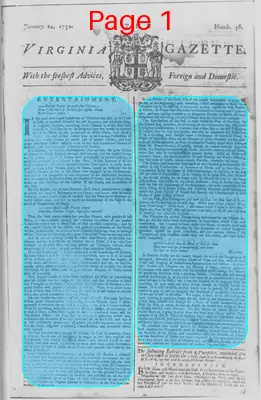
Literary
January 24, 1752
The Virginia Gazette
Richmond, Williamsburg, Richmond County, Virginia
What is this article about?
This philosophical essay argues that uncontrolled thoughts can lead to moral corruption, emphasizing the need to govern the mind to prevent vice. It discusses the sparsity of true action in life, the dangers of indulging wicked imaginations, and the importance of self-examination for virtue, drawing on classical and religious sources.
Clipping
OCR Quality
95%
Excellent
Full Text
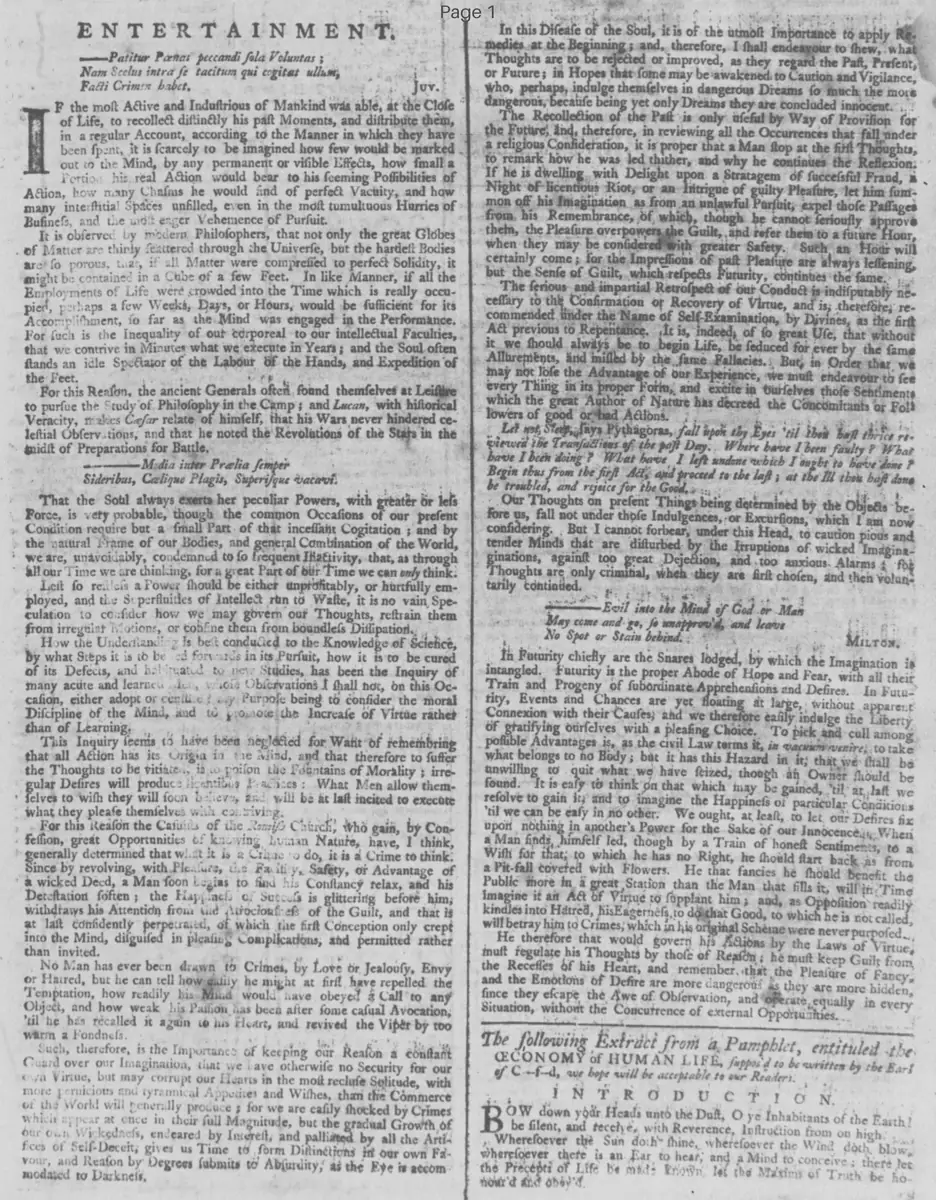
ENTERTAINMENT
—Patitur Paenas peccandi sola Voluntas;
Nam Scelus intra se tacitum qui cogitat ullum
Facti Crimen habet.
Juv.
If the most Active and Industrious of Mankind was able, at the Close of Life, to recollect distinctly his past Moments, and distribute them, in a regular Account, according to the Manner in which they have been spent, it is scarcely to be imagined how few would be marked out to the Mind, by any permanent or visible Effects, how small a portion his real Action would bear to his seeming Possibilities of Action, how many Chasms he would find of perfect Vacuity, and how many interstitial Spaces unfilled, even in the most tumultuous Hurries of Business, and the most eager Vehemence of Pursuit.
It is observed by modern Philosophers, that not only the great Globes of Matter are thinly scattered through the Universe, but the hardest Bodies are so porous, that, if all Matter were compressed to perfect Solidity, it might be contained in a Cube of a few Feet. In like Manner, if all the Employments of Life were crowded into the Time which is really occupied, perhaps a few Weeks, Days, or Hours, would be sufficient for its Accomplishment, so far as the Mind was engaged in the Performance.
For such is the Inequality of our corporeal to our intellectual Faculties, that we contrive in Minutes what we execute in Years; and the Soul often stands an idle Spectator of the Labour of the Hands, and Expedition of the Feet.
For this Reason, the ancient Generals often found themselves at Leisure to pursue the Study of Philosophy in the Camp; and Lucan, with historical Veracity, makes Caesar relate of himself, that his Wars never hindered celestial Observations, and that he noted the Revolutions of the Stars in the midst of Preparations for Battle.
-Media inter Prælia semper
Sideribus, Cœlique Plagis, Superique Vacari.
That the Soul always exerts her peculiar Powers, with greater or less Force, is very probable, though the common Occasions of our present Condition require but a small Part of that incessant Cogitation; and by the natural Frame of our Bodies, and general Combination of the World, we are, unavoidably, condemned to so frequent Inactivity, that, as through all our Time we are thinking, for a great Part of our Time we can only think.
Lest our Riches should be either unprofitably, or hurtfully employed, and the Superfluities of Intellect run to Waste, it is no vain Speculation to consider how we may govern our Thoughts, restrain them from irregular Motions, or confine them from boundless Dissipation.
How the Understanding is best consulted to the Knowledge of Science, by what Steps it is to be directed in its Pursuit, how it is to be cured of its Defects, and habituated to new Studies, has been the Inquiry of many acute and learned Men, whose Observations I shall not, on this Occasion, either adopt or contest; my Purpose being to consider the moral Discipline of the Mind, and to note the Increase of Virtue rather than of Learning.
This Inquiry seems to have been neglected for Want of remembering that all Action has its Origin in the Mind, and that therefore to suffer the Thoughts to be vitiated, is to poison the Fountains of Morality; irregular Desires will produce irregular Actions: What Men allow themselves to wish, they will soon believe, and will be at last incited to execute what they please themselves with contriving.
For this Reason the Casuists of the Romish Church, who gain, by Confession, great Opportunities of knowing Human Nature, have, I think, generally determined that what it is a Crime to do, it is a Crime to think.
Since by revolving, with Pleasure, the Feasibility, Safety, or Advantage of a wicked Deed, a Man soon begins to find his Constancy relax, and his Detestation fainter; the Hypocrisy of Success is glittering before him; withdraws his Attention from the Terrors of the Guilt, and that is at last confidently perpetrated, of which the first Conception only crept into the Mind, disguised in pleasing Complications, and permitted rather than invited.
No Man has ever been drawn to Crimes, by Love Or Jealousy, Envy or Hatred, but he can tell how easily he might at first have repelled the Temptation, how readily his Mind would have obeyed a Call to any Object, and how weak his Passion has been after some casual Avocation, "til he has recalled it again to his Heart, and revived the Viper by too warm a Fondness.
Such, therefore, is the Importance of keeping our Reason a constant Guard over our Imagination, that we have otherwise no Security for our Virtue, but may corrupt our Hearts in the most recluse Solitude, with more pernicious and tyrannical Appetites and Wishes, than the Commerce of the World will generally produce; for we are easily shocked by Crimes which appear at once in their full Magnitude, but the gradual Growth of our Own Wickedness, endeared by Interest, and palliated by all the Artifices of Self-Deceit, gives us Time to form Distinctions in our own Favour, and Reason by Degrees submits to Absurdity, as the Eye is accommodated to Darkness.
In this Disease of the Soul, it is of the utmost Importance to apply remedies at the Beginning; and, therefore, I shall endeavour to shew, what Thoughts are to be rejected or improved, as they regard the Past, Present, or Future; in Hopes that some may be awakened to Caution and Vigilance, who, perhaps, indulge themselves in dangerous Dreams so much the more dangerous, because being yet only Dreams they are concluded innocent.
The Recollection of the Past is only useful by Way of Provision for the Future, and, therefore, in reviewing all the Occurrences that fall under a religious Consideration, it is proper that a Man stop at the first Thoughts, to remark how he was led thither, and why he continues the Reflexion.
If he is dwelling with Delight upon a Stratagem of successful Fraud, a Night of licentious Riot, or an Intrigue of guilty Pleasure, let him summon off his Imagination as from an unlawful Pursuit, expel those Passages from his Remembrance, of which, though he cannot seriously approve them, the Pleasure overpowers the Guilt, and refer them to a future Hour, when they may be considered with greater Safety. Such an Hour will certainly come; for the Impressions of past Pleasure are always fleeting, but the Sense of Guilt, which respects Futurity, continues the same.
The serious and impartial Retrospect of our Conduct is indispensably necessary to the Confirmation or Recovery of Virtue, and is, therefore, recommended under the Name of Self-Examination, by Divines, as the first Act previous to Repentance. It is, indeed, of so great Use, that without it we should always be to begin Life, be seduced for ever by the same Allurements, and misled by the same Fallacies. But, in Order that we may not lose the Advantage of our Experience, we must endeavour to see every Thing in its proper Form, and excite in Ourselves those Sentiments which the great Author of Nature has decreed the Concomitants or Followers of good or bad Actions.
Thus
Let not Sleep, says Pythagoras, fall upon thy Eyes 'til thou hast thrice reviewed the Transactions of the past Day. Where have I been faulty? What have I been doing? What have I left undone which I ought to have done? Begin thus from the first Act, and proceed to the last; at the Ill thou hast done be troubled, and rejoice for the Good.
Our Thoughts on present Things being determined by the Objects before us, fall not under those Indulgences, or Excursions, which I am now considering. But I cannot forbear, under this Head, to caution pious and tender Minds that are disturbed by the irruptions of wicked Imaginations, against too great Dejection, and too anxious Alarms; so Thoughts are only criminal, when they are first chosen, and then voluntarily continued.
Evil into the Mind of God or Man
May come and go, so unapproved, and leave
No Spot or Stain behind.
MILTON.
In Futurity chiefly are the Snares lodged, by which the Imagination is intangled. Futurity is the proper Abode of Hope and Fear, with all their Train and Progeny of subordinate Apprehensions and Desires. In Futurity, Events and Chances are yet floating at large, without apparent Connexion with their Causes; and we therefore easily indulge the Liberty of gratifying ourselves with a pleasing Choice. To pick and cull among possible Advantages is, as the civil Law terms it, in vacuo venire, to take what belongs to no Body; but it has this Hazard in it; that we shall be unwilling to quit what we have seized, though an Owner should be found. It is easy to think on that which may be gained, till at last we resolve to gain it and to imagine the Happiness of particular Conditions 'til we can be easy in no other. We ought, at least, to let our Desires fix upon nothing in another's Power for the Sake of our Innocence. When a Man finds himself led, though by a Train of honest Sentiments, to a Wish for that to which he has no Right, he should start back as from a Pit-fall covered with Flowers. He that fancies he should benefit the Public more in a great Station than the Man that fills it, will in Time imagine it an Act of Virtue to supplant him; and, as Opposition readily kindles into Hatred, his Eagerness to do that Good, to which he is not called, will betray him to Crimes, which in his original Scheme were never purposed.
He therefore that would govern his Actions by the Laws of Virtue, must regulate his Thoughts by those of Reason: he must keep Guilt from the Recesses of his Heart, and remember that the Pleasure of Fancy and the Emotions of Desire are more dangerous as they are more hidden, since they escape the Awe of Observation, and operate, equally in every Situation, without the Concurrence of external Opportunities.
—Patitur Paenas peccandi sola Voluntas;
Nam Scelus intra se tacitum qui cogitat ullum
Facti Crimen habet.
Juv.
If the most Active and Industrious of Mankind was able, at the Close of Life, to recollect distinctly his past Moments, and distribute them, in a regular Account, according to the Manner in which they have been spent, it is scarcely to be imagined how few would be marked out to the Mind, by any permanent or visible Effects, how small a portion his real Action would bear to his seeming Possibilities of Action, how many Chasms he would find of perfect Vacuity, and how many interstitial Spaces unfilled, even in the most tumultuous Hurries of Business, and the most eager Vehemence of Pursuit.
It is observed by modern Philosophers, that not only the great Globes of Matter are thinly scattered through the Universe, but the hardest Bodies are so porous, that, if all Matter were compressed to perfect Solidity, it might be contained in a Cube of a few Feet. In like Manner, if all the Employments of Life were crowded into the Time which is really occupied, perhaps a few Weeks, Days, or Hours, would be sufficient for its Accomplishment, so far as the Mind was engaged in the Performance.
For such is the Inequality of our corporeal to our intellectual Faculties, that we contrive in Minutes what we execute in Years; and the Soul often stands an idle Spectator of the Labour of the Hands, and Expedition of the Feet.
For this Reason, the ancient Generals often found themselves at Leisure to pursue the Study of Philosophy in the Camp; and Lucan, with historical Veracity, makes Caesar relate of himself, that his Wars never hindered celestial Observations, and that he noted the Revolutions of the Stars in the midst of Preparations for Battle.
-Media inter Prælia semper
Sideribus, Cœlique Plagis, Superique Vacari.
That the Soul always exerts her peculiar Powers, with greater or less Force, is very probable, though the common Occasions of our present Condition require but a small Part of that incessant Cogitation; and by the natural Frame of our Bodies, and general Combination of the World, we are, unavoidably, condemned to so frequent Inactivity, that, as through all our Time we are thinking, for a great Part of our Time we can only think.
Lest our Riches should be either unprofitably, or hurtfully employed, and the Superfluities of Intellect run to Waste, it is no vain Speculation to consider how we may govern our Thoughts, restrain them from irregular Motions, or confine them from boundless Dissipation.
How the Understanding is best consulted to the Knowledge of Science, by what Steps it is to be directed in its Pursuit, how it is to be cured of its Defects, and habituated to new Studies, has been the Inquiry of many acute and learned Men, whose Observations I shall not, on this Occasion, either adopt or contest; my Purpose being to consider the moral Discipline of the Mind, and to note the Increase of Virtue rather than of Learning.
This Inquiry seems to have been neglected for Want of remembering that all Action has its Origin in the Mind, and that therefore to suffer the Thoughts to be vitiated, is to poison the Fountains of Morality; irregular Desires will produce irregular Actions: What Men allow themselves to wish, they will soon believe, and will be at last incited to execute what they please themselves with contriving.
For this Reason the Casuists of the Romish Church, who gain, by Confession, great Opportunities of knowing Human Nature, have, I think, generally determined that what it is a Crime to do, it is a Crime to think.
Since by revolving, with Pleasure, the Feasibility, Safety, or Advantage of a wicked Deed, a Man soon begins to find his Constancy relax, and his Detestation fainter; the Hypocrisy of Success is glittering before him; withdraws his Attention from the Terrors of the Guilt, and that is at last confidently perpetrated, of which the first Conception only crept into the Mind, disguised in pleasing Complications, and permitted rather than invited.
No Man has ever been drawn to Crimes, by Love Or Jealousy, Envy or Hatred, but he can tell how easily he might at first have repelled the Temptation, how readily his Mind would have obeyed a Call to any Object, and how weak his Passion has been after some casual Avocation, "til he has recalled it again to his Heart, and revived the Viper by too warm a Fondness.
Such, therefore, is the Importance of keeping our Reason a constant Guard over our Imagination, that we have otherwise no Security for our Virtue, but may corrupt our Hearts in the most recluse Solitude, with more pernicious and tyrannical Appetites and Wishes, than the Commerce of the World will generally produce; for we are easily shocked by Crimes which appear at once in their full Magnitude, but the gradual Growth of our Own Wickedness, endeared by Interest, and palliated by all the Artifices of Self-Deceit, gives us Time to form Distinctions in our own Favour, and Reason by Degrees submits to Absurdity, as the Eye is accommodated to Darkness.
In this Disease of the Soul, it is of the utmost Importance to apply remedies at the Beginning; and, therefore, I shall endeavour to shew, what Thoughts are to be rejected or improved, as they regard the Past, Present, or Future; in Hopes that some may be awakened to Caution and Vigilance, who, perhaps, indulge themselves in dangerous Dreams so much the more dangerous, because being yet only Dreams they are concluded innocent.
The Recollection of the Past is only useful by Way of Provision for the Future, and, therefore, in reviewing all the Occurrences that fall under a religious Consideration, it is proper that a Man stop at the first Thoughts, to remark how he was led thither, and why he continues the Reflexion.
If he is dwelling with Delight upon a Stratagem of successful Fraud, a Night of licentious Riot, or an Intrigue of guilty Pleasure, let him summon off his Imagination as from an unlawful Pursuit, expel those Passages from his Remembrance, of which, though he cannot seriously approve them, the Pleasure overpowers the Guilt, and refer them to a future Hour, when they may be considered with greater Safety. Such an Hour will certainly come; for the Impressions of past Pleasure are always fleeting, but the Sense of Guilt, which respects Futurity, continues the same.
The serious and impartial Retrospect of our Conduct is indispensably necessary to the Confirmation or Recovery of Virtue, and is, therefore, recommended under the Name of Self-Examination, by Divines, as the first Act previous to Repentance. It is, indeed, of so great Use, that without it we should always be to begin Life, be seduced for ever by the same Allurements, and misled by the same Fallacies. But, in Order that we may not lose the Advantage of our Experience, we must endeavour to see every Thing in its proper Form, and excite in Ourselves those Sentiments which the great Author of Nature has decreed the Concomitants or Followers of good or bad Actions.
Thus
Let not Sleep, says Pythagoras, fall upon thy Eyes 'til thou hast thrice reviewed the Transactions of the past Day. Where have I been faulty? What have I been doing? What have I left undone which I ought to have done? Begin thus from the first Act, and proceed to the last; at the Ill thou hast done be troubled, and rejoice for the Good.
Our Thoughts on present Things being determined by the Objects before us, fall not under those Indulgences, or Excursions, which I am now considering. But I cannot forbear, under this Head, to caution pious and tender Minds that are disturbed by the irruptions of wicked Imaginations, against too great Dejection, and too anxious Alarms; so Thoughts are only criminal, when they are first chosen, and then voluntarily continued.
Evil into the Mind of God or Man
May come and go, so unapproved, and leave
No Spot or Stain behind.
MILTON.
In Futurity chiefly are the Snares lodged, by which the Imagination is intangled. Futurity is the proper Abode of Hope and Fear, with all their Train and Progeny of subordinate Apprehensions and Desires. In Futurity, Events and Chances are yet floating at large, without apparent Connexion with their Causes; and we therefore easily indulge the Liberty of gratifying ourselves with a pleasing Choice. To pick and cull among possible Advantages is, as the civil Law terms it, in vacuo venire, to take what belongs to no Body; but it has this Hazard in it; that we shall be unwilling to quit what we have seized, though an Owner should be found. It is easy to think on that which may be gained, till at last we resolve to gain it and to imagine the Happiness of particular Conditions 'til we can be easy in no other. We ought, at least, to let our Desires fix upon nothing in another's Power for the Sake of our Innocence. When a Man finds himself led, though by a Train of honest Sentiments, to a Wish for that to which he has no Right, he should start back as from a Pit-fall covered with Flowers. He that fancies he should benefit the Public more in a great Station than the Man that fills it, will in Time imagine it an Act of Virtue to supplant him; and, as Opposition readily kindles into Hatred, his Eagerness to do that Good, to which he is not called, will betray him to Crimes, which in his original Scheme were never purposed.
He therefore that would govern his Actions by the Laws of Virtue, must regulate his Thoughts by those of Reason: he must keep Guilt from the Recesses of his Heart, and remember that the Pleasure of Fancy and the Emotions of Desire are more dangerous as they are more hidden, since they escape the Awe of Observation, and operate, equally in every Situation, without the Concurrence of external Opportunities.
What sub-type of article is it?
Essay
What themes does it cover?
Moral Virtue
What keywords are associated?
Moral Discipline
Thought Control
Imagination
Virtue
Self Examination
Guilt
Temptation
Literary Details
Subject
Moral Discipline Of The Mind
Form / Style
Philosophical Prose Essay
Key Lines
Patitur Paenas Peccandi Sola Voluntas; Nam Scelus Intra Se Tacitum Qui Cogitat Ullum Facti Crimen Habet.
Media Inter Prælia Semper Sideribus, Cœlique Plagis, Superique Vacari.
Evil Into The Mind Of God Or Man May Come And Go, So Unapproved, And Leave No Spot Or Stain Behind.
Let Not Sleep, Says Pythagoras, Fall Upon Thy Eyes 'Til Thou Hast Thrice Reviewed The Transactions Of The Past Day. Where Have I Been Faulty? What Have I Been Doing? What Have I Left Undone Which I Ought To Have Done? Begin Thus From The First Act, And Proceed To The Last; At The Ill Thou Hast Done Be Troubled, And Rejoice For The Good.