Thank you for visiting SNEWPapers!
Sign up free
Domestic News
August 7, 1931
The Mahnomen Pioneer
Mahnomen, Mahnomen County, Minnesota
What is this article about?
A. G. Ruggles, state entomologist at the University of Minnesota, urges Minnesota farmers to continue poisoning grasshoppers until frost to prevent egg-laying and a potential worse outbreak next year, safeguarding the 1932 crop. Instructions available from county agents or the Division of Entomology.
Clipping
OCR Quality
98%
Excellent
Full Text
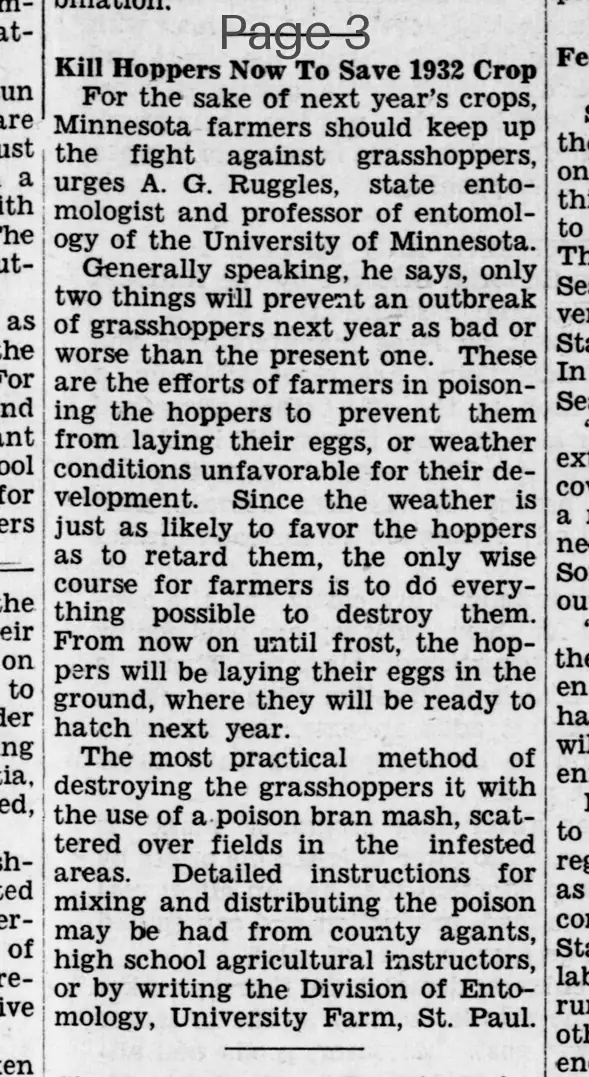
Kill Hoppers Now To Save 1932 Crop
For the sake of next year's crops, Minnesota farmers should keep up the fight against grasshoppers, urges A. G. Ruggles, state entomologist and professor of entomology of the University of Minnesota.
Generally speaking, he says, only two things will prevent an outbreak of grasshoppers next year as bad or worse than the present one. These are the efforts of farmers in poisoning the hoppers to prevent them from laying their eggs, or weather conditions unfavorable for their development. Since the weather is just as likely to favor the hoppers as to retard them, the only wise course for farmers is to do everything possible to destroy them.
From now on until frost, the hoppers will be laying their eggs in the ground, where they will be ready to hatch next year.
The most practical method of destroying the grasshoppers it with the use of a poison bran mash, scattered over fields in the infested areas.
Detailed instructions for mixing and distributing the poison may be had from county agents, high school agricultural instructors, or by writing the Division of Entomology, University Farm, St. Paul
For the sake of next year's crops, Minnesota farmers should keep up the fight against grasshoppers, urges A. G. Ruggles, state entomologist and professor of entomology of the University of Minnesota.
Generally speaking, he says, only two things will prevent an outbreak of grasshoppers next year as bad or worse than the present one. These are the efforts of farmers in poisoning the hoppers to prevent them from laying their eggs, or weather conditions unfavorable for their development. Since the weather is just as likely to favor the hoppers as to retard them, the only wise course for farmers is to do everything possible to destroy them.
From now on until frost, the hoppers will be laying their eggs in the ground, where they will be ready to hatch next year.
The most practical method of destroying the grasshoppers it with the use of a poison bran mash, scattered over fields in the infested areas.
Detailed instructions for mixing and distributing the poison may be had from county agents, high school agricultural instructors, or by writing the Division of Entomology, University Farm, St. Paul
What sub-type of article is it?
Agriculture
What keywords are associated?
Grasshoppers
Minnesota Farmers
Pest Control
1932 Crop
Poison Bran Mash
What entities or persons were involved?
A. G. Ruggles
Where did it happen?
Minnesota
Domestic News Details
Primary Location
Minnesota
Event Date
From Now On Until Frost
Key Persons
A. G. Ruggles
Event Details
A. G. Ruggles urges Minnesota farmers to poison grasshoppers using bran mash to prevent egg-laying and a worse outbreak next year, as weather may not help. Instructions from county agents or Division of Entomology.