Thank you for visiting SNEWPapers!
Sign up free
Editorial
January 28, 1811
Portland Gazette, And Maine Advertiser
Portland, Cumberland County, Maine
What is this article about?
The editorial praises Josiah Quincy's speech opposing the admission of New Orleans territory into the Union as unconstitutional, warning it dissolves the bond of the states and threatens Eastern influence. It criticizes Jefferson and Madison's administration for selfish foreign policies favoring France over Britain and risking war for power retention.
Clipping
OCR Quality
90%
Excellent
Full Text
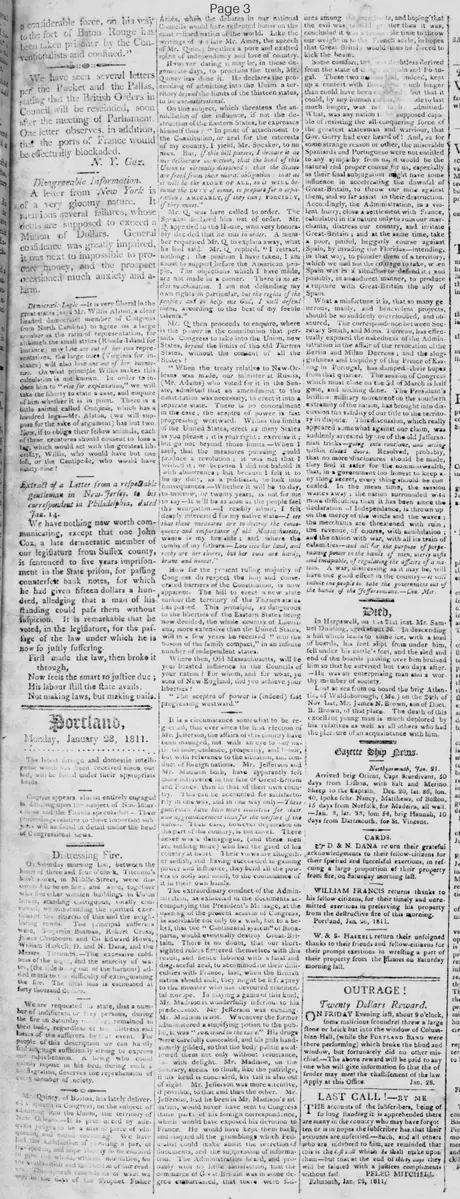
Mr. Quincy, of Boston, has lately delivered a speech in Congress, on the subject of admitting into the Union, the territory of New Orleans. It is pronounced by adequate judges to be a master piece of eloquence, and sound reasoning. We have had the satisfaction of perusing a part of this speech, and hope shortly to be enabled to give the whole, without mutilation, for the edification and information of our readers. This speech reminds us of what we once saw in the debates of the prophet Fisher Ames, when the debates in our national Councils would have reflected honor on the most refined nation of the world. Like the writings of the late Mr. Ames, the speech of Mr. Quincy breathes a pure and exalted spirit of independency and love of country. However daring it may be, in these degenerate days, to proclaim the truth, Mr. Quincy has done it. He declares the proceeding of admitting into the Union a territory beyond the limits of the thirteen states, to be unconstitutional.
On this subject, which threatens the annihilation of the influence, if not the destruction of the Eastern States, he expresses himself thus: "In point of attachment to the Constitution, or zeal for the interests of my country, I yield, Mr. Speaker, to no man. But, if this bill passes, I declare it as my deliberate conviction, that the bond of this Union is virtually dissolved: that the States are freed from their moral obligation: that as it will be the RIGHT OF ALL, so it will become the duty of some, to prepare for a separation: AMICABLY, if they can; FORCIBLY, if they must."
Mr. Q. was here called to order. The Speaker declared him out of order. Mr. Q. appealed to the House, who very honorably decided that he was in order. A member requested Mr. Q. to explain away, what he had said. Mr. Q. replied, "I retract nothing; the position I have taken, I am about to support before the American people. The objections which I have made, are not made in a corner. There is no secret machination. I am not defending my own rights in particular, but the rights of the people; and so help me God, I will defend them, according to the best of my feeble talents."
Mr. Q. then proceeds to enquire, where is the power in the constitution that permits Congress to take into the Union, new States, beyond the limits of the old Thirteen States, without the consent of all the States?
"When the treaty relative to New Orleans was made, our minister at Russia, (Mr. Adams) who voted for it in the Senate, admitted that an amendment to the constitution was necessary, to erect it into a separate state. There is no concealment in the case, the sceptre of power is fast progressing westward. Within the limits of the United States, erect as many States as you please; it is your right; exercise it; but go not beyond those limits.—When I said, that the measures pursuing would produce a revolution: it was not that I wished it: or because I did not behold it with abhorrence; but because I felt it to be my duty, as a politician, to look into consequences.—Whether it will be to day, to-morrow, or twenty years, is not for me to say—It will be as soon as the people feel the usurpation.—I readily admit, I felt deeply interested for my native state—I see that these measures are to destroy the consequence and importance of old Massachusetts, where is my birthplace: and where the tombs of my fathers.—Low lies her land, and rocky are her shores, but her sons are hardy, brave and honest.
How far the present ruling majority of Congress do respect the duty and consecrated barriers of the Constitution, is now apparent. The bill to erect a new state without the territory of the Thirteen states has passed. This principle, so dangerous to the liberties of the Eastern States being now decided, the whole country of Louisiana, more extensive than the United States, will in a few years be received "into the bosom of the family compact," in an infinite number of independent states. Where then, Old Massachusetts, will be your boasted influence in the Councils of your nation? For whom, and for what, ye sons of New England, did you achieve your liberties?
"The sceptre of power is (indeed) fast progressing westward."
It is a circumstance somewhat to be regretted, that ever since the first election of Mr. Jefferson, the affairs of this country have been managed, not with an eye to our national independence, prosperity, and honor, but with reference to the situation, and conduct of foreign nations. Mr. Jefferson and Mr. Madison both, have apparently felt more interest in the fate of Great-Britain and France than in that of their own country. This can be accounted for satisfactorily in one way, and in one way only—These gentlemen have been more solicitous for their own aggrandizement than for the welfare of the nation. Their case, however deplorable on the part of the country, is not novel. There never was a demagogue, (and these men are nothing more) who had the good of his country at heart. Their views are altogether selfish, and having succeeded in gaining power and influence, they bend all the powers of body and mind, to the continuance of it in their own hands.
The extraordinary conduct of the Administration, as exhibited in the documents accompanying the President's Message, at the opening of the present session of Congress, is ascribable not only to a wish, but to a belief, that the "Continental system" of Bonaparte, would eventually destroy Great-Britain. There is no doubt, that our short-sighted rulers flattered themselves with this result, and hence labored with a fatal and disgraceful zeal, to accommodate their difficulties with France, lest, when the British nation should sink, they might be left a prey to the monster who has devoured continental Europe. In playing a game of this kind, Mr. Madison is wonderfully inferior to his predecessor. Mr. Jefferson was cunning—Mr. Madison is not. Whenever the former administered a stupifying potion to the public, it was "sugared to the taste." His drugs were carefully concealed, and his pills handsomely gilded, so that the body politic swallowed them not only without reluctance, but with delight. Mr. Madison, on the contrary, seems to think, like the partridge, if his head is concealed, his tail is also out of sight. Mr. Jefferson was more attentive, if possible, to that end than the other. Mr. Jefferson, had he been in Mr. Madison's situation, would never have sent to Congress those parts of his foreign correspondence, which would have exposed his devotion to France. He would have kept them back, and risqued all the grumblings which Feds. could make about the secretion of documents, and the suppression of information. The Administration heard, and probably with no little satisfaction, that the commerce of Great Britain was in some degree embarrassed, that there were failures among the merchants, and hoping that the evil was terrible than it was, concluded it was a favorable time to throw our weight into the French scale, in hopes that Great Britain would thus be forced to kick the beam.
Some comfort, too, was doubtless derived from the state of things in Spain and Portugal. These two nations alone, indeed, kept up a contest with Bonaparte much longer than could have been expected but that it could, by any human means, be supposed to last much longer, was not to be admitted. What, was any nation to be supposed capable of resisting the all-conquering force of the greatest statesman and warrior, that Gov. Gerry had ever heard of! And, as for some strange reason or other, the miserable Spaniards and Portuguese were not entitled to any sympathy from us, it would be the natural and proper course for us, especially as their final subjugation might have some influence in accelerating the downfall of Great-Britain, to throw our mite against them, and so far assist in their destruction. Accordingly, the Administration, in a violent hurry, close a settlement with France, calculated in its nature only to ruin our merchants, distress our country, and irritate Great-Britain; and at the same time, take a poor, pitiful, beggarly course against Spain, by invading the Floridas—intending, in that way, to plunder them of a territory, which we had not the courage to take, when Spain was in a situation to defend it: and possibly, in an indirect manner, to produce a rupture with Great-Britain the ally of Spain.
What a misfortune it is, that so many generous, manly, and benevolent projects, should be so suddenly overclouded, and obscured. The correspondence between Secretary Smith, and Mons. Turreau, has effectually exposed the nakedness of the Administration in the affair of the revocation of the Berlin and Milan Decrees; and the sluggishness and torpidity of the Prince of Ess. ning in Portugal, has damped their hopes from that quarter. The session of Congress which must close on the 3d of March is half gone, and nothing done. The President's brilliant military movement on the southern extremity of the nation, has brought into discussion the validity of our title to the territory in dispute. This discussion, which really appeared somewhat against our claim, was suddenly arrested by one of the old Jeffersonian tricks—going into conclave, and acting within closed doors. Resolved, probably, that no more 'disclosures should be made,' they find it safer for the commonwealth, that, in a government too honest to keep anything secret, every thing should be concealed. In the mean time, the session wastes away; the nation surrounded with more difficulties than it has been since the declaration of Independence, is thrown upon the mercy of the winds and the waves; the merchants are threatened with ruin; the revenue, of course, with annihilation; and the nation with war, with all its train of calamities—and all for the purpose of perpetuating power in the hands of men, utterly unfit and incapable, of regulating the affairs of a nation. A war, distressing as it may be, will have one good effect in the country—it will induce the people to take the government out of the hands of the Jeffersonians.—Con. Mir.
On this subject, which threatens the annihilation of the influence, if not the destruction of the Eastern States, he expresses himself thus: "In point of attachment to the Constitution, or zeal for the interests of my country, I yield, Mr. Speaker, to no man. But, if this bill passes, I declare it as my deliberate conviction, that the bond of this Union is virtually dissolved: that the States are freed from their moral obligation: that as it will be the RIGHT OF ALL, so it will become the duty of some, to prepare for a separation: AMICABLY, if they can; FORCIBLY, if they must."
Mr. Q. was here called to order. The Speaker declared him out of order. Mr. Q. appealed to the House, who very honorably decided that he was in order. A member requested Mr. Q. to explain away, what he had said. Mr. Q. replied, "I retract nothing; the position I have taken, I am about to support before the American people. The objections which I have made, are not made in a corner. There is no secret machination. I am not defending my own rights in particular, but the rights of the people; and so help me God, I will defend them, according to the best of my feeble talents."
Mr. Q. then proceeds to enquire, where is the power in the constitution that permits Congress to take into the Union, new States, beyond the limits of the old Thirteen States, without the consent of all the States?
"When the treaty relative to New Orleans was made, our minister at Russia, (Mr. Adams) who voted for it in the Senate, admitted that an amendment to the constitution was necessary, to erect it into a separate state. There is no concealment in the case, the sceptre of power is fast progressing westward. Within the limits of the United States, erect as many States as you please; it is your right; exercise it; but go not beyond those limits.—When I said, that the measures pursuing would produce a revolution: it was not that I wished it: or because I did not behold it with abhorrence; but because I felt it to be my duty, as a politician, to look into consequences.—Whether it will be to day, to-morrow, or twenty years, is not for me to say—It will be as soon as the people feel the usurpation.—I readily admit, I felt deeply interested for my native state—I see that these measures are to destroy the consequence and importance of old Massachusetts, where is my birthplace: and where the tombs of my fathers.—Low lies her land, and rocky are her shores, but her sons are hardy, brave and honest.
How far the present ruling majority of Congress do respect the duty and consecrated barriers of the Constitution, is now apparent. The bill to erect a new state without the territory of the Thirteen states has passed. This principle, so dangerous to the liberties of the Eastern States being now decided, the whole country of Louisiana, more extensive than the United States, will in a few years be received "into the bosom of the family compact," in an infinite number of independent states. Where then, Old Massachusetts, will be your boasted influence in the Councils of your nation? For whom, and for what, ye sons of New England, did you achieve your liberties?
"The sceptre of power is (indeed) fast progressing westward."
It is a circumstance somewhat to be regretted, that ever since the first election of Mr. Jefferson, the affairs of this country have been managed, not with an eye to our national independence, prosperity, and honor, but with reference to the situation, and conduct of foreign nations. Mr. Jefferson and Mr. Madison both, have apparently felt more interest in the fate of Great-Britain and France than in that of their own country. This can be accounted for satisfactorily in one way, and in one way only—These gentlemen have been more solicitous for their own aggrandizement than for the welfare of the nation. Their case, however deplorable on the part of the country, is not novel. There never was a demagogue, (and these men are nothing more) who had the good of his country at heart. Their views are altogether selfish, and having succeeded in gaining power and influence, they bend all the powers of body and mind, to the continuance of it in their own hands.
The extraordinary conduct of the Administration, as exhibited in the documents accompanying the President's Message, at the opening of the present session of Congress, is ascribable not only to a wish, but to a belief, that the "Continental system" of Bonaparte, would eventually destroy Great-Britain. There is no doubt, that our short-sighted rulers flattered themselves with this result, and hence labored with a fatal and disgraceful zeal, to accommodate their difficulties with France, lest, when the British nation should sink, they might be left a prey to the monster who has devoured continental Europe. In playing a game of this kind, Mr. Madison is wonderfully inferior to his predecessor. Mr. Jefferson was cunning—Mr. Madison is not. Whenever the former administered a stupifying potion to the public, it was "sugared to the taste." His drugs were carefully concealed, and his pills handsomely gilded, so that the body politic swallowed them not only without reluctance, but with delight. Mr. Madison, on the contrary, seems to think, like the partridge, if his head is concealed, his tail is also out of sight. Mr. Jefferson was more attentive, if possible, to that end than the other. Mr. Jefferson, had he been in Mr. Madison's situation, would never have sent to Congress those parts of his foreign correspondence, which would have exposed his devotion to France. He would have kept them back, and risqued all the grumblings which Feds. could make about the secretion of documents, and the suppression of information. The Administration heard, and probably with no little satisfaction, that the commerce of Great Britain was in some degree embarrassed, that there were failures among the merchants, and hoping that the evil was terrible than it was, concluded it was a favorable time to throw our weight into the French scale, in hopes that Great Britain would thus be forced to kick the beam.
Some comfort, too, was doubtless derived from the state of things in Spain and Portugal. These two nations alone, indeed, kept up a contest with Bonaparte much longer than could have been expected but that it could, by any human means, be supposed to last much longer, was not to be admitted. What, was any nation to be supposed capable of resisting the all-conquering force of the greatest statesman and warrior, that Gov. Gerry had ever heard of! And, as for some strange reason or other, the miserable Spaniards and Portuguese were not entitled to any sympathy from us, it would be the natural and proper course for us, especially as their final subjugation might have some influence in accelerating the downfall of Great-Britain, to throw our mite against them, and so far assist in their destruction. Accordingly, the Administration, in a violent hurry, close a settlement with France, calculated in its nature only to ruin our merchants, distress our country, and irritate Great-Britain; and at the same time, take a poor, pitiful, beggarly course against Spain, by invading the Floridas—intending, in that way, to plunder them of a territory, which we had not the courage to take, when Spain was in a situation to defend it: and possibly, in an indirect manner, to produce a rupture with Great-Britain the ally of Spain.
What a misfortune it is, that so many generous, manly, and benevolent projects, should be so suddenly overclouded, and obscured. The correspondence between Secretary Smith, and Mons. Turreau, has effectually exposed the nakedness of the Administration in the affair of the revocation of the Berlin and Milan Decrees; and the sluggishness and torpidity of the Prince of Ess. ning in Portugal, has damped their hopes from that quarter. The session of Congress which must close on the 3d of March is half gone, and nothing done. The President's brilliant military movement on the southern extremity of the nation, has brought into discussion the validity of our title to the territory in dispute. This discussion, which really appeared somewhat against our claim, was suddenly arrested by one of the old Jeffersonian tricks—going into conclave, and acting within closed doors. Resolved, probably, that no more 'disclosures should be made,' they find it safer for the commonwealth, that, in a government too honest to keep anything secret, every thing should be concealed. In the mean time, the session wastes away; the nation surrounded with more difficulties than it has been since the declaration of Independence, is thrown upon the mercy of the winds and the waves; the merchants are threatened with ruin; the revenue, of course, with annihilation; and the nation with war, with all its train of calamities—and all for the purpose of perpetuating power in the hands of men, utterly unfit and incapable, of regulating the affairs of a nation. A war, distressing as it may be, will have one good effect in the country—it will induce the people to take the government out of the hands of the Jeffersonians.—Con. Mir.
What sub-type of article is it?
Constitutional
Partisan Politics
Foreign Affairs
What keywords are associated?
Territorial Expansion
Constitutional Limits
Louisiana Territory
Jefferson Administration
Foreign Policy
Eastern States
Union Dissolution
Partisan Criticism
What entities or persons were involved?
Mr. Quincy
Fisher Ames
Mr. Jefferson
Mr. Madison
Mr. Adams
Bonaparte
Secretary Smith
Mons. Turreau
Gov. Gerry
Editorial Details
Primary Topic
Opposition To Admitting New Orleans Territory Into The Union
Stance / Tone
Strongly Anti Territorial Expansion And Anti Jefferson Administration
Key Figures
Mr. Quincy
Fisher Ames
Mr. Jefferson
Mr. Madison
Mr. Adams
Bonaparte
Secretary Smith
Mons. Turreau
Gov. Gerry
Key Arguments
Admitting Territory Beyond The Thirteen States Is Unconstitutional
Such Admission Dissolves The Union Bond And Frees States From Moral Obligation
Preparation For Separation May Be Necessary, Amicably If Possible, Forcibly If Must
Jefferson And Madison Prioritize Personal Aggrandizement Over National Welfare
Administration Favors France Over Britain, Risking War And Economic Ruin
Policies Aim To Perpetuate Power Rather Than Promote Independence And Honor
Territorial Expansion Threatens Eastern States' Influence
Foreign Policy Accommodates Bonaparte's Continental System Against Britain