Thank you for visiting SNEWPapers!
Sign up free
Rutland Herald
Rutland, Rutland County, Vermont
What is this article about?
1844 diplomatic tensions between the US and Mexico over the proposed annexation of Texas, involving correspondence from Secretary Calhoun to ministers Shannon and King, military threats, and Mexico's firm refusal led by Senor Rejon, amid US internal politics favoring Southern slave interests.
Clipping
OCR Quality
Full Text
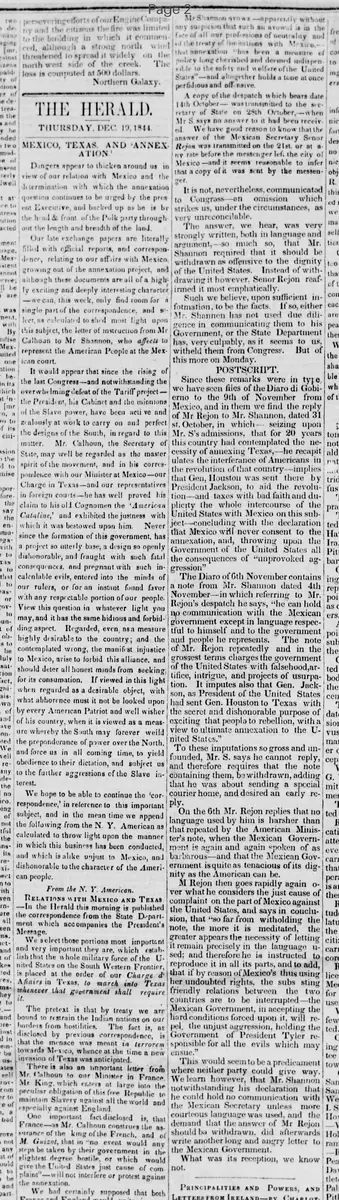
THURSDAY, DEC. 19, 1844.
MEXICO. TEXAS. AND ANNEXATION.
Dangers appear to thicken around us in view of our relations with Mexico and the determination with which the annexation question continues to be urged by the present Executive, and backed up as he is by the head & front of the Polk party throughout the length and breadth of the land.
Our late exchange papers are literally filled with official reports, and correspondence, relating to our affairs with Mexico, growing out of the annexation project, and although these documents are all of a highly exciting and deeply interesting character—we can, this week, only find room for a single part of the correspondence. and select, as calculated to shed most light upon this subject, the letter of instruction from Mr. Calhoun to Mr. Shannon, who affects to represent the American People at the Mexican court.
It would appear that since the rising of the last Congress—and notwithstanding the overwhelming defeat of the Tariff project—the President, his Cabinet and the minions of the Slave power, have been active and zealously at work to carry on and perfect the designs of the South, in regard to this matter. Mr. Calhoun, the Secretary of State, may well be regarded as the master spirit of the movement, and in his correspondence with our Minister at Mexico—our Charge in Texas—and our representatives in foreign courts—he has well proved his claim to his old Cognomen the 'American Cataline,' and exhibited the justness with which it was bestowed upon him. Never since the formation of this government, has a project so utterly base, a design so openly dishonorable, and fraught with such fatal consequences, and pregnant with such incalculable evils, entered into the minds of our rulers, or for an instant found favor with any respectable portion of our people.
View this question in whatever light you may, and it has the same hideous and forbidding aspect. Regarded, even, as a measure highly desirable to the country; and the contemplated wrong, the manifest injustice to Mexico, arise to forbid this alliance, and should deter all honest minds from seeking for its consummation. If viewed in this light when regarded as a desirable object, with what abhorrence must it not be looked upon by every American Patriot and well wisher of his country, when it is viewed as a measure whereby the South may forever wield the preponderance of power over the North, and force us in all coming time, to yield obedience to their dictation, and subject us to the further aggressions of the Slave interest.
We hope to be able to continue the 'correspondence,' in reference to this important subject, and in the mean time we append the following from the N. Y. American as calculated to throw light upon the manner in which this business has been conducted, and which is alike unjust to Mexico, and dishonorable to the character of the American people.
From the N. Y. American.
Relations with Mexico and Texas—In the Herald this morning is published the correspondence from the State Department which accompanies the President's Message.
We select those portions most important and very important they are, which establish that the whole military force of the United States on the South Western Frontier, is placed at the order of our Charge d'Affairs in Texas, to march into Texas whenever that government shall require it.
The pretext is that by treaty we are bound to restrain the Indian nations on our borders from hostilities. The fact is, as disclosed by previous correspondence, is that the menace was meant in terrorem towards Mexico, whence at the time a new invasion of Texas was anticipated.
There is also an important letter from Mr. Calhoun to our Minister in France, Mr. King, which enters at large into the peculiar obligation of this free Republic to maintain Slavery against all the world and especially against England.
One important fact disclosed is, that France—as Mr. Calhoun construes the assurance of the king of the French, and of M. Guizot, that in 'no event would any steps be taken by their government in the slightest degree hostile, or which would give the United States just cause of complaint'—will not interfere or protest against the annexation.
We had certainly supposed that both France and England would unite in protesting against such a measure.
Another dispatch for which we have not room to day, is from Mr. Shannon to the Mexican Government, in which he informs them that the Government of the United States will consider a renewed invasion of Texas by Mexico, 'as highly offensive,' as it can only arise from a desire to defeat the proposed annexation; and, inasmuch as that annexation was wished by the United States, upon them, and not upon Texas, should Mexico turn her resentment, if just cause of resentment there be—
Mr. Shannon avows—apparently without any suspicion that such an avowal is in the face of all our professions of neutrality and of the treaty of limitations with Mexico.—that annexation 'has been a measure of policy long cherished and deemed indispensable to the safety and welfare of the United States'—and altogether holds a tone at once perfidious and offensive.
A copy of the despatch which bears date 14th October—was transmitted to the Secretary of State on 28th October,—when Mr. S. says no answer to it had been received. We have good reason to know that the answer of the Mexican Secretary Senor Rejon was transmitted on the 21st, or at any rate before the messenger left the city of Mexico—and it seems reasonable to infer that a copy of it was sent by the messenger.
It is not, nevertheless, communicated to Congress—an omission which strikes us, under the circumstances, as very unreconcilable.
The answer, we hear, was very strongly written, both in language and argument,—so much so, that Mr. Shannon required that it should be withdrawn as offensive to the dignity of the United States. Instead of withdrawing it however, Senor Rejon reaffirmed it most emphatically.
Such we believe, upon sufficient information, to be the facts. If so, either Mr. Shannon has not used due diligence in communicating them to his Government, or the State Department has, very culpably, as it seems to us, withheld them from Congress. But of this more on Monday.
POSTSCRIPT
Since these remarks were in type we have seen files of the Diario di Gobieno to the 9th of November from Mexico, and in them we find the reply of Mr. Rejon to Mr. Shannon, dated 31st. October, in which—seizing upon Mr. S's admissions, that for 20 years this country had contemplated the necessity of annexing Texas,—he recapitulates the interference of Americans in the revolution of that country—implies that Gen. Houston was sent there by President Jackson, to aid the revolution—and taxes with bad faith and duplicity the whole intercourse of the United States with Mexico on this subject—concluding with the declaration that Mexico will never consent to the annexation, and, throwing upon the Government of the United States all the consequences of 'unprovoked aggression'
The Diario of 6th November contains a note from Mr. Shannon dated 4th November—in which referring to Mr. Rejon's despatch he says, 'he can hold no communication with the Mexican government except in language respectful to himself and to the government and people he represents. The note of Mr. Rejon repeatedly and in the grossest terms charges the government of the United States with falsehood, artifice, intrigue, and projects of usurpation. It imputes also that Gen. Jackson, as President of the United States had sent Gen. Houston to Texas with the secret and dishonorable purpose of exciting that people to rebellion, with a view to ultimate annexation to the U. nited States.'
To these imputations so gross and unfounded, Mr. S. says he cannot reply, and therefore requires that the note containing them, be withdrawn, adding that he was about sending a special courier home, and desired an early reply.
On the 6th Mr. Rejon replies that no language used by him is harsher than that repeated by the American Minister's note, when the Mexican Government is again and again spoken of as barbarous—and that the Mexican Government is quite as tenacious of its dignity as the American can be.
Mr. Rejon then goes rapidly again over what he considers the just cause of complaint on the part of Mexico against the United States. and says in conclusion, that 'so far from withholding the note, the more it is meditated, the greater appears the necessity of letting it remain precisely in the language used; and therefore he is instructed to reproduce it in all its parts, and to add, that if by reason of Mexico's thus using her undoubted rights, the subsisting friendly relations between the two countries are to be interrupted the Mexican Government, in accepting the hard conditions forced upon it, will repel, the unjust aggression, holding the Government of President Tyler responsible for all the evils which may ensue.'
This would seem to be a predicament where neither party could give way.
We learn however, that Mr. Shannon notwithstanding his declaration that he could hold no communication with the Mexican Secretary unless more courteous language was used, and the demand that the answer of Mr. Rejon should be withdrawn, did afterwards write another long and angry letter to the Mexican Government.
What was its reception, we know not.
What sub-type of article is it?
What keywords are associated?
What entities or persons were involved?
Where did it happen?
Foreign News Details
Primary Location
Mexico
Event Date
October November 1844
Key Persons
Outcome
diplomatic standoff with mexico refusing annexation, us military forces placed at texas's disposal as threat to mexico, france non-interfering, mutual accusations of bad faith and aggression, potential interruption of relations.
Event Details
US Secretary of State Calhoun instructs Minister Shannon on annexation policy, placing US military at Texas's order to deter Mexican invasion; Shannon warns Mexico against attacking Texas, avowing long-term US interest in annexation; Mexican Secretary Rejon strongly protests, accusing US of duplicity and interference in Texas revolution, refuses to withdraw offensive note, vows to repel aggression; France assures non-interference; internal US criticism of the policy as dishonorable and pro-slavery.