Thank you for visiting SNEWPapers!
Sign up free
The Liberator
Boston, Suffolk County, Massachusetts
What is this article about?
George Sennott writes to the Boston Courier defending the Rutland Convention in Vermont as a serious gathering of over 3,000 discussing marriage and women's roles, criticizing the paper's biased 'Free Lovers' report. He advocates for women's right to vote and serve on juries, emphasizing true marriage and social reform.
Clipping
OCR Quality
Full Text
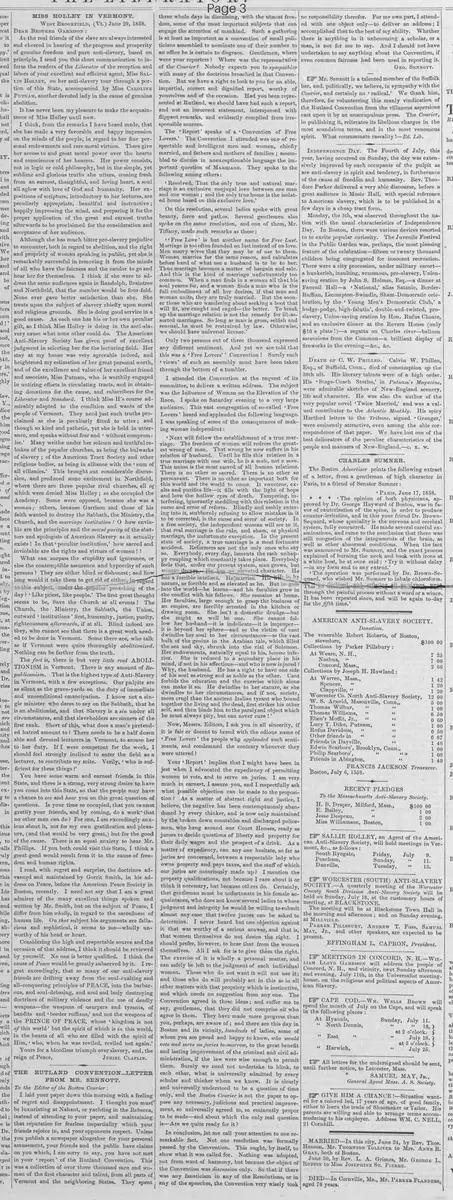
To the Editor of the Boston Courier:
I laid your paper down this morning with a feeling of regret and disappointment. I thought you must be luxuriating at Nahant, or yachting in the Rebecca, instead of attending to your paper, and maintaining that reputation for fearless impartiality which your friends rejoice in, and your opponents respect. Unless you publish a newspaper altogether for your personal amusement, your friends and the public have claims on you which, I am sorry to say, you have not met in your 'report' of the Rutland Convention. This was a collection of over three thousand men and women of the first character and talent, from all parts of Vermont and the neighboring States. They spent three whole days in discussing, with the utmost freedom, some of the most important subjects that can engage the attention of mankind. Such a gathering is at least as important as a convention of small politicians assembled to nominate one of their number to an office he is certain to disgrace. Gentlemen, where were your reporters? Where was the representative of the Courier? Nobody expects you to sympathize with many of the doctrines broached in that Convention. But we have a right to look to you for an able, impartial, correct and dignified report, worthy of yourselves and of the occasion. Had you been represented at Rutland, we should have had such a report, and not an incorrect statement, interspersed with flippant remarks, and evidently compiled from irresponsible sources.
The 'Report' speaks of a 'Convention of Free Lovers.' The Convention I attended was one of respectable and intelligent men and women, chiefly married, and fathers and mothers of families; assembled to discuss in unexceptionable language the important question of MARRIAGE. They spoke to the following among others:
Resolved, That the only true and natural marriage is an exclusive conjugal love between one man and one woman; and the only true home is the isolated home based on this exclusive love.
On this resolution, several ladies spoke with great beauty, force and pathos. Several gentlemen also spoke on the same resolution, and one of them, Mr. Tiffany, made such remarks as these:
'Free Love' is but another name for Free Lust. Marriage is too often founded on lust instead of on love. Men marry wives that they may be of use to them. Woman marries for the same reason, and calculates beforehand of what use a husband is to be to her. Thus marriage becomes a matter of bargain and sale. And this is the kind of marriage unfortunately too common. When a man finds in a woman all that his soul yearns for, and a woman finds a man who is the full embodiment of all her desires, if that man and woman unite, they are truly married. But the sooner those who are wandering about seeking a boot that will fit, are caught and caged--the better. To break up the marriage relation is not the remedy for ill-assorted marriages. So long as man is gross, selfish and sensual, he must be restrained by law. Otherwise, we should have universal license.'
Only two persons out of three thousand expressed any different sentiment. And yet we are told that this was a 'Free Lovers' Convention! Surely such 'views' of such an assembly must have been taken through the bottom of a tumbler.
I attended the Convention at the request of its committee, to deliver a written address. The subject was the Influence of Woman on the Elevation of the Race. I spoke on Saturday evening to a very large audience. This vast congregation of so-called 'Free Lovers' heard and applauded the following language.
I was speaking of some of the consequences of making woman independent:
'Next will follow the establishment of a true marriage. The freedom of woman will redress the greatest wrong of man. That wrong he now suffers in his relation of husband. Until he fills this relation in a true marriage with one wife, he is a male, not a man. This union is the most sacred of all human relations. There is no other so sacred. There is no other so permanent. There is no other so important both for this world and the world to come. It sweetens, exalts and purifies life--it fills with the light of hope and love the hollow caves of death. Tampering, interfering, ignorantly meddling with this relation is the curse and error of reform. Blindly and rashly entering into it, stubbornly refusing to allow mistakes in it to be corrected, is the curse and error of society. In a free society, the independent woman will see to it, that real marriage is the rule, and sham, or physical marriage, the unfortunate exception. In the present state of society, a true marriage is a most fortunate accident. Reformers are not the only ones who say so. Everybody, every day, laments the rash unhappy coupling which constantly takes place. Everybody feels that, under our present system, man grows, but woman decays. He has an elevated character. He has a forcible intellect. He marries. His wife is, by nature, as forcible and as elevated as he. But he goes into the world--he learns--and his faculties grow in the conflict with his fellows. She remains at home. Her faculties, large enough to grasp the business of an empire, are forcibly arrested in the kitchen or drawing room. She isn't a domestic drudge--but she might as well be one. She cannot follow her husband--it is indelicate--it is improper--it is beyond her sphere--and so the victim of cant dwindles her soul to her circumstances--as the vast bulk of the genius in the Arabian tale, which filled the sea and sky, shrunk into the vial of Solomon. Her endowments, naturally equal to his, become inferior. She is reduced to a secondary place in his mind, if not in his affections--and who is now injured? Why, the husband. He has a right to have one side of his soul as strong and as noble as the other. Cant forbids the education and the exercise which alone can make it so. He dwindles to her stature, as she dwindles to her circumstances, and if not, society, more cruel than the ancient Italian tyrant who bound together the living and the dead, first strikes his other self, and then binds him to the paralyzed object which he must always pity, but can never cure!'
Now, Messrs. Editors, I ask you in all sincerity, if it is fair or decent to brand with the odious name of 'Free Lovers' the people who applauded such sentiments, and condemned the contrary whenever they were uttered?
Your 'Report' implies that I might have been in jest when I advocated the expediency of permitting women to vote, and to serve on juries. I am very much in earnest, I assure you, and I respectfully ask what possible objection can be made to the proposition? As a matter of abstract right and justice, I believe, the negative has been contemptuously abandoned by every thinker, and is now only maintained by the broken down constables and discharged policemen, who hang around our Court Houses, ready as jurors to decide questions of liberty and property for their daily wages and the prospect of a drink. As a matter of expediency, can any one hesitate, so far as juries are concerned, between a respectable lady who owns property and pays taxes, and the stuff of which our juries are notoriously made up? I mention the property qualifications, not because I care about it or think it necessary, but because others do. Certainly, that gentleman must be unfortunate in his female acquaintance, who does not know several ladies to whose judgment and integrity he would be willing to submit almost any case that twelve jurors can be asked to determine. I never heard but one objection against it that was worthy of a serious answer, and that is, that women themselves do not desire the right. I should prefer, however, to hear that from the women themselves. All I ask for is to give them the right. The exercise of it is wholly a personal matter, and can safely be left to the judgment of each individual woman. Those who do not want it will not use it; and those who do will probably act in this as in all other matters with that propriety which is instinctive, and which needs no suggestion from any one. The Convention agreed in these ideas; and suffer me to say, gentlemen, that they did not comprise all who agree in them. They have made more progress than you, perhaps, are aware of; and there are this day in Boston and its vicinity, hundreds of ladies, some of whom you are proud and happy to know, who would vote and serve on juries to-morrow, to the great benefit and lasting improvement of the criminal and civil administration, if the law were wise enough to permit them. Surely we need not undertake to blink, to each other, what is universally admitted by every scholar and thinker whom we know. It is clearly and universally understood to be a question of time only, and the Boston Courier is not the paper to oppose any necessary, judicious and practical improvement, so universally agreed to, so eminently proper to be made--and about which the only real question is--Are we quite ready for it?
In conclusion, let me call your attention to one remarkable fact. Not one resolution was formally passed by the Convention. This ought, by itself, to show what it was called for. Nothing was adopted, not from want of harmony, but because the object of the Convention was discussion only. So that if there was any fanaticism in any of the Resolutions, or in any of the speeches, the Convention very wisely took no responsibility therefor. For my own part, I attended with one object only--to deliver an address; I accomplished that to the best of my ability. Whether there is anything in it unbecoming a scholar, or a man, is not for me to say. And I should not have undertaken to say anything about the Convention, if even common fairness had been used in reporting it.
Geo. Sennott.
Mr. Sennott is a talented member of the Suffolk bar, and, politically, we believe, in sympathy with the Courier, and certainly no radical.' We thank him, therefore, for volunteering this manly vindication of the Rutland Convention from the villanous aspersions cast upon it by an unscrupulous press. The Courier, in publishing it, reiterates its libellous charges in the most scandalous terms, and in the most venomous spirit. What consummate rascality!--Ed. Lib.
What sub-type of article is it?
What themes does it cover?
What keywords are associated?
What entities or persons were involved?
Letter to Editor Details
Author
Geo. Sennott
Recipient
Editor Of The Boston Courier
Main Argument
the rutland convention was a serious assembly discussing marriage and women's influence, not a 'free lovers' gathering as misreported by the courier; the paper should provide impartial coverage and support women's rights to vote and serve on juries for justice and reform.
Notable Details