Thank you for visiting SNEWPapers!
Sign up free
Fayetteville Observer
Fayetteville, Lincoln County, Tennessee
What is this article about?
Richmond report on President Davis's message reviewing Confederate military successes against invasions, war stages, foreign relations, blockade invalidity, Northern atrocities, Lincoln's proclamation, and recommendations for taxation and bonds. Confident tone expects war's end.
Clipping
OCR Quality
Full Text
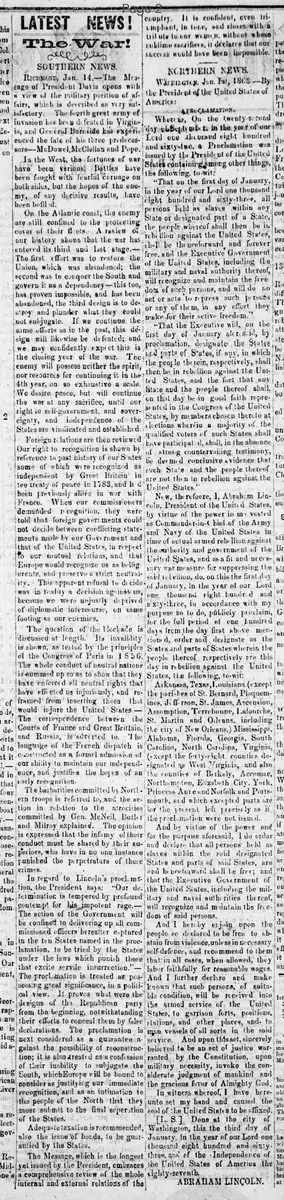
SOUTHERN NEWS.
RICHMOND, Jan. 14.—The Message of President Davis opens with a view of the military position of affairs, which is described as very satisfactory. The fourth great army of invasion has been defeated in Virginia, and General Burnside has experienced the fate of his three predecessors—McDowell, McClellan and Pope. In the West, the fortunes of war have been various. Battles have been fought with fearful carnage on both sides, but the hopes of the enemy of any decisive results, have been baffled. On the Atlantic coast, the enemy are still confined to the protecting cover of their fleets. A review of our history shows that the war has entered its third and last stage. The first effort was to restore the Union, which was abandoned; the second was to conquer the South and govern it as a dependency—this too has proven impossible, and has been abandoned, the third design is to destroy and plunder what they could not subjugate. If we continue the same efforts as in the past, this design will likewise be defeated; and we may confidently expect this is the closing year of the war. The enemy will possess neither the spirit, nor resources for continuing it in the 4th year, on so exhaustive a scale. We desire peace, but will continue the war at any sacrifice, until our right to self-government, and sovereignty, and independence, of the States are vindicated and established.
Foreign Relations are then reviewed. Our right to recognition is shown by reference to past history of our States some of which were recognized as independent by Great Britain in the treaty of peace in 1783, and had been previously allies in war with France. When our commissioners demanded recognition, they were told that foreign governments could not decide between conflicting statements made by our Government and that of the United States, in respect to our mutual relations, and that Europe would recognize us as belligerents, and preserve a strict neutrality. This apparent refusal to decide, was in reality a decision against us, because we were unjustly deprived of diplomatic intercourse, on equal footing as our enemies.
The question of the blockade is discussed at length. Its invalidity is shown, as tested by the principles of the Congress of Paris in 1856. The whole conduct of neutral nations is summed up so as to show that they have enforced all neutral rights that have effected us injuriously, and refrained from asserting those that would injure the United States.
The correspondence between the Courts of France and Great Britain, and Russia, is adverted to. Their language of the French dispatch is construed as a formal admission of our ability to maintain our independence, and justifies the hopes of an early recognition.
The barbarities committed by Northern troops is referred to, and the action in relation to the atrocities committed by Gen. McNeil, Butler and Milroy explained. The opinion is expressed that the infamy of their conduct must be shared by their superiors, who have in no one instance punished the perpetrators of these crimes.
In regard to Lincoln's proclamation, the President says: "Our determination is tempered by profound contempt for his impotent rage." The action of the Government will be confined to delivering up all commissioned officers hereafter captured in the ten States named in the proclamation, to be tried by the States under the laws which punish those that excite servile insurrection."
The proclamation is treated as possessing great significance, in a political view. It proves what were the designs of the Republican party from the beginning, notwithstanding their efforts to conceal them by false declarations. The proclamation is next considered as a guarantee against the possibility of reconstruction; it is also treated as a confession of their inability to subjugate the South, which Europe will be bound to consider as justifying our immediate recognition, and as an intimation to the people of the North that they must submit to the final separation of the States.
Adequate taxation is recommended, also the issue of bonds, to be guaranteed by the States.
The Message, which is the longest yet issued by the President, embraces a comprehensive review of the whole internal and external relations of the country. It is confident, even triumphant, in tone, and closes with tribute to our women, without whose sublime endurance, it declares that our success would have been impossible.
What sub-type of article is it?
What keywords are associated?
What entities or persons were involved?
Where did it happen?
Domestic News Details
Primary Location
Richmond
Event Date
Jan. 14.
Key Persons
Outcome
fourth invasion defeated in virginia; various battles in west with carnage but no decisive enemy results; enemy confined to fleets on atlantic coast; war expected to end this year; hopes for recognition; response to lincoln's proclamation by trying captured officers.
Event Details
President Davis's message reviews satisfactory military position, defeat of invasions, war stages from union restoration to plunder, foreign relations and right to recognition, invalid blockade, neutral nations' conduct, French dispatch admitting independence ability, Northern troops' barbarities by McNeil, Butler, Milroy, contempt for Lincoln's proclamation, its political significance as confession of subjugation failure, recommendations for taxation and state-guaranteed bonds, tribute to women.