Thank you for visiting SNEWPapers!
Sign up free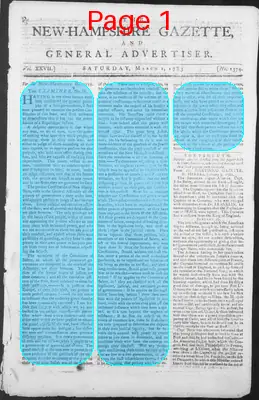
Editorial
March 1, 1783
The New Hampshire Gazette And General Advertiser
Portsmouth, Exeter, Rockingham County, New Hampshire
What is this article about?
In 'The Examiner, No. IV,' the author critiques the New Hampshire Constitution as despotic rather than republican, arguing it vests unlimited powers in the General Assembly and Committee of Safety without accountability or separation of powers, allowing potential abuse despite current leaders' good conduct.
Clipping
OCR Quality
95%
Excellent
Full Text
For the New-Hampshire Gazette.
THE EXAMINER, No. IV.
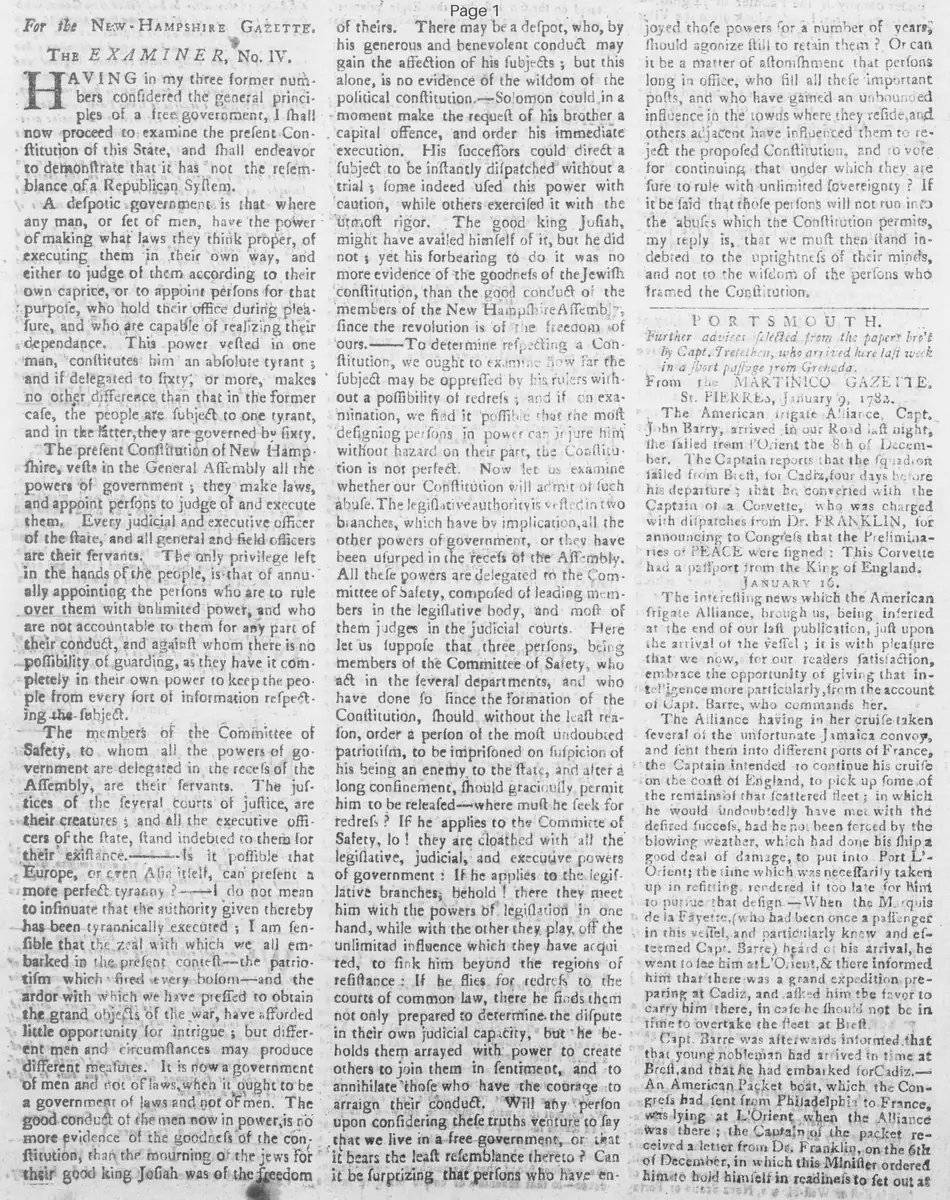
Having in my three former numbers considered the general principles of a free government, I shall now proceed to examine the present Constitution of this State, and shall endeavor to demonstrate that it has not the resemblance of a Republican System.
A despotic government is that where any man, or set of men, have the power of making what laws they think proper, of executing them in their own way, and either to judge of them according to their own caprice, or to appoint persons for that purpose, who hold their office during pleasure, and who are capable of realizing their dependence. This power vested in one man, constitutes him an absolute tyrant; and if delegated to sixty, or more, makes no other difference than that in the former case, the people are subject to one tyrant, and in the latter, they are governed by sixty.
The present Constitution of New Hampshire, vests in the General Assembly all the powers of government; they make laws, and appoint persons to judge of and execute them. Every judicial and executive officer of the state, and all general and field officers are their servants. The only privilege left in the hands of the people, is that of annually appointing the persons who are to rule over them with unlimited power, and who are not accountable to them for any part of their conduct, and against whom there is no possibility of guarding, as they have it completely in their own power to keep the people from every sort of information respecting the subject.
The members of the Committee of Safety, to whom all the powers of government are delegated in the recess of the Assembly, are their servants. The judges of the several courts of justice, are their creatures; and all the executive officers of the state stand indebted to them for their existence. Is it possible that Europe, or even Asia itself, can present a more perfect tyranny? I do not mean to insinuate that the authority given thereby has been tyrannically executed; I am sensible that the zeal with which we all embarked in the present contest—the patriotism which filled every bosom—and the ardor with which we have pressed to obtain the grand objects of the war, have afforded little opportunity for intrigue; but different men and circumstances may produce different measures. It is now a government of men and not of laws, which it ought to be a government of laws and not of men. The good conduct of the men now in power, is no more evidence of the goodness of the constitution, than the mourning of the Jews for their good king Josiah was of the freedom of theirs.
There may be a despot, who, by his generous and benevolent conduct may gain the affection of his subjects; but this alone, is no evidence of the wisdom of the political constitution. Solomon could in a moment make the request of his brother a capital offence, and order his immediate execution. His successors could direct a subject to be instantly dispatched without a trial; some indeed used this power with caution, while others exercised it with the utmost rigor. The good king Josiah, might have availed himself of it, but he did not; yet his forbearing to do it was no more evidence of the goodness of the Jewish constitution, than the good conduct of the members of the New Hampshire Assembly since the revolution is of the freedom of ours. To determine respecting a Constitution, we ought to examine how far the subject may be oppressed by his rulers without a possibility of redress: and if on examination, we find it possible that the most designing persons in power can injure him without hazard on their part, the Constitution is not perfect. Now let us examine whether our Constitution will admit of such abuse. The legislative authority is vested in two branches, which have by implication, all the other powers of government, or they have been usurped in the recess of the Assembly. All these powers are delegated to the Committee of Safety, composed of leading members in the legislative body, and most of them judges in the judicial courts. Here let us suppose that three persons, being members of the Committee of Safety, who act in the several departments, and who have done so since the formation of the Constitution, should without the least reason, order a person of the most undoubted patriotism, to be imprisoned on suspicion of his being an enemy to the state, and after a long confinement, should graciously permit him to be released—where must he seek for redress? If he applies to the Committee of Safety, lo! they are clothed with all the legislative, judicial, and executive powers of government: If he applies to the legislative branches, behold! there they meet him with the powers of legislation in one hand, while with the other they play off the unlimited influence which they have acquired, to sink him beyond the regions of resistance: If he flies for redress to the courts of common law, there he finds them not only prepared to determine the dispute in their own judicial capacity, but he beholds them arrayed with power to create others to join them in sentiment, and to annihilate those who have the courage to arraign their conduct. Will any person upon considering these truths venture to say that we live in a free government, or that it bears the least resemblance thereto? Can it be surprising that persons who have enjoyed those powers for a number of years should agonize still to retain them? Or can it be a matter of astonishment that persons long in office, who fill all these important posts, and who have gained an unbounded influence in the towns where they reside, and others adjacent have influenced them to reject the proposed Constitution, and to vote for continuing that under which they are sure to rule with unlimited sovereignty? If it be said that those persons will not run into the abuses which the Constitution permits, my reply is, that we must then stand indebted to the uprightness of their minds, and not to the wisdom of the persons who framed the Constitution.
THE EXAMINER, No. IV.
Having in my three former numbers considered the general principles of a free government, I shall now proceed to examine the present Constitution of this State, and shall endeavor to demonstrate that it has not the resemblance of a Republican System.
A despotic government is that where any man, or set of men, have the power of making what laws they think proper, of executing them in their own way, and either to judge of them according to their own caprice, or to appoint persons for that purpose, who hold their office during pleasure, and who are capable of realizing their dependence. This power vested in one man, constitutes him an absolute tyrant; and if delegated to sixty, or more, makes no other difference than that in the former case, the people are subject to one tyrant, and in the latter, they are governed by sixty.
The present Constitution of New Hampshire, vests in the General Assembly all the powers of government; they make laws, and appoint persons to judge of and execute them. Every judicial and executive officer of the state, and all general and field officers are their servants. The only privilege left in the hands of the people, is that of annually appointing the persons who are to rule over them with unlimited power, and who are not accountable to them for any part of their conduct, and against whom there is no possibility of guarding, as they have it completely in their own power to keep the people from every sort of information respecting the subject.
The members of the Committee of Safety, to whom all the powers of government are delegated in the recess of the Assembly, are their servants. The judges of the several courts of justice, are their creatures; and all the executive officers of the state stand indebted to them for their existence. Is it possible that Europe, or even Asia itself, can present a more perfect tyranny? I do not mean to insinuate that the authority given thereby has been tyrannically executed; I am sensible that the zeal with which we all embarked in the present contest—the patriotism which filled every bosom—and the ardor with which we have pressed to obtain the grand objects of the war, have afforded little opportunity for intrigue; but different men and circumstances may produce different measures. It is now a government of men and not of laws, which it ought to be a government of laws and not of men. The good conduct of the men now in power, is no more evidence of the goodness of the constitution, than the mourning of the Jews for their good king Josiah was of the freedom of theirs.
There may be a despot, who, by his generous and benevolent conduct may gain the affection of his subjects; but this alone, is no evidence of the wisdom of the political constitution. Solomon could in a moment make the request of his brother a capital offence, and order his immediate execution. His successors could direct a subject to be instantly dispatched without a trial; some indeed used this power with caution, while others exercised it with the utmost rigor. The good king Josiah, might have availed himself of it, but he did not; yet his forbearing to do it was no more evidence of the goodness of the Jewish constitution, than the good conduct of the members of the New Hampshire Assembly since the revolution is of the freedom of ours. To determine respecting a Constitution, we ought to examine how far the subject may be oppressed by his rulers without a possibility of redress: and if on examination, we find it possible that the most designing persons in power can injure him without hazard on their part, the Constitution is not perfect. Now let us examine whether our Constitution will admit of such abuse. The legislative authority is vested in two branches, which have by implication, all the other powers of government, or they have been usurped in the recess of the Assembly. All these powers are delegated to the Committee of Safety, composed of leading members in the legislative body, and most of them judges in the judicial courts. Here let us suppose that three persons, being members of the Committee of Safety, who act in the several departments, and who have done so since the formation of the Constitution, should without the least reason, order a person of the most undoubted patriotism, to be imprisoned on suspicion of his being an enemy to the state, and after a long confinement, should graciously permit him to be released—where must he seek for redress? If he applies to the Committee of Safety, lo! they are clothed with all the legislative, judicial, and executive powers of government: If he applies to the legislative branches, behold! there they meet him with the powers of legislation in one hand, while with the other they play off the unlimited influence which they have acquired, to sink him beyond the regions of resistance: If he flies for redress to the courts of common law, there he finds them not only prepared to determine the dispute in their own judicial capacity, but he beholds them arrayed with power to create others to join them in sentiment, and to annihilate those who have the courage to arraign their conduct. Will any person upon considering these truths venture to say that we live in a free government, or that it bears the least resemblance thereto? Can it be surprising that persons who have enjoyed those powers for a number of years should agonize still to retain them? Or can it be a matter of astonishment that persons long in office, who fill all these important posts, and who have gained an unbounded influence in the towns where they reside, and others adjacent have influenced them to reject the proposed Constitution, and to vote for continuing that under which they are sure to rule with unlimited sovereignty? If it be said that those persons will not run into the abuses which the Constitution permits, my reply is, that we must then stand indebted to the uprightness of their minds, and not to the wisdom of the persons who framed the Constitution.
What sub-type of article is it?
Constitutional
Legal Reform
What keywords are associated?
New Hampshire Constitution
Republican Government
Despotism
Committee Of Safety
Separation Of Powers
Government Of Men
Unlimited Power
What entities or persons were involved?
General Assembly
Committee Of Safety
Judges
New Hampshire Constitution
Editorial Details
Primary Topic
Critique Of New Hampshire Constitution As Despotic
Stance / Tone
Strongly Critical Of Unlimited Legislative Power
Key Figures
General Assembly
Committee Of Safety
Judges
New Hampshire Constitution
Key Arguments
Despotic Government Defined As Unchecked Power To Make, Execute, And Judge Laws
New Hampshire Constitution Vests All Powers In General Assembly Without Accountability
Committee Of Safety Holds All Powers During Recess, Composed Of Legislators And Judges
No Separation Of Powers Allows Potential Abuse Without Redress
Good Conduct Of Current Leaders Does Not Validate The Constitution's Flaws
Hypothetical Imprisonment Without Redress Illustrates Tyranny