Thank you for visiting SNEWPapers!
Sign up free
Story
March 25, 1890
Deseret Evening News
Salt Lake City, Salt Lake County, Utah
What is this article about?
An American defends national manners by recounting three anecdotes of rude English guests criticizing American hospitality, food, and customs during visits to prominent families.
Clipping
OCR Quality
96%
Excellent
Full Text
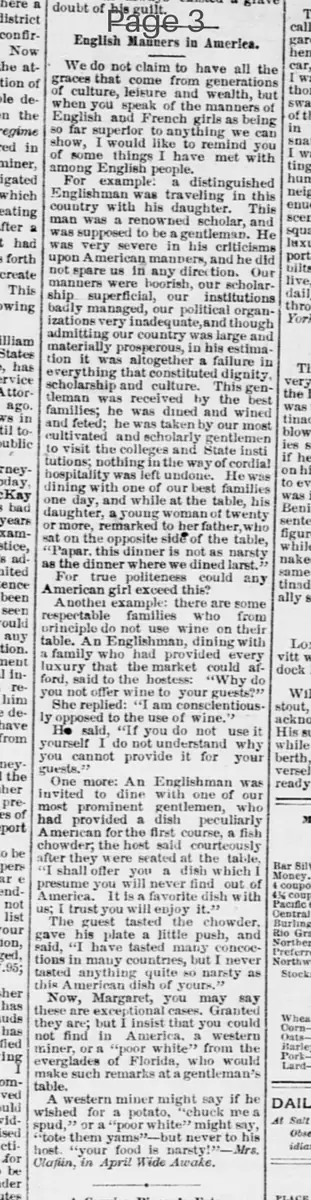
English Manners in America.
We do not claim to have all the graces that come from generations of culture, leisure and wealth, but when you speak of the manners of English and French girls as being so far superior to anything we can show, I would like to remind you of some things I have met with among English people.
For example: a distinguished Englishman was traveling in this country with his daughter. This man was a renowned scholar, and was supposed to be a gentleman. He was very severe in his criticisms upon American manners, and he did not spare us in any direction. Our manners were boorish, our scholarship superficial, our institutions badly managed, our political organizations very inadequate, and though admitting our country was large and materially prosperous, in his estimation it was altogether a failure in everything that constituted dignity, scholarship and culture. This gentleman was received by the best families; he was dined and wined and feted; he was taken by our most cultivated and scholarly gentlemen to visit the colleges and State institutions; nothing in the way of cordial hospitality was left undone. He was dining with one of our best families one day, and while at the table, his daughter, a young woman of twenty or more, remarked to her father, who sat on the opposite side of the table, 'Papa, this dinner is not as nasty as the dinner where we dined last.' For true politeness could any American girl exceed this?
Another example: there are some respectable families who from principle do not use wine on their table. An Englishman, dining with a family who had provided every luxury that the market could afford, said to the hostess: 'Why do you not offer wine to your guests?' She replied: 'I am conscientiously opposed to the use of wine.' He said, 'If you do not use it yourself I do not understand why you cannot provide it for your guests.'
One more: An Englishman was invited to dine with one of our most prominent gentlemen, who had provided a dish peculiarly American for the first course, a fish chowder; the host said courteously after they were seated at the table, 'I shall offer you a dish which I presume you will never find out of America. It is a favorite dish with us; I trust you will enjoy it.' The guest tasted the chowder, gave his plate a little push, and said, 'I have tasted many concoctions in many countries, but I never tasted anything quite so nasty as this American dish of yours.' Now, Margaret, you may say these are exceptional cases. Granted they are; but I insist that you could not find in America, a western miner, or a 'poor white' from the everglades of Florida, who would make such remarks at a gentleman's table. A western miner might say if he wished for a potato, 'chuck me a spud,' or a 'poor white' might say, 'tote them yams'—but never to his host, 'your food is nasty!'—Mrs. Ulalin, in April Wide Awake.
We do not claim to have all the graces that come from generations of culture, leisure and wealth, but when you speak of the manners of English and French girls as being so far superior to anything we can show, I would like to remind you of some things I have met with among English people.
For example: a distinguished Englishman was traveling in this country with his daughter. This man was a renowned scholar, and was supposed to be a gentleman. He was very severe in his criticisms upon American manners, and he did not spare us in any direction. Our manners were boorish, our scholarship superficial, our institutions badly managed, our political organizations very inadequate, and though admitting our country was large and materially prosperous, in his estimation it was altogether a failure in everything that constituted dignity, scholarship and culture. This gentleman was received by the best families; he was dined and wined and feted; he was taken by our most cultivated and scholarly gentlemen to visit the colleges and State institutions; nothing in the way of cordial hospitality was left undone. He was dining with one of our best families one day, and while at the table, his daughter, a young woman of twenty or more, remarked to her father, who sat on the opposite side of the table, 'Papa, this dinner is not as nasty as the dinner where we dined last.' For true politeness could any American girl exceed this?
Another example: there are some respectable families who from principle do not use wine on their table. An Englishman, dining with a family who had provided every luxury that the market could afford, said to the hostess: 'Why do you not offer wine to your guests?' She replied: 'I am conscientiously opposed to the use of wine.' He said, 'If you do not use it yourself I do not understand why you cannot provide it for your guests.'
One more: An Englishman was invited to dine with one of our most prominent gentlemen, who had provided a dish peculiarly American for the first course, a fish chowder; the host said courteously after they were seated at the table, 'I shall offer you a dish which I presume you will never find out of America. It is a favorite dish with us; I trust you will enjoy it.' The guest tasted the chowder, gave his plate a little push, and said, 'I have tasted many concoctions in many countries, but I never tasted anything quite so nasty as this American dish of yours.' Now, Margaret, you may say these are exceptional cases. Granted they are; but I insist that you could not find in America, a western miner, or a 'poor white' from the everglades of Florida, who would make such remarks at a gentleman's table. A western miner might say if he wished for a potato, 'chuck me a spud,' or a 'poor white' might say, 'tote them yams'—but never to his host, 'your food is nasty!'—Mrs. Ulalin, in April Wide Awake.
What sub-type of article is it?
Curiosity
What themes does it cover?
Social Manners
What keywords are associated?
English Manners
American Hospitality
Rude Guests
Dinner Criticism
Cultural Contrast
What entities or persons were involved?
Distinguished Englishman
His Daughter
Englishman
Hostess
Prominent Gentleman
Mrs. Ulalin
Where did it happen?
America
Story Details
Key Persons
Distinguished Englishman
His Daughter
Englishman
Hostess
Prominent Gentleman
Mrs. Ulalin
Location
America
Story Details
An American writer shares three anecdotes of English visitors rudely criticizing American dinners, wine abstinence, and fish chowder at hospitable American tables, contrasting with purported American rudeness.